
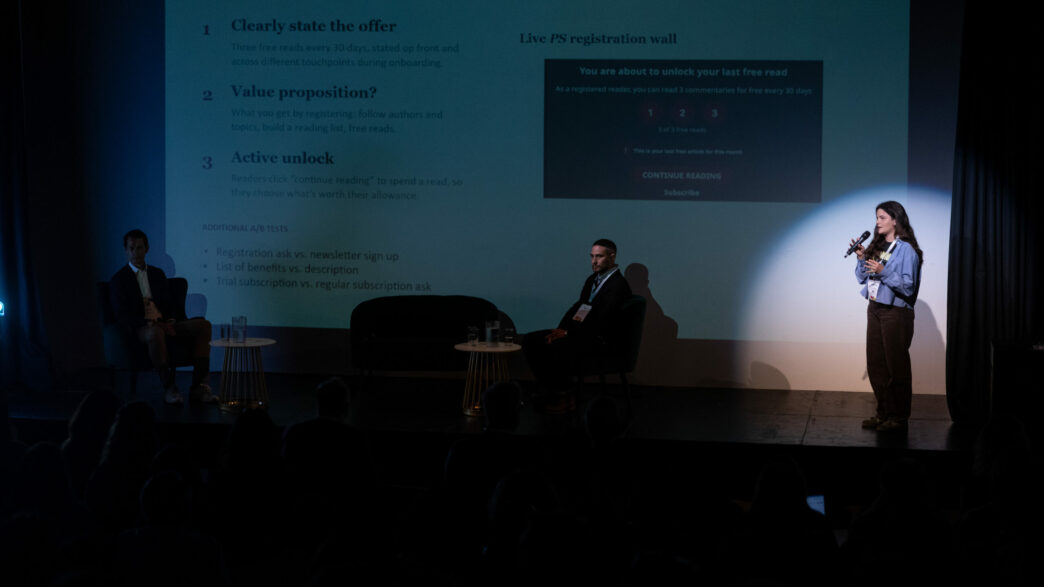
At the Audiencers’ Festival in London, Shirin Shity, Senior Marketing Manager at Project Syndicate, shared how transitioning from an aggressive friction model to an open, communication-first strategy revitalised user engagement and subscription conversion.
> Project Syndicate passed 200,000 registered accounts while engagement stayed flat because the wall fired straight after a reader's first article. People arriving from LinkedIn or social left before discovering what the site was for

> The second leak was their most engaged readers. Newsletter subscribers kept hitting unpredictable hard walls with no indication of how many free articles remained or when the allowance reset, which broke exactly the habit the team was trying to build

> Working with FT Strategies & Poool, they concluded more friction wasn't the answer and loosened the wall instead. Readers now get three free reads every 30 days, up from two, with the terms stated openly across multiple touchpoints rather than discovered by hitting a wall

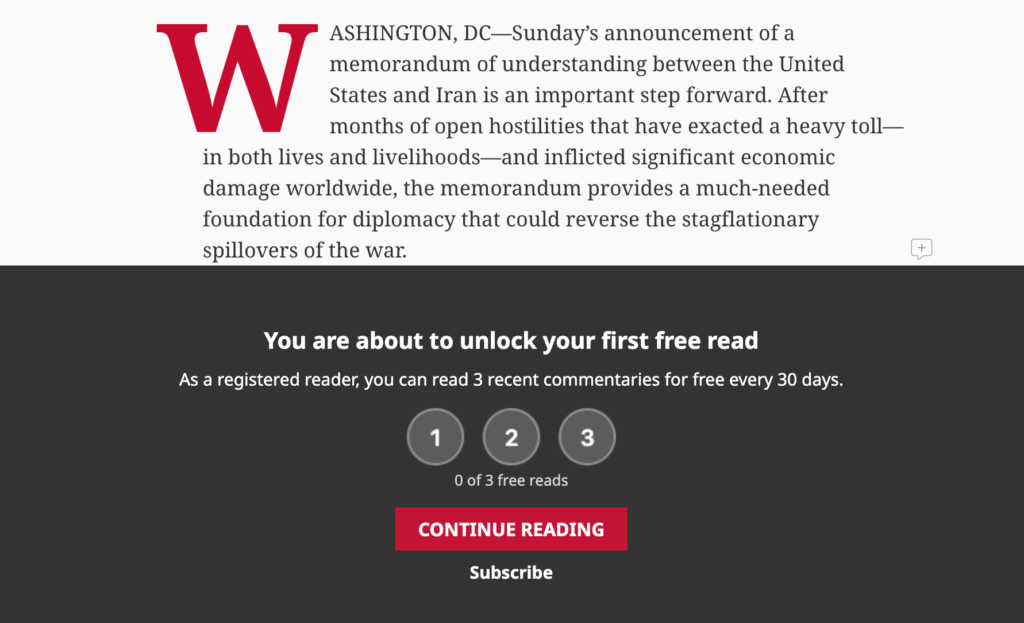
> The mechanism is the interesting part: on the second and third article, readers have to click "Continue Reading" to spend a credit. Making the allowance something you actively spend, rather than something silently consumed, turns it into something worth having

> Over a four-week trial, registered users converting to paid rose 52%, click-through across registration and paywalls went from 7% to 9%, subscription prompt success from 11% to 14%, and RFV scores lifted 22%. Monthly sessions for logged-in accounts climbed from 1.9 to 2.5
By treating the registration layer as a value journey rather than a restrictive barrier, the publication grew their logged user base, increased the number of registered users converting into paid subscribers by 52% and saw a 22% uplift in overall RFV (Recency, Frequency, Volume) scores.
Context: balancing global reach with direct subscriptions
For over 30 years, Project Syndicate has operated as a syndication network, distributing high-level commentary from leading global thinkers as widely as possible. Its primary business model involves charging media outlets in developed countries to subsidize the dissemination of op-eds to more than 520 outlets across 158 countries.
Direct consumer digital subscriptions represent a newer engine of growth. However, traditional subscription paywalls naturally pull against their historic key metric, reach. This tension is where registration sits perfectly: it acts as a bridge, allowing for intentional content sampling while pulling anonymous readers into a known ecosystem.
The evolution of the reg wall
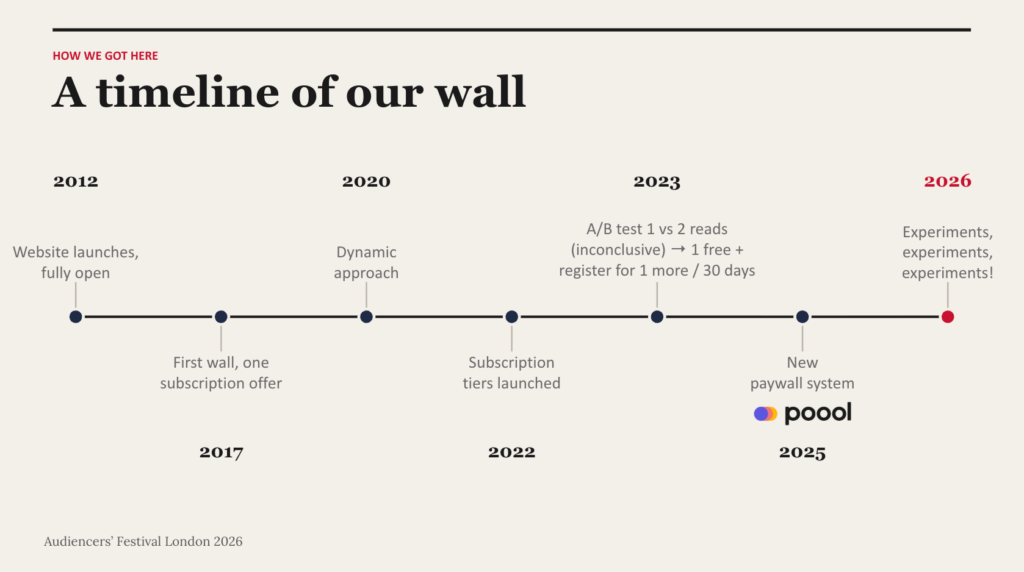
Project Syndicate launched its initial website in 2012 as a fully open platform. The site has since evolved through several operational iterations:
- 2017: Introduced the first native paywall with a single subscription offer.
- 2020–2022: Moved to a dynamic paywall approach and introduced multi-tiered subscription packages.
- 2023: Conducted A/B testing comparing a 1-read vs. 2-read allowance. This led to a standard model where readers received 1 free article, then had to register to receive 1 additional free article every 30 days.
- 2025–2026: Migrated to a new, flexible paywall architecture (powered by Poool) to run rapid onsite user experiments. Prior to this upgrade, backend limitations meant simple copy or design changes took weeks or months to implement through remote developers.
The metrics that made the case for a change
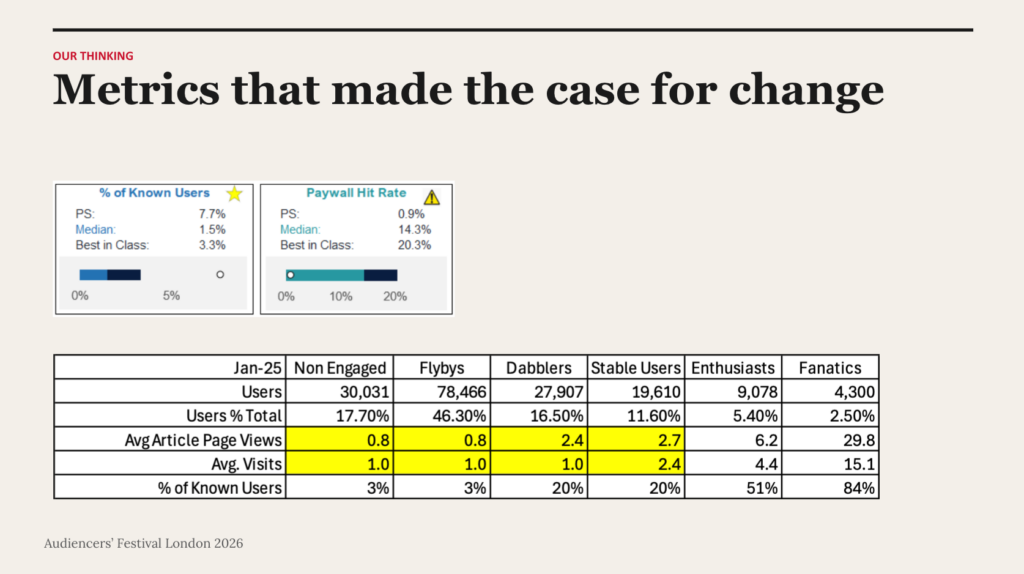
Data collected in early 2025 revealed a structural mismatch between user acquisition and long-term retention. While Project Syndicate excelled at building an initial database of registered users, surpassing 200,000 total accounts, active engagement post-registration was remarkably low.
An audit of user segments highlighted two main leakage points:
1. The fly-by loop
Because the old registration wall appeared immediately after a visitor’s first article, light readers coming from external platforms (such as LinkedIn or social media) simply left. The wall blocked them before they could discover the site’s wider value, resulting in zero captured emails and an average of just 0.8 article page views per user.
2. The newsletter wall
Even highly engaged newsletter subscribers regularly hit unpredictable hard walls without any indication of how many free articles they had remaining or when their monthly allowance would reset. This arbitrary friction disrupted habit formation and caused valuable readers to abandon the platform entirely.
The experiment: communication over friction
Collaborating with FT Strategies, the marketing team realised that increasing wall friction was not the answer. Instead, expanding content sampling while providing transparent progress indicators would give readers a clearer path to building a subscription habit.
The team launched a soft-to-hard paywall journey based on three pillars:
- Transparent onboarding: The site clearly states the exact terms of the offer up front across multiple touchpoints: three free reads every 30 days.
- Explicit personalisation benefits: The registration wall highlights functional perks, showing readers they can follow specific topics, track favorite authors, and save pieces to a personalised reading list.

- An active unlock mechanism: Instead of immediately showing a full article, the platform introduces a stepped widget on the second and third pieces. Readers must intentionally click a “Continue Reading” button to spend one of their available credits, encouraging them to treat their monthly allowance as something of value. Once the third credit is spent, a hard paywall prompts a direct subscription offer.
Strategic impact and performance signals
The soft-to-hard communication strategy yielded immediate results over a four-week trial period, proving that looser constraints could drive higher economic value:
- Higher direct subscriptions: The business saw a 52% increase in registered users converting into paid subscribers compared to the previous model.
- Stronger onsite conversion rates: The combined click-through rate across both registration and paywalls jumped from 7% to 9%, while subscription prompt success rates rose from 11% to 14%.
- Deeper reader habits: Registered users saw a 22% uplift in overall RFV (Recency, Frequency, Volume) scores. Average monthly sessions for authenticated accounts climbed from 1.9 to 2.5, demonstrating steady habit formation.
Core takeaways
Shirin summarised the lessons from Project Syndicate’s migration into three operating principles for digital publishers:
- Registration volume is a vanity metric without engagement: Amassing hundreds of thousands of registered emails is meaningless unless you build an active onboarding experience that keeps readers engaged during the critical first 30 to 90 days
- Understand your audience: Publishers must build flexible data infrastructures to track how their unique audience sample content, how often they return, and what roadblocks cause them to churn
- Fail fast: Cultivating an internal environment where teams feel safe running iterative product experiments, and knowing when to sunset unsuccessful tests, is essential to keeping pace with fast-changing user behaviour