Inside WAN-IFRA Marseille 2026: the deals, the data, and the fight for what journalism is worth

WAN-IFRA World Congress 2026 WAN-IFRA World Congress 2026
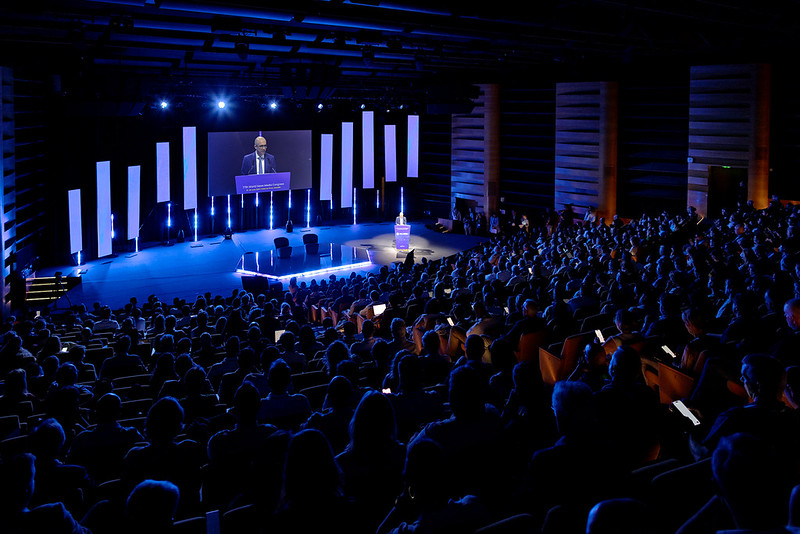
Photo by WAN-IFRA
The Audiencers' team spent the first three days of June in Marseille for WAN-IFRA's 77th World News Media Congress (1–3 June 2026). Three days, one dominant question: what does AI mean for the value, and future of journalism? We sat through a dozen sessions to share a wrap-up of the event, and the conversations that mattered most.
  • “Information wants to be expensive because it’s so valuable”: AG Sulzberger, Chairman & Publisher, The New York Times, opened the Stewart Brand quote the industry has been misquoting for 20 years, and laid out an 8-point plan against AI’s “original sin”
  • “ChatGPT converts 17x better than Facebook and 173x better than Google Discover”: Louis Dreyfus on the Le Monde & OpenAI deal, and why 25% of the revenue goes to the newsroom
  • “Your next customer won’t be a human, it’ll be an agent”: the new three-layer infrastructure (Rights, Access, Payment) that lets publishers charge the machines
  • “The metric I look at every morning is the share of our content that AI cannot copy”: VG’s Gard Steiro on speedboats, and hiring “the profiles we hired in the 90s”

The AI reckoning: rights, traffic, and the first real deals
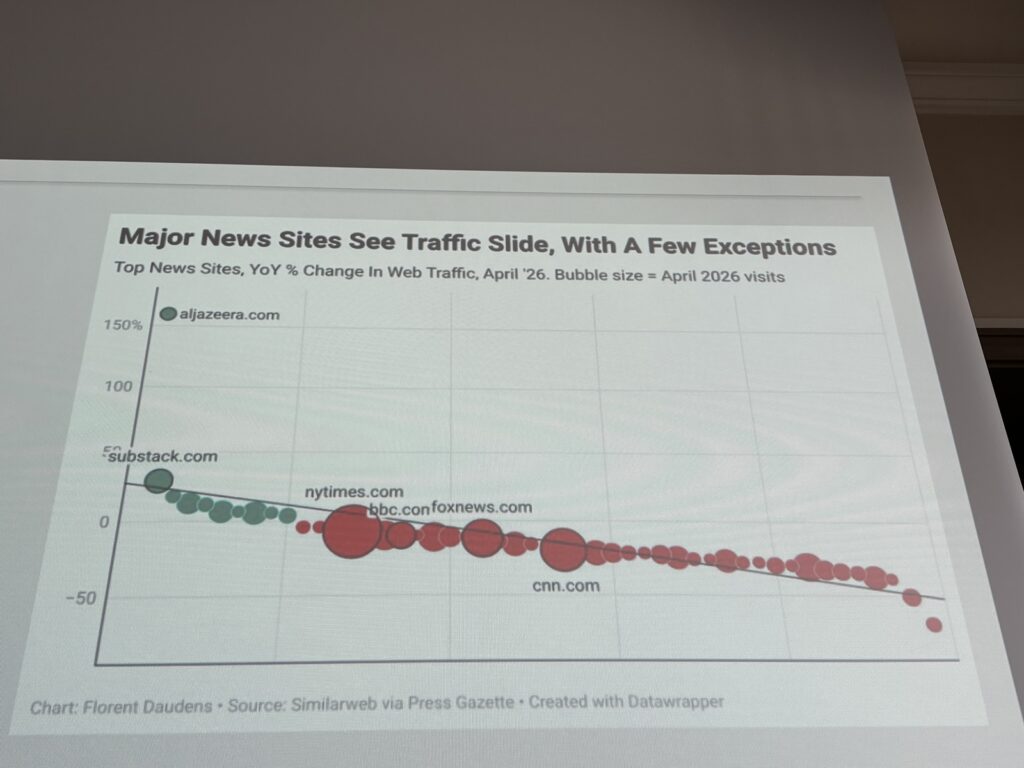
The backdrop to the whole congress: almost every major news site is down year-on-year, with Al Jazeera and Substack the rare exceptions. (Chart: Florent Daudens · Source: Similarweb via Press Gazette, WAN-IFRA Marseille 2026)

AG Sulzberger (NYT): the “original sin,” and an 8-point plan

The congress opened on its hardest line. AG Sulzberger (Chairman & Publisher, The New York Times) argued that generative AI is built on an “original sin” (the unprecedented theft of publishers’ intellectual property) and that this theft is now re-enacted “countless times every single day.” His most effective passage broke an AI model into four inputs: talent, compute, energy and data. The first three are paid for, handsomely; the fourth, books, films, music, journalism, is taken without consent or compensation. No tech CEO would ask their engineers to work for free or steal chips from an Nvidia plant; on data, “we just take” has become the norm.

“Tech giants strip-mine news websites… that otherwise would go to the news organisations that created this work.”

AG Sulzberger, Chairman & Publisher, The New York Times

He was careful to add he is not anti-AI (the NYT uses these tools internally) and that his target is the companies’ choices, not the technology.

The scale he put on the table: the NYT publishes ~500,000 original works a year for over $2bn, and remains the single largest source of proprietary data in a major dataset used to train many different models. Meanwhile the Google click is 10x harder than a decade ago, rival AI models send 96% less referral traffic than a Google search, and the largest news sites tracked by comScore have lost 45%+ of traffic in four years. His action plan came in eight points — four to defend your rights (stand up for them, deal carefully, push legislators, join together) and four to strengthen your title (use AI the right way, be a destination first, focus on original reporting, explain why journalism matters). He closed by restoring the half of the Stewart Brand quote everyone forgets:


“Information wants to be expensive, because it’s so valuable — the right information in the right place just changes your life.”

Stewart Brand, quoted by AG Sulzberger

Le Monde × OpenAI vs the SPUR coalition: negotiate alone or organise together?

The panel, “Creating an AI content marketplace where publishers can win,” moderated by Madhav Chinnappa (Reuters Institute, ex-Google), with Niamh Burns (Enders Analysis) and David Buttle (DJB Strategies / SPUR coalition), put two strategies side by side. Burns framed it: news has real value in the AI era, but mostly for B2B and enterprise use; on the consumer side, AI products are embryonic and news sits at the margins. She cited the Disney / Sora deal, pulled abruptly after launch, as a warning — you can license what you want, you have no control over the product.

Louis Dreyfus (President & CEO, Groupe Le Monde) told how the OpenAI deal began: three years ago, a French publishers’ association lamented “we don’t even have OpenAI’s address.” Dreyfus used a public Q&A with Sam Altman — “you’re in France, the country of copyright… 83% of our revenue comes from our readers; how do you expect reliable information without that?” — got an “OK, I’m willing to discuss it,” and signed after a January-to-March negotiation. The numbers: ChatGPT converts 17x better than Facebook and 173x better than Google Discover, with no cannibalisation. (An INA study presented elsewhere at the congress confirmed the visibility upside: on French editorial queries, nearly a third of ChatGPT’s outbound traffic points to Le Monde — the publisher that signed.)

“We made a choice at Le Monde: to treat the revenue from these outputs as neighbouring rights. We share 25% of it with the newsroom — every single person in it. It helps the journalists, it helps journalism, not just the publisher’s business model.”

Louis Dreyfus, President & CEO, Groupe Le Monde

David Buttle, a founding member of the SPUR coalition, made the collective case: publishers arrived in disarray to search and social, and shouldn’t repeat it with AI. His warning on the deals themselves was the panel’s sharpest:

“Most of today’s AI deals are defensive agreements, not product partnerships. You sign, and you still get scraped. It’s rational to take the money on the table — but know that we have no control over what becomes of our content.”

David Buttle, DJB Strategies / SPUR coalition

On Mistral, Dreyfus was precise — a nuance worth keeping exactly as he framed it. His point was not that Mistral rejects copyright, but that it has signed with the press agency AFP and not yet engaged the wider French press: “it would be a good signal for a French company, backed by the French government, to abide by copyright AND engage with all the major French publishers,” noting NewsGuard ranks Mistral as the least reliable LLM on news.

Madhav Chinnappa closed with the framework that travelled around the room: “We now have three audiences to serve — agents, bots and consumers. ABC. Build products that the foundation models will, reluctantly, want to cite. Don’t wait for regulation. And do it collectively.”

Ezra Eeman (WAN-IFRA / NPO): from “AI in media” to “media inside AI”

Ezra Eeman’s State of AI plenary delivered the conceptual pivot of the congress. AI is now a mainstream habit (ChatGPT ~2.5bn queries/day; Google AI Overviews ~8bn AI answers/day; +250% AI use among UK over-55s in a year). But it’s barely used for news: only ~10% of prompts are about current events. People use AI to do things (write, learn, decide, act); classic journalism sits in the opposite quadrant, “generic, built for mass consumption.”

AI is now a mainstream habit across every age group — including +250% growth among the over-55s. (Source: Ezra Eeman, State of AI, WAN-IFRA Marseille 2026)

“The future value of journalism is no longer the article itself. What becomes valuable is everything around it: provenance, context, your editorial judgement, the updates, continuity over time. The question is how to turn all of that into machine-readable intelligence.”

Ezra Eeman, AI in Media Lead, WAN-IFRA / Strategy & Innovation Director, NPO

His WAN-IFRA “AI in Media” survey put hard figures on the shift: 58% of publishers report falling search traffic, 72% blame AI, and only 3.5% receive meaningful referral traffic from chatbots. His user-journey framework — Finding, Feeling, Flowing — describes a world where a personal agent surfaces the news before you ask, adapts it to your mood and context, and follows you across devices. The economic warning was concrete: a fixed-price subscription versus real marginal AI costs per query. “A large media group told me last week it had a monthly budget of ~€300,000 for coding tokens. They burned through it in 10 days.” His two parallel playbooks: go upstream (a trusted ingredient inside AI systems) and downstream (own the relationship, the community, the experience).

Florent Daudens & Christophe Israël: your next customer is an agent

The opening AI session (Florent Daudens, co-founder of Mizal AI, ex-Hugging Face; Christophe Israël, AI consultant founder of OK Lab) turned the theory into infrastructure. Daudens’ core message: the value chain is broken and must be rebuilt on three machine-readable layers where publishers can finally hold control:

  1. Rights & Permissions (RSL, ODRL, CC Signals — robots.txt was a gentleman’s agreement, useless against agents)
  2. Access & Enforcement (OAuth + MCP, Web Bot Auth)
  3. Payment & Value Exchange (x402, AP2, AgentCore Payments). Micro-payments failed for humans (mental friction) but will work for agents (zero friction) — Sam Altman has floated “an agent paying 70 cents for a summary, $1 for the full article.”

“Your next customer won’t be a human, it’ll be an agent. Move from a supplier mindset to a builder mindset — you can design a conversion funnel on the agent side, just as you did for readers.”

Florent Daudens, co-founder, Mizal AI

Mizal has a “newsroom in a box” running daily in a large public broadcaster: five agent routines fire before the 8:30am editorial meeting (competitive briefing, fact-checking the prior day’s 20 articles — it already caught a real error past the desk — grammar/style, social trend monitoring, podcast monitoring).

Christophe Israël’s counterpoint: none of this holds without governance on four pillars (Policy, Roles, Risk, Monitoring), and Daudens’ refrain for anyone deploying agentic workflows — “evals, evals, evals.” The hard question is no longer technical but cultural: how do you equip teams to be good at working with AI agents?

The newsroom of tomorrow, in an AI world, is already being built

The Future Newsrooms Study 2026 (FT Strategies × WAN-IFRA): four gaps

Lisa MacLeod (Director, FT Strategies) launched the first edition of an annual global benchmark. Its thesis: we’ve entered the “community era.” When generic content is trivial to produce, the advantage shifts to what’s hard to replicate — original journalism, trusted relationships, loyal communities. For the first time, engagement is cited as the most frequent #1 priority for the year, ahead of reach. The study names four structural gaps:

  • Strategy: 25% of newsrooms don’t translate strategy into daily editorial decisions; 62% involve only 1–2 roles in setting long-term strategy
  • Trust: reporters still spend 38% of their time on production vs 33% pre-publication and just 11% post-publication — “a catastrophic waste,” given how good production automation already is
  • Capability: only 14% of leaders are very/extremely confident their tech stack is fit for purpose; 42% still measure AI success by “time saved”
  • Skills: confidence drops from 55% today to 39% at three years; 61% of newsrooms have no formal training programme

“Maybe the KPI isn’t ‘we saved seven hours,’ but ‘we made more original stories this week.’ The right question isn’t how much time you saved — it’s what can you do now that you couldn’t do before?”

Freja Sofia Kalderén, Development Editor, Bonnier — quoted in the study

The standout adoption case was Bonnier News (~2,000 journalists, 11 countries), which built three in-house AI platforms and, crucially, solved adoption through voluntary workshops (sceptics excluded by design, then opting in once ambassadors are trained): 2,000+ journalists trained, 7,800 prompts contributed in 10 months, weekly active users +45%. MacLeod’s own obsession: commissioning. “When commissioning is done right, aligned with the business, that’s where you unlock value, but today it stays destination-based, and 45% of newsrooms only use data after publishing, to validate, never upstream to steer.”

Gard Steiro (VG): speedboats, and the only metric he checks each morning

Gard Steiro, Editor-in-Chief of VG (Schibsted, Norway, with 2 million daily users, half the country), opened with a disclaimer: “if you’re expecting clear answers, you’ll be disappointed. Our job as newsrooms is to navigate uncertainty.” VG is a container ship, hard to turn, so it launches “speedboats”: small teams that run ahead, experiment, take sharp turns and come back with transferable learnings.

“They can move faster, they can be more agile, they can make sharp turns and experiment freely without risking the entire cargo, or audience trust in our journalism.”

“And one of these speedboats is called VGX,” a project for which company tasked a small team to “rethink everything” and “challenge the way we work across VG and Schibsted.”

VGX: engineers, business developers, designers and a single reporter, mandated to rethink everything from scratch.

One such project has meant abandoning some basic tenets of news publishing, including the traditional news article format.

Instead, the VGX app has no traditional front page, instead presenting users with a feed of content. And rather than being primarily text-based, video is a natural part of the app experience.

And of course, the metrics are following suite:

“I used to look at reach, now we’ve defined a new key metric: the share of our content that AI cannot copy. It’s at least as important as traffic, conversion and churn — because that’s our future.”

Gard Steiro, Editor-in-Chief, VG (Schibsted)

This is defined as “Super Content” – articles where journalists have been outside the office to report on the story, when they’re on location where the story is being written from, or when VG has received information that is not publicly available.

“This is a key step forward … because this content is our future.”


A big thank you to the WAN-IFRA team for three days of frank, useful conversations in Marseille — and to the speakers who shared real numbers, not just slides. See you next year.

Methodology: this recap was written for Audiencers by Claude (Anthropic), based on Trint audio transcripts of the sessions and the speakers’ slides, translated and cleaned, and (for the Future Newsrooms Study) cross-checked against the official report. Quotations in quote marks are faithful reformulations, not exact verbatims; a few proper nouns transcribed from audio were verified before publication. Sessions covered at the WAN-IFRA World News Media Congress, Marseille, 1–3 June 2026.