

At the Audiencers’ Festival in London, Ross Wilmot, Director of Reader Revenue at Broadsheet, shared how implementing a registration wall served as the cornerstone for a highly resilient digital subscription model. By transforming anonymous audiences into known, authenticated users, Broadsheet unlocked a powerful engagement framework that directly accelerated conversion rates.
After months of testing, Broadsheet found registration works best as a step before the paywall, building a direct relationship while readers are still deciding

> Registration selects for quality: Superfans register at 127 times the rate of casual Fly-bys, with 38% willingly authenticating

> Newsletters are the conversion engine: registered, newsletter-engaged readers hit the paywall 3.5 times per visitor against 0.1 for anonymous ones, a 35x difference

> The compounding effect: that cohort is 0.7% of the audience but drives 43% of all digital subscription conversions, an over-index of 61x. Direct offer emails to readers already warmed by daily editorial account for a further 18%
The strategy behind registration
To pave the way for their subscription model, Broadsheet deployed a registration wall in December 2025, strategically positioning it as an essential precursor to the full paywall, which followed on 21 April 2026, both built and launched using Poool. This sequential approach was designed to achieve several key outcomes:
- Accelerating conversion: By unlocking specific engagement features, the team could efficiently increase user exposure frequency to the upcoming paywall.
- Unlocking direct channels: Secure marketing permissions during the registration process to establish direct lines of communication, which heavily influences ultimate conversion.
- Setting the tone: Introducing a clear value exchange on the site, conditioning readers to understand that completing an action is required to access premium content, ensuring a smoother transition to a paid model.
- Boosting confidence: Confirming the audience’s willingness to complete an action built immense internal confidence within the company regarding the viability of the model.
- Guiding product strategy: Capturing known user identities allowed Broadsheet to develop personalised services tailored to specific reader needs.
Five key findings from Broadsheet’s registration data
Despite being in the early stages of the paywall rollout, Broadsheet data has already yielded critical insights regarding user behavior and the reader revenue funnel.
1. Registration captures high-quality readers
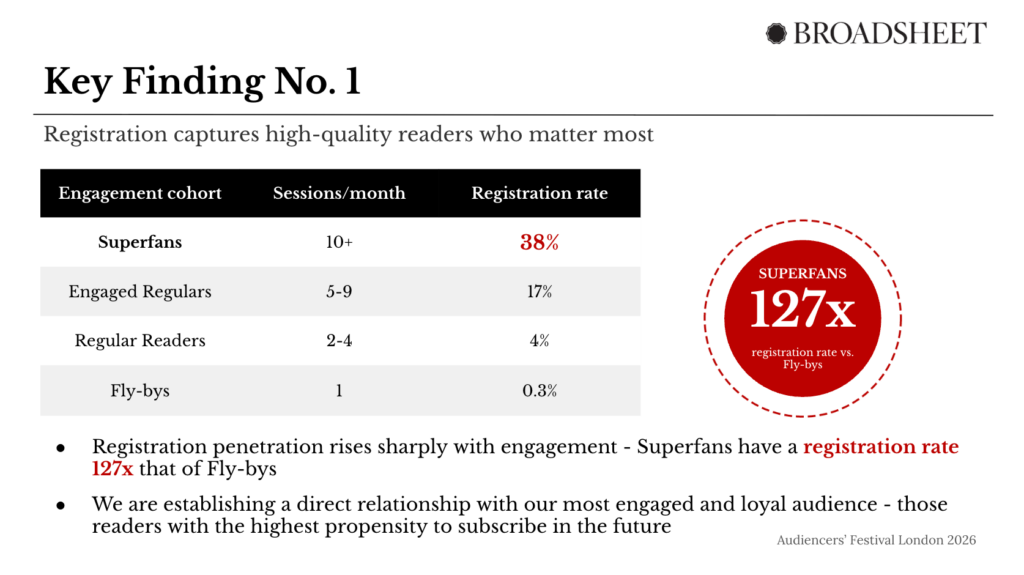
Broadsheet segments its audience into four distinct engagement cohorts based on monthly session frequency:
- Fly-bys (1 session)
- Regular Readers (2–4 sessions)
- Engaged Regulars (5–9 sessions)
- Superfans (10+ sessions)
The data reveals that registration penetration rises sharply alongside engagement. Specifically, Superfans exhibit a registration rate 127 times higher than casual Fly-bys, with 38% of them willingly authenticating. This confirms that a registration wall successfully establishes a direct relationship with the most loyal segments of the audience, those with the highest propensity to buy a subscription in the future.
2. Newsletters initiate the conversion journey
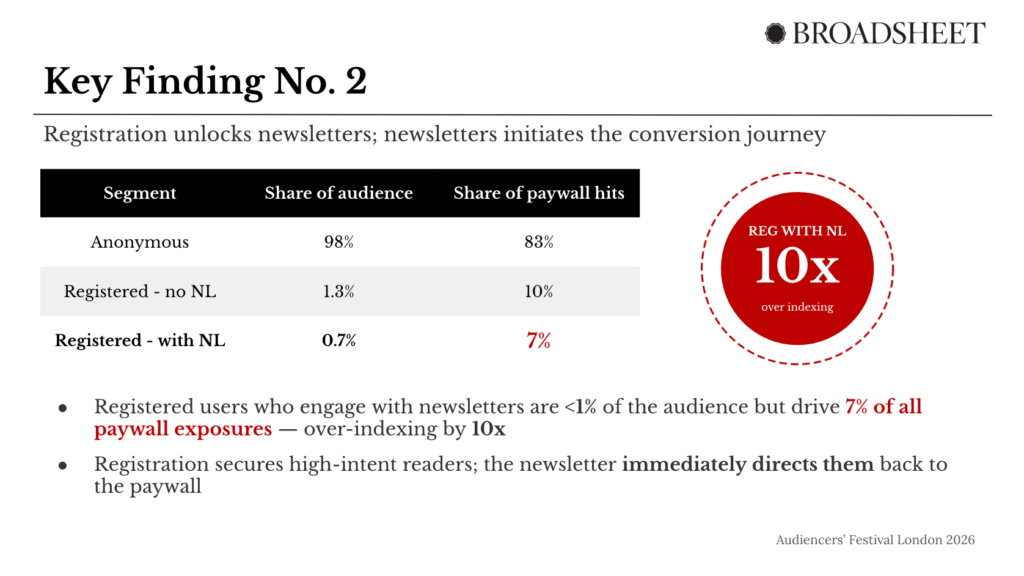
Authentication acts as the primary gateway to newsletter adoption, which serves as a massive catalyst for paywall hits.
While registered users who actively engage with newsletters account for less than 1% of the total audience, they drive a staggering 7% of all paywall exposures. This means that this specific segment over-indexes for paywall hits by an impressive 10x, successfully drawing high-intent readers straight back into premium, monetisable touchpoints.
3. The newsletter is the core conversion engine
The daily newsletter serves as a continuous, automated nudge that repeatedly invites authenticated users back to the site, where they naturally encounter paywalled boundaries.
Registered users who are signed up for newsletters hit the paywall an average of 3.5 times per unique visitor, representing a 35x higher exposure rate compared to the average anonymous reader, who sits at a mere 0.1 exposures.
4. The compounding effect drives the majority of subscriptions
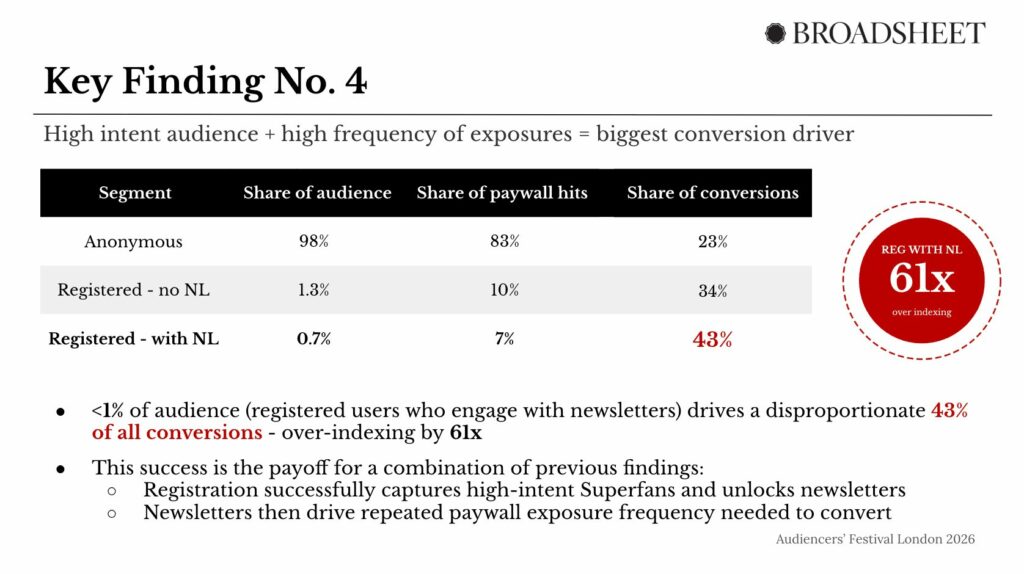
When high-intent audiences are paired with a high frequency of paywall exposures, the compounding effect generates the vast majority of subscriber growth.
The numbers paint a clear picture: the cohort of registered, newsletter-engaged users, which accounts for a tiny 0.7% fraction of the total audience, drives a disproportionate 43% of all digital subscription conversions. This equates to an extraordinary over-indexing factor of 61x. Registration hooks the high-intent reader, and the newsletter sequentially delivers the repeat paywall exposure required to close the sale.
5. Registration unlocks direct offer emails
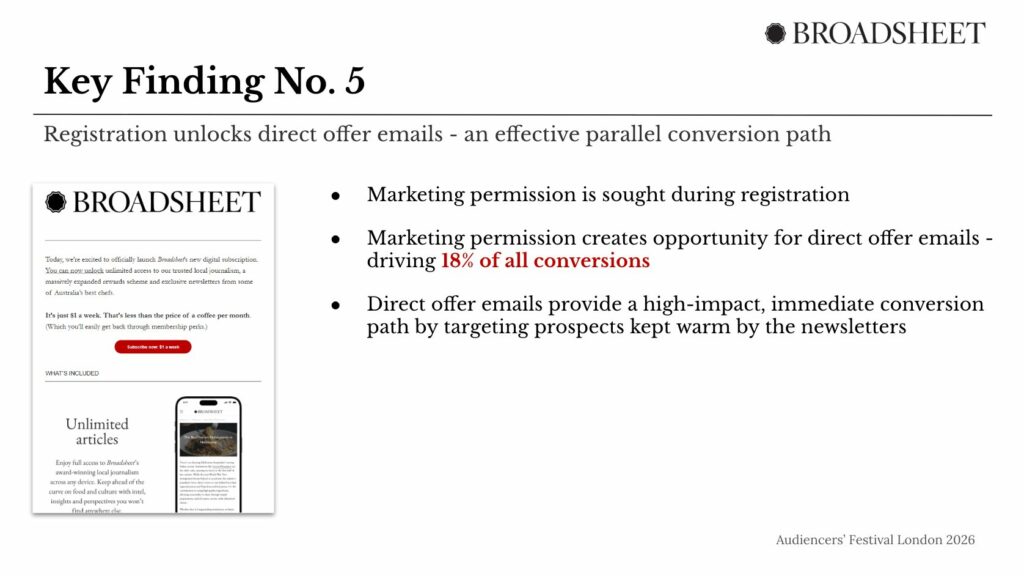
The marketing permissions captured during the initial registration step open up a highly profitable parallel conversion path: direct offer emails.
By targeting prospects who are already kept warm by daily editorial newsletters, these high-impact, immediate sales emails successfully account for 18% of all subscription conversions.
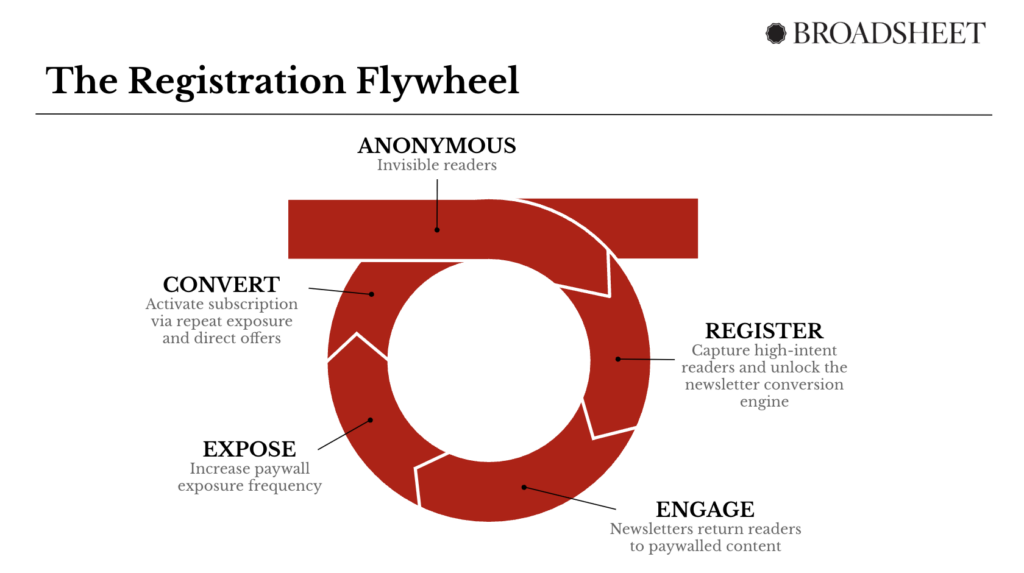
The registration flywheel
The compounding dynamics of Broadsheet’s strategy form a self-sustaining lifecycle designed to maximise reader value:
- Register: Capture invisible, anonymous readers via the registration wall to unlock the newsletter engine.
- Engage: Deploy targeted newsletters to consistently return these authenticated readers back to paywalled content.
- Expose: Systematically increase the frequency of paywall exposures over time.
- Convert: Activate premium digital subscriptions through a combination of repeated paywall prompts and direct offer emails.
Next steps for Broadsheet
To refine the registration flywheel and further optimize conversion rates, Broadsheet is focusing on five core strategic enhancements:
- Refining analytics tracking: Adjusting internal analytics tracking frameworks to compile a completely transparent picture of user engagement metrics both immediately before and after registration
- Revamping user onboarding: Overhauling the initial post-registration onboarding flow to actively encourage the early adoption of editorial newsletters across the new database
- Introducing dynamic onsite experiences: Moving away from a static, one-size-fits-all approach to deliver tailored onsite journeys based on an individual’s specific engagement cohort
- Segmenting email campaigns: Categorising and filtering direct offer email campaigns to match the specific engagement levels of different user cohorts
- Continuous A/B testing: Initiating rigorous A/B testing variations directly on the registration wall interface to continuously optimize structural conversion efficiency