At the Audiencers’ Festival Montréal, Emilie Harkin, SVP of Growth at The Guardian, broke down what actually motivates readers to give money to a publication with no paywall.
The Guardian doesn't have a paywall, anyone can read it, whether they pay or not. So the 1.4 million people who choose to give money anyway aren't paying for access, they're paying for something else entirely

> Ownership is the product: The organisation's value proposition comes down to three words - global, independent, free. Owned by the Scott Trust, their sole purpose is to ensure The Guardian can keep publishing. It's this that's sold to readers

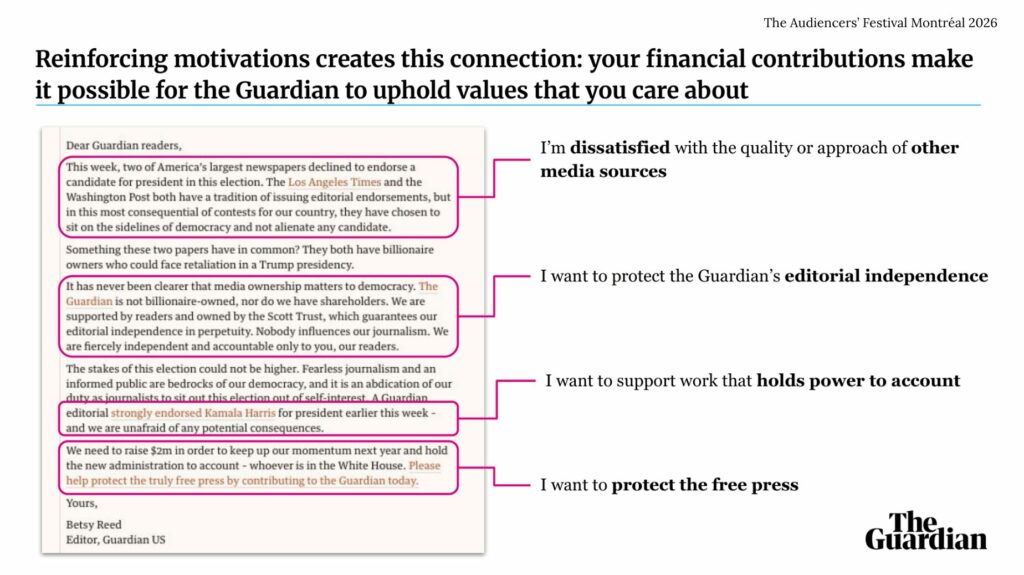
> One email, built entirely around that pitch, generated $2 million. When The Washington Post and LA Times pulled their 2024 election endorsements, The Guardian sent readers a simple message - we published ours, and always will, because no billionaire can tell us not to

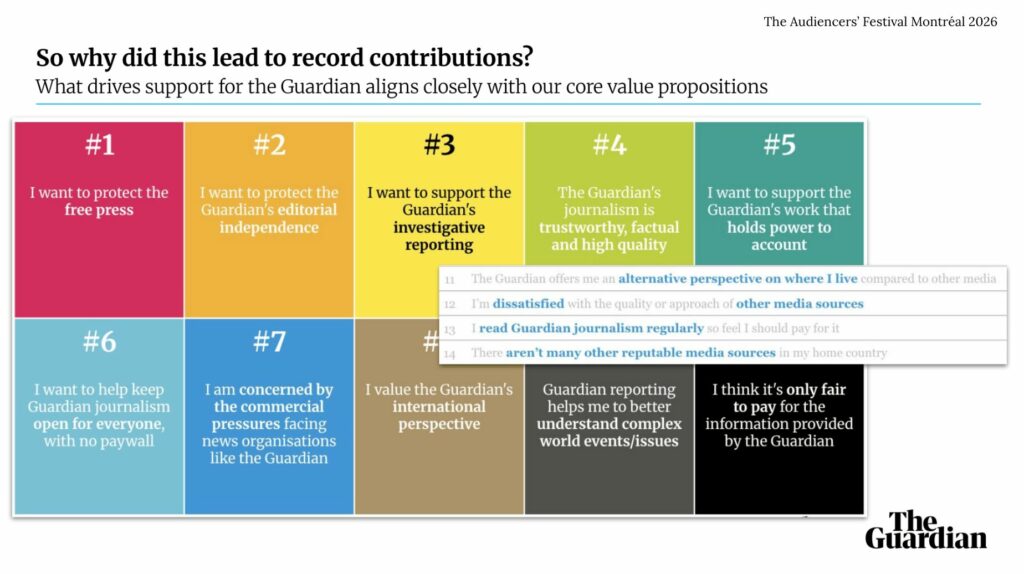
> But it's the method that's worth noting rather than the moment: The Guardian surveys readers right after they give, with the goal of understanding the why. The top answers include protecting the free press, editorial independence, or the journalism itself

> These surfaced motivations don't just become a slide that's presented once to the team, they're used to build every single message that asks for support. They keep telling the story, deliberately and repeatedly
The Guardian doesn’t have a paywall. Anyone can read it, regardless of ability to pay. So every dollar it raises from readers is, in Harkin’s words, an elective transaction: nobody is required to give anything to keep reading. That constraint is exactly what makes The Guardian’s reader revenue data useful to anyone running a subscription business, paywalled or not, because it isolates motivation from access. People aren’t paying to get in the door. They’re paying for something else entirely.
The starting point: ownership as the product
The Guardian was founded just over 200 years ago as The Manchester Guardian, a local UK paper. It’s now the fifth most visited news site in the world, pulling in roughly a billion page views a month. Its US team is small, about six people, working alongside a much larger marketing and reader revenue team of around 90 people at the London HQ.
The organization’s value proposition, as Harkin frames it, comes down to three words: global, independent, free. The independence part is structural, not just marketing language. The Guardian has no billionaire owner. It’s owned by the Scott Trust, established 90 years ago with a single purpose: ensure The Guardian can keep publishing in perpetuity. The Trust isn’t built to generate returns for shareholders. It exists to keep funding journalism.
That structure becomes the actual product sold to readers, not just backstory.
Ownership isn’t just a backstory
In the lead-up to the 2024 US election, both The Washington Post and the LA Times pulled their presidential endorsements, reportedly at the direction of their billionaire owners. Inside The Guardian, an editor suggested sending readers a simple message: we published our endorsement, and we always will, because no billionaire can tell us not to.
That email went out to The Guardian’s list. It generated two million dollars.
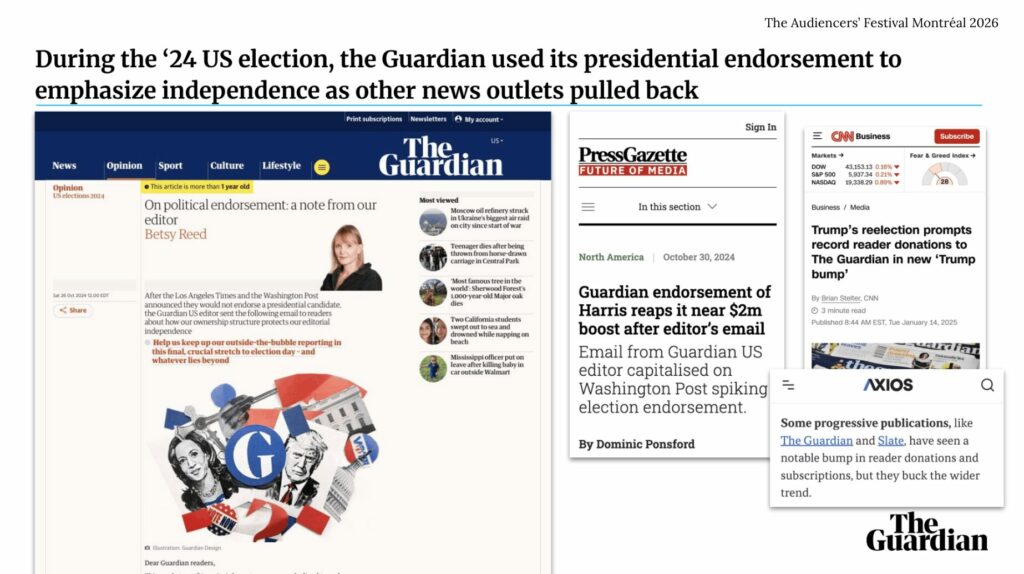
Harkin described it as one of those moments where you assume your analytics dashboard is broken, because the spike looks impossible for a normal day. What it confirmed for her team was that US readers are far more media-literate about ownership structures than publishers often give them credit for. People understood exactly what billionaire ownership can do to editorial decisions, because they’d just watched it happen at two major outlets, and they responded to a publication that structurally couldn’t be pressured the same way.
What people say when you ask them why they paid
The Guardian surveys readers immediately after they support the organization, while the motivation is still fresh. The consistent, top-ranked answers: protect the free press, protect editorial independence, protect the journalism itself. Further down the list, at roughly position six, is a motivation specific to The Guardian’s model: keeping the journalism free and open for everyone, not paywalled.
Further down still, in positions eleven through fourteen, is a newer and growing motivation: dissatisfaction with other media sources. Harkin ties this directly to visible cases of ownership interference, citing Jeff Bezos later restricting which topics The Washington Post’s opinion pages were authorized to cover. Readers notice, and it shows up in what they tell you when they give.
How this research becomes the actual email copy
The endorsement email wasn’t written as an abstract mission statement. It was built, deliberately, around the specific motivations the research had already surfaced, worded so it read as natural rather than like a fundraising checklist:
- Dissatisfied with other media: named exactly what The Washington Post and LA Times did, and what The Guardian did instead
- Wants editorial independence protected: explained the Scott Trust ownership model in plain terms
- Wants work that holds power to account: made clear that only the editor-in-chief, never a business owner, decides what gets published
- Wants to protect the free press: the direct ask
Harkin’s point in walking through this line by line: the research isn’t a slide you present once internally and then forget. It’s the literal structure of the copy you send.
The revenue mechanics underneath it
Readers who want to support The Guardian financially see three recurring options: a five-dollar monthly contribution, a fifteen-dollar tier called Supporter Plus that comes with added benefits, and a higher Digital Plus tier with more on top. There’s also a one-time support option and a recently launched student discount.
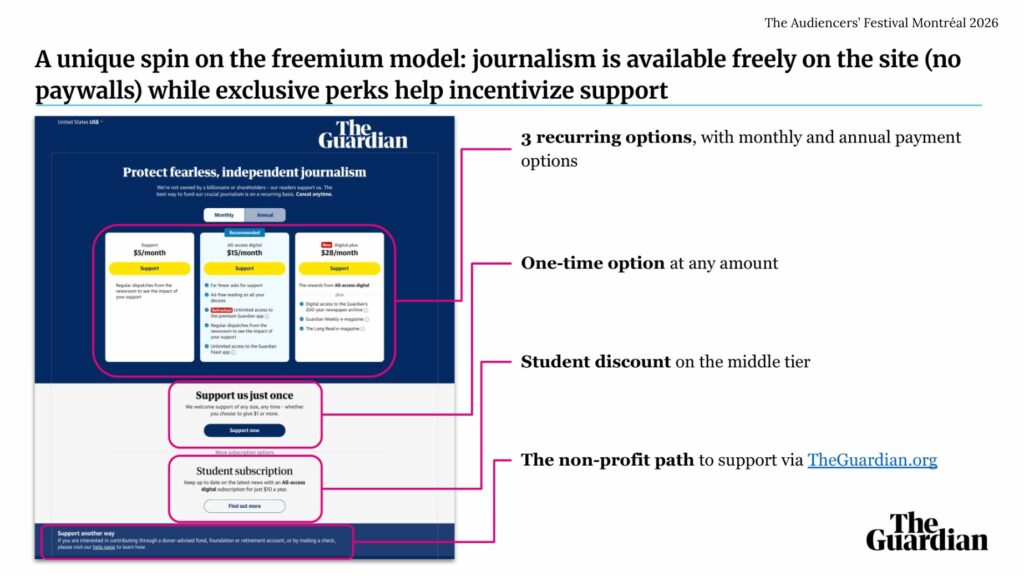
Alongside the main organization sits theguardian.org, a registered nonprofit. Harkin pointed to US philanthropic culture, Americans give roughly half a trillion dollars a year to causes, ranging from small one-off donations to major gifts, as a real reason this structure matters specifically in the US market, even though The Guardian itself isn’t a nonprofit. The motivations that drive nonprofit giving (mission alignment, wanting to sustain something you believe should exist) map closely onto why people choose to pay The Guardian.
The Guardian currently has 1.4 million digital subscribers. The UK has the largest paid supporter base, but North America, US and Canada combined, is the fastest-growing region, now at 14% of the base.
The takeaway
Her closing point applies well beyond publications without a paywall: figure out the full range of motivations and emotional connections your audience has with your organization, not just the functional value proposition of “you get access to the app.” Then keep telling that story, deliberately and repeatedly, across your marketing rather than assuming people already know it.
For The Guardian, that story is ownership. For another publication, it might be something else entirely, a specific beat, a founding mission, a community it serves. The method Harkin described, survey people right after they convert while the reason is still fresh, then build your actual marketing copy around what they tell you, works regardless of what that story turns out to be.