
How we segmented our paywall audience to optimize ARPU 

How we segmented our paywall audience to optimize ARPU How we segmented our paywall audience to optimize ARPU

This article was written by Ann-Kathrin Wind & Marvin Suder at Handelsblatt Media, Germany.

Key takeaways to copy & share
> Handelsblatt Media Group, Germany's leading business publisher, had a paywall conversion problem that wasn't a product problem. Its four H+ tiers were each well-positioned. The mistake was showing all of them at once, at the moment of highest reader impatience

> Step one was removing the higher-priced products from the paywall entirely. It felt like hiding revenue. Conversion rose significantly instead, because the reader no longer had a package comparison to work through before checkout

> The new default is a single offer: H+ Standard digital access, with a trial or a three-month commitment at 30% off the monthly price

> Step two put choice back selectively. A Likelihood-to-Subscribe score decides who sees Premium, on the hypothesis that high-scoring users have both a higher willingness to pay and genuine use for the extra features

> The decisive metric was never initial conversion. Premium converts from trial to paid less reliably than Standard, so a failed Premium trial doesn't just underdeliver, it replaces a Standard subscriber you would have kept. The question became which offer generates the highest sustainable revenue per segment, not which offer converts best

At Handelsblatt, the problem was clear: our paywall conversion rate was too low, and we were not generating enough subscription volume. 

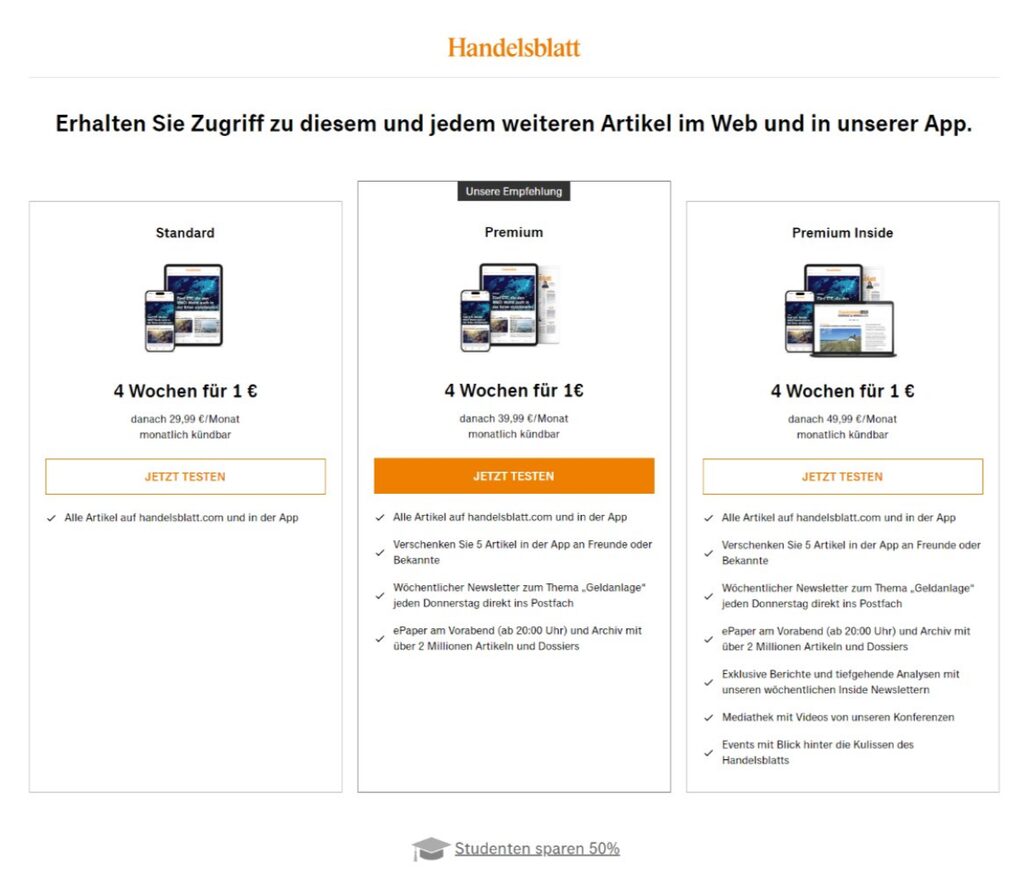
However, product diversification was not the issue. We already offered a strong portfolio  tailored to different use cases: 

  • H+ Standard, including digital access to all articles on the website and in the app
  • H+ Premium, adds the e-paper and a paid newsletter 
  • H+ Premium Student, the Premium experience at a student price 
  • H+ Premium Business, users who also want business-focused content, events  and professional learning opportunities 

Each product was relevant and well-positioned. The mistake was showing all of them at once, at the moment of highest reader impatience.
Handelsblatt subscription

We set two objectives: Reduce the number of decisions a reader has to make and make better use of our Likelihood-to-Subscribe scores. 

Step 1: Cutting complexity at the paywall 

The first meant shortening the time between “I want to read this article” and checkout. Removing the higher-priced products from the initial paywall felt risky and seemed, on paper, like we’d be hiding potential revenue. But we did it anyway, betting that getting users into the product experience fast mattered more than upselling them right at the door.  

By eliminating the need to choose between several packages, we initially achieved a significantly higher conversion rate. 

Our new default paywall offer became H+ Standard digital access. In addition to a trial,  we offered users the option to commit to a three-month subscription at a 30% discount  compared with the monthly price. 

The effect became apparent quickly. With no package comparison to work through,  conversion rose significantly. Communicating less information turned out to be the clearer message and simplifying the offer helped remove friction. 

Step 2: Moving from a one-size-fits-all paywall to propensity segmentation 

During our tests, we observed that H+ Premium was also in strong demand. The product clearly appealed to a high value group of users.  

So, we reviewed the paywall flow again with a different question: how do we keep the simplicity of a single-offer paywall without showing every reader the same single offer. 

We started by splitting our audience into two groups: 

  • Users with a low likelihood to subscribe 
  • Users with a high likelihood to subscribe
Handelsblatt subscription

Our hypothesis was that users in the high-likelihood segment might have both a higher willingness to pay more and genuine use for the extra Premium features. To test this assumption, we used our Likelihood-to-Subscribe (LTS) score to decide which users would see the Premium offer. The central question was where to set the cut-off and how to present Premium without smuggling complexity back in. 

Step 3: Optimizing for revenue, not just conversion 

Finding the right cut-off took more than looking at the initial conversion rate comparison. We tested different thresholds and evaluated several downstream metrics: 

  • Initial trial conversion 
  • Trial to paid conversion 
  • Resulting subscription revenue 
  • Retention and subscription lifetime  

This broader perspective was essential because H+ Premium generally converted less reliably from trial to full price than H+ Standard. So, a paywall variant that wins on initial conversions was not automatically the better commercial option and can still lose on revenue. Premium trials that never convert to paid don’t just underdeliver, they replace the potential Standard subscriber that we would otherwise have kept.  

Our analysis therefore focused on the entire revenue stream rather than on the initial  conversion alone. The decisive question was therefore never “which offer converts  best?” but:  

“Which offer generates the highest sustainable revenue per user segment?” 

What we have learned

Our experience showed that paywall optimization is not necessarily about presenting more choice. In our case, offering less choice raised conversion and segmentation then allowed us to reintroduce a higher-priced product selectively, targeting users who were more likely to value and pay for it. 

The result is a more differentiated paywall strategy: 

  • A simple, low-friction entry for users with a lower likelihood to subscribe
  • A higher-value Premium offer for users with a stronger likelihood to subscribe
  • A measurement framework that considered both conversion and downstream  revenue 

The most important change was moving away from a one-size-fits-all paywall. Instead of asking every user to choose between several products, we used user-level signals to decide which offer was most appropriate. 

For us, ARPU growth did not start with raising prices. It started with reducing complexity, understanding user intent and matching the right product to the right audience. 

About the authors 

Ann-Kathrin Wind is a Performance Marketing Manager in Marketing and Sales at  Handelsblatt Media Group. 

Marvin Suder is Topic Owner Conversion in Product and Technology at Handelsblatt  Media Group. 

Together they work in a cross-functional team on onsite optimization for Handelsblatt  and WirtschaftsWoche, from paywall design and audience segmentation to conversion  optimization. 

About Handelsblatt Media Group 

Handelsblatt Media Group is Germany’s leading publishing house for business and  financial journalism. With brands including Handelsblatt and WirtschaftsWoche, a  growing portfolio of digital information products and a strong live events business, the  company delivers independent, reliable business intelligence to decisionmakers in  business, politics and society.