Inside Le Monde in English: Four Years in and already profitable

Le Monde in English Le Monde in English

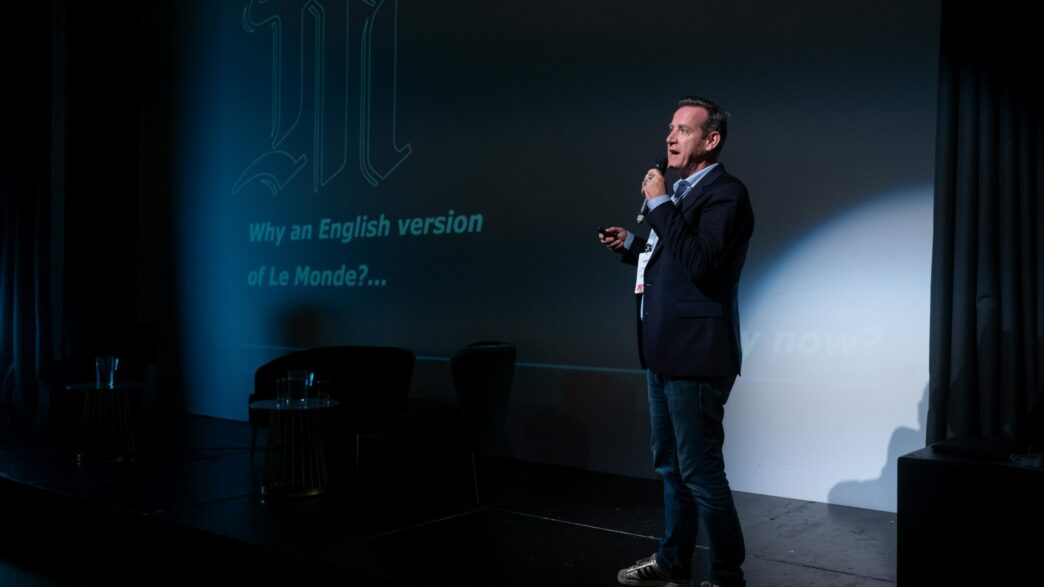
At the Audiencers’ Festival in London, Arnaud Aubron, Director of Diversification at Le Monde, took to the stage to share the journey of Le Monde in English, a project that the organisation has dreamed of for 50 years. 

With technological advances and the move to digital, Le Monde in English was launched in 2022, and has since gone from strength to strength. 

Why an English version and why now?

The fundamental reason for publishing in English is simple: to speak to the world, you have to speak English. If Le Monde wanted its journalism to have a truly global impact, keeping it exclusively in French was no longer an option.

But the more pressing question was why now?

1. Reaching the glass ceiling in France

As of December 31, 2025, Le Monde ranked number one in digital subscriptions in France, boasting 602,218 purely digital subscribers. Additionally, Le Monde drove 35% of all digital subscriber growth in France in 2025.
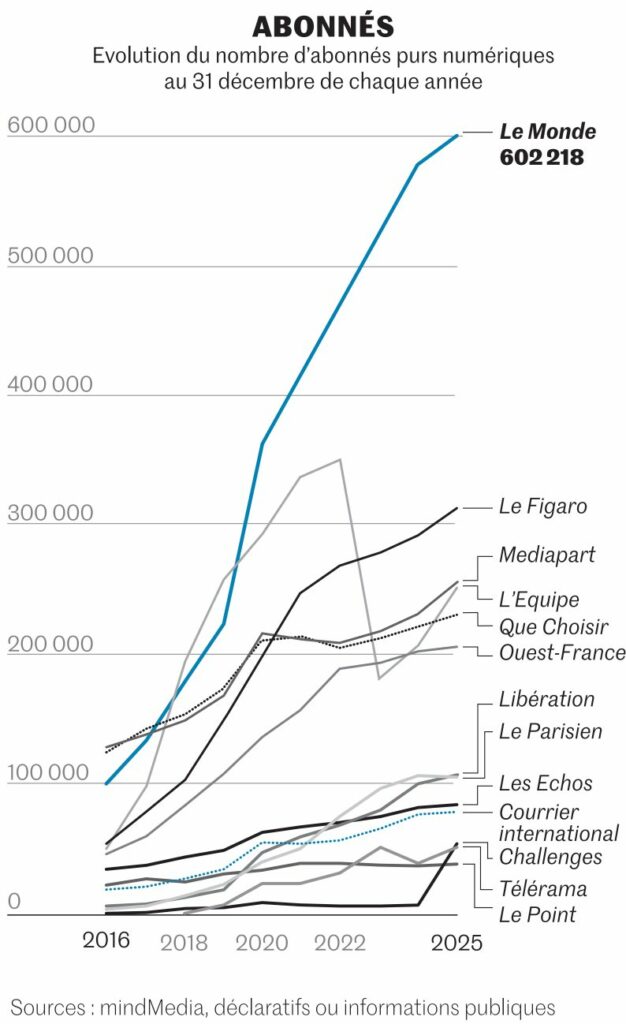
Digital subscriber figures for French media

While the publication possesses elite know-how in digital subscriptions, the French market itself is capped. The total addressable market in France sits around 3.3 million total news subscribers across all publications. With Le Monde capturing such a significant portion, the team faced a looming question: Can we hit 1 million or 1.5 million subscribers in a market this small? They simply didn’t know. To sustain further growth, they had to look beyond their domestic, and linguistic, borders.


2. The tech triggers

Two key factors finally made the project feasible in 2022:

  • Artificial Intelligence: AI finally matured enough to drastically lower the financial and temporal costs of translation.
  • The digital subscription model: Unlike the 1970s print attempt, which incurred immense logistics costs to print and ship copies across the UK and US without any guarantee of sales, digital distribution completely eliminates the friction of international expansion.

Aubron contrasted this with The New York Times, which launched a Spanish edition in 2016 but shuttered it a few years later. The New York Times relied heavily on manual translation without AI and built a business model dependent on advertising rather than subscriptions, a strategy that ultimately proved unsustainable.

The launch and operational workflow

Following Aubron’s appointment in September 2021, the project launched in April 2022 to coincide with the French presidential elections.

At launch, the assumption was that AI could handle the heavy lifting, followed by a quick proofread. In reality, it required much more human intervention.

  1. DeepL translation: The software was used to generate the initial baseline translation. While highly rated, the technology in 2022 still required heavy editing to meet Le Monde’s journalistic standards.
  2. Professional freelance translators: To ensure maximum quality for a premium subscription product, two translator agencies were brought in to meticulously review and correct the AI-generated text.
  3. In-house editorial team: A dedicated team of 8 journalists was embedded directly within the French newsroom. This physical proximity allowed them to collaborate, anticipate news, and edit translations seamlessly alongside the original authors.

Article selection: quality over quantity

Le Monde in English does not create original content; it exclusively translates a curated selection of the French edition.

  • 30% of French articles translated: The team skips live coverage, podcasts, and strictly local French wire stories (e.g., specific domestic politics, local school or banking issues) that hold little relevance to an international audience.
  • +10 daily dispatches: They supplement translated deep-dives with roughly ten English news dispatches per day to provide hot news.

Pricing: A “second read” strategy

Because an international reader is highly likely to already hold a primary subscription to a domestic title like The New York Times or The Guardian, Le Monde in English positions itself as a “second read.”

To account for this, the pricing structure had to be highly accessible:

  • Introductory price: €2.50 per month for the first year.
  • Standard price: Loops up to €10.00 per month progressively.
  • Average price point: As of March 2026, the average revenue per user sits at €4.66.

Aubron noted that an attempt to raise prices in 2025 stalled subscriber growth because the price increase came at a time when audience acquisition hadn’t scaled sufficiently to absorb the change. Lesson learned: a secondary read strategy demands highly sensitive, highly competitive pricing.

Four years later: audience & subscription performance

The strategy has paid off, yielding steady traffic and subscription growth since the launch 4 years ago.

  • Current Subscriber Base: Hovering near 16,000 active subscribers.
  • The American engine: A staggering 50% of all subscribers come from the United States. Aubron attributed this to a stark cultural difference in the propensity to pay for news: while only roughly 10% of French consumers pay for digital news, closer to 20% of Americans do. The subscriber base consists heavily of students, retirees, and individuals with an existing personal, educational, or marital link to France.
  • Global traffic footprint: The platform pulls in approximately 5 million monthly visits.
    • United States: 38.5%
    • United Kingdom: 12.2%
    • Canada: 9.5%
    • France: 7.3% (although access to the English edition from France is limited to subscribers on higher-tier plans)
    • India: the fastest-growing traffic segment
    • Germany: the first non-anglophone country.

What do they read?

True to Le Monde’s core strengths, the most read sections are international news, French politics, and economy. Surprisingly, culture and lifestyle pieces perform exceptionally well; articles about new Parisian restaurant openings or art exhibitions see massive engagement from readers living as far away as Texas and Florida.

Subscriber acquisition strategies

To recruit international subscribers, Le Monde deploys a three-pronged approach:

  1. Leveraging LeMonde.fr’s SEO hierarchy: Internal debates weighed whether to launch on a standalone domain (LeMonde.com) or a subdirectory (LeMonde.fr/en). Choosing LeMonde.fr proved to be a major SEO blessing, allowing the English edition to instantly draft off the massive domain authority of the main French site.
  2. Paid acquisition adjustments: Google advertising is a core driver. Aubron also highlighted a massive breakthrough in their Meta acquisition costs: after peaking at an expensive €86.90 cost-per-acquisition (CPA) in late 2025, optimization strategies successfully drove that CPA down to just €9.30 by March 2026.
  3. Strategic publisher partnerships: By setting up reciprocal marketing exchanges with premium Anglo-Saxon publishers (The New York Times, The Guardian, The Atlantic), Le Monde cross-promotes free trial offers directly to highly qualified audiences who are already accustomed to paying for premium journalism.

Achieving break-even

The most significant milestone of the session was the announcement that Le Monde in English has officially achieved financial break-even in 2026, a full year ahead of the initial business plan.

Revenue breakdown:

  • Subscriptions: 66.2% (The core driver of the business).
  • Licensing: 16.9%.
  • B2B: 12.3%.
  • Advertising: 4.6%.

Product evolutions: what’s new today?

Since its 2022 launch, the operational model has undergone substantial changes, heavily driven by advancements in generative AI:

AI-driven productivity gains

  • The transition to ChatGPT: Le Monde migrated its primary translation workflow away from DeepL to customized ChatGPT protocols. This allowed the team to deeply bake Le Monde’s distinct editorial tone and style guides directly into the translation layer.
  • Eliminating the translation layer: The quality of generative AI advancements and the know-how developed by the team of journalists completely eliminated the need for external freelance translators.
  • Creating journalism jobs via AI: Instead of using tech to downsize, Le Monde redirected those cost savings into expanding its internal editorial team from 8 to 10 full-time in-house journalists. AI handles the mechanical translation, freeing human journalists to focus purely on editing, nuance, and curation.

Platform and multimedia expansion

  • A bilingual app: They integrated a native toggle inside the core Le Monde app, allowing users to switch effortlessly between the French and English editions. While app users represent just 4% of total English traffic, they account for a massive 49% of all English subscribers.
  • A dedicated YouTube channel: Rather than merging video content, they launched a standalone English YouTube channel. High-end video investigations have achieved breakout success: their video on Dubai money laundering garnered 760,000 views (vs. 1 million for the French original), and their documentary on the November 13 Paris attacks pulled in 2 million views (nearly matching the 2.2 million views of the French version).
  • Apple News+ integration: Le Monde in English is now available directly within the Apple News+ ecosystem to capture a broader layer of casual readers.
  • M International magazine: In March 2025, they went “back to paper” by launching a premium, biannual print magazine called M International (themed “The French Touch”). They distribute 25,000 copies across 350 elite newsstands in 20 countries and 37 global cities.

Key takeaways

Aubron concluded his presentation with three definitive lessons learned over the four-year journey:

  • It’s not about translation: Translation is now a commoditized utility. Success comes down to content market fit, product distribution, and understanding the distinct profile of your international audience.
  • Hard to imagine working in another language: Due to global curiosity around French art de vivre, culture, and global politics, in the US, the English edition works beautifully. However, Aubron noted he would not attempt to launch a Spanish or German edition of Le Monde yet, as those markets lack the critical size and same unique cross-border structural demand.
  • AI can create jobs: The project stands as living proof that when publishers embrace automated productivity tools like generative AI, they can reinvest the dividends directly into hiring more human journalists to elevate the final product.