For the past three decades, the digital playbook for media companies has shifted with the technology landscape. We have marched through the mass-market era of controlled distribution, the search intent era of optimizing for keywords, and the platform era of chasing feed visibility.
According to the inaugural Future Newsrooms Study 2026, a global benchmark report produced by FT Strategies and WAN-IFRA, supported by Arc XP, surveying 448 newsroom leaders across 86 countries, we have firmly entered the Community Era.
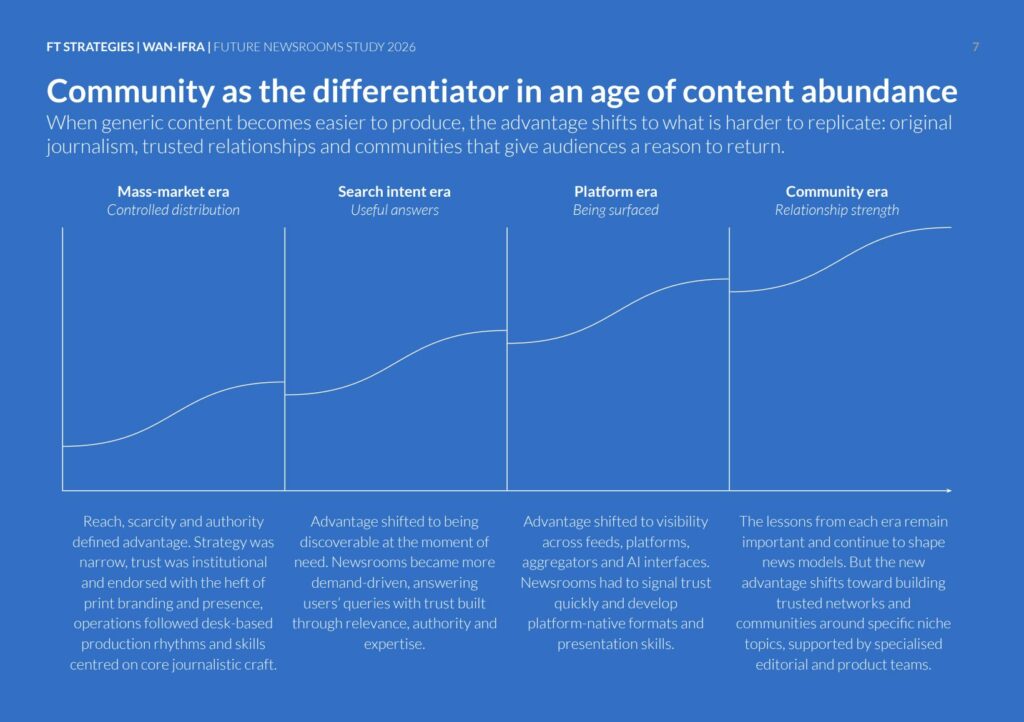
As generative AI makes generic, commodity content effortless to produce, reach alone is no longer a viable baseline for economic survival. Instead, competitive advantage has swung decisively toward what is hardest to replicate: relationships, original reporting, and building trusted networks around specific niche audiences.
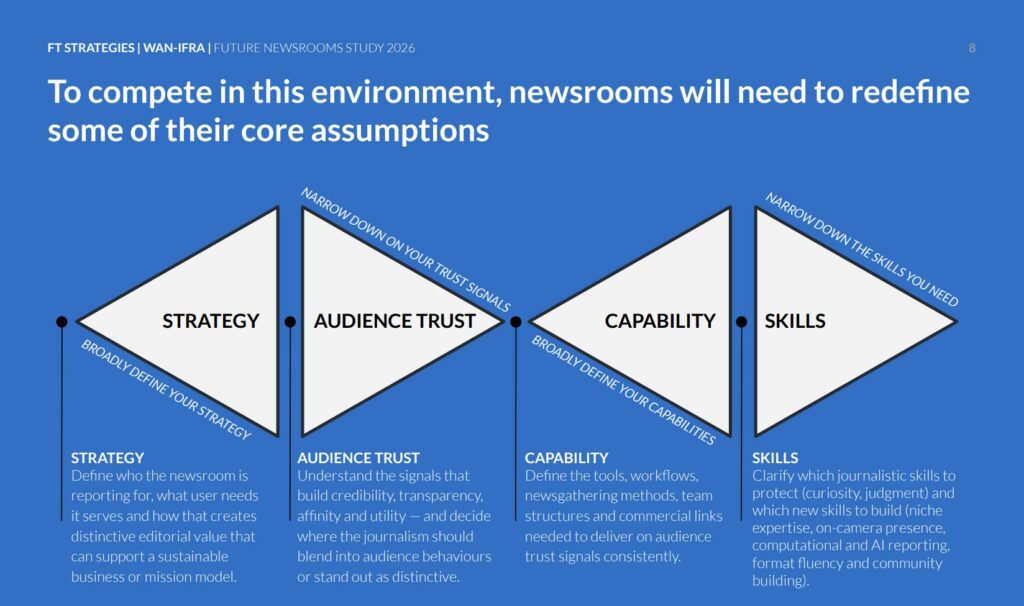
To help publishing teams bridge the gap between audience-first rhetoric and daily operational reality, here is a practical operational breakdown of the study’s four core pillars – strategy, audience trust, capability & skills

1. The strategy gap: moving engagement to the heart of the business
Newsrooms are recognizing that deep audience engagement is the primary lever to unlock long-term financial sustainability. In fact, audience engagement was the most frequently selected top-three goal for 2026.

However, a significant execution gap remains: 25% of newsrooms still make daily editorial decisions purely on instinct or reactivity, and 42% operate with only loose structural alignment.
Furthermore, the data proves that editorial growth stems directly from operational discipline. Newsrooms that systematically review and discontinue low-impact initiatives are nearly twice as likely to experience budget growth compared to those that manage portfolios on an ad hoc basis (50% vs. 28%).
What your team can do:
- Diversify the strategy table: Break down the church-and-state silos. Include audience engagement and platform leaders directly in your long-term strategy and investment conversations. Structurally aligned newsrooms over-index significantly on bringing these non-traditional roles to the table.
- Implement “portfolio discipline”: Set up a formal quarterly review to audit your newsletters, verticals, and content formats. Be ruthless about killing initiatives that fail to build a loyal public so you can redirect scarce editorial resources toward high-impact journalism.
- Shift from destination-first to audience-led commissioning: Currently, 64% of newsrooms still design stories for a single primary legacy channel (like print or a homepage template) and adapt them later. Instead, adopt commissioning frameworks—potentially assisted by internal AI tools—that force editors to identify a defined user need or specific audience group before a story is assigned.
2. The audience trust gap: rethinking participation and storytelling
Trust has evolved from rigid, institutional authority into relatable, relational signals. While newsroom leaders heavily prioritize audience relationship building, their workflows tell a different story: reporters spend a staggering 38% of their week on technical production drag, but a meager 11% on post-publication work like community building and responding to reader feedback.

When it comes to distinctiveness in an abundant content ecosystem, the ‘evergreen explainer’ of the past is being disrupted. Publishing teams are pivoting toward deep background reporting (+6pp in structurally aligned newsrooms) while actively steering away from low-margin daily breaking news (-10pp).
What your team can do:
- Bring community in-house: Stop relying on volatile, algorithmic social media comment sections to house your audience network. Take inspiration from pioneers like Newpress (building algorithm-free spaces for co-creation) or the Financial Times (leveraging interactive digital forums like “Ask an Expert”) to turn passive readers into highly engaged, recurring subscribers.

- Lean into service-oriented co-creation: Consider launching a reader-initiated reporting vertical. New Zealand’s Stuff Digital launched “Solving Stuff,” an interactive project prompting readers to submit local problems for journalists to actively investigate. This approach generated massive reader investment, with average time-on-page and completion rates soaring well above site averages.
- Be candid and transparent: Build ‘Behind the Story’ formats into your editorial mix to pull back the curtain on how your journalism is sourced and verified. Relational trust relies on showing your audience your journalistic motivations and methods.
3. The capability gap: shifting AI from efficiency to strategic maturity
Publishers are widely trapped in a Level 1 AI maturity mindset: 42% use time savings as their primary KPI for AI success, focusing strictly on automating existing administrative tasks like transcription or copyediting.
However, the biggest barriers holding back AI integration are people-based rather than technical, namely skills gaps (61%) and cultural skepticism (52%). Crucially, the study found that 57% of organizations do not have explicit AI representation in the newsroom, which directly correlates to the lowest literacy and adoption rates.

What your team can do:
- Embed AI roles directly in editorial: Do not leave technology procurement solely to isolated corporate IT or CTO functions. Move your tech budget closer to production by placing editor-coders, hybrid technologists, or dedicated newsroom engineers directly within your reporting desks. High AI usage and literacy jump dramatically (to 46%) when technical leads are embedded in the newsroom.
- Modernize backend metadata: Your AI tools are only as powerful as your archive. Publishing teams that systematically structure and tag their content assets with robust metadata report exponentially higher levels of successful AI integration and content retrievability.
- Reframe the AI conversation: Move beyond generic, mandatory tool-click training. Adopt a strategy like Bonnier News, which ran voluntary, playful workshops focusing on demystifying what AI fundamentally is and cannot do. This organically transforms open-minded early adopters into internal ambassadors who win over newsroom skeptics by proving how technology frees up capacity to do more investigative work.
4. The skills gap: transitioning from generalists to sharper specialists
Confidence in the future readiness of editorial talent drops sharply when media leaders look three years ahead. To thrive in a visually and technically demanding landscape, the industry is transitioning from broad generalism to a tightly bundled set of hybrid skills.
The primary skills priorities identified for future readiness include tech-enabled journalism (e.g., open-source intelligence, AI prompting), audience data fluency, and production expertise (short-form video editing, visual design). Yet, 61% of newsrooms still provide no formal training for these vital new competencies.

What your team can do:
- Formally define hybrid reporting profiles: Modern reporting roles require a multi-disciplinary approach. Audit your hiring pipeline to look for cross-functional profiles, such as Open Source Intelligence (OSINT) reporters who combine coding with investigative craft, or “Podcast Correspondents” capable of owning a niche category across written text, audio recording, and visual presentation end-to-end.
- Invest heavily in creator-like on-camera training: 41% of newsrooms want to upskill existing staff into multi-platform visual creators, yet 68% of them offer no formal video or presentation coaching. If your strategy relies on launching visual content on TikTok, YouTube, or Instagram, you must systematically allocate budget to presentation, vocal coaching, and platform algorithm fluency.
- Evolve compensation models to retain niche talent: Because audience affinity is increasingly shifting from legacy institutional corporate brands to recognizable individual personalities, media companies must rethink retention. A dominant 78% of media executives agree that alternative payment structures, such as bespoke revenue shares, hybrid contracts, or performance-linked bonuses, are becoming essential to protect and incentivize your most prominent, community-driving journalists.

Download the full Future Newsrooms Study 2026 report from FT Strategies here.