
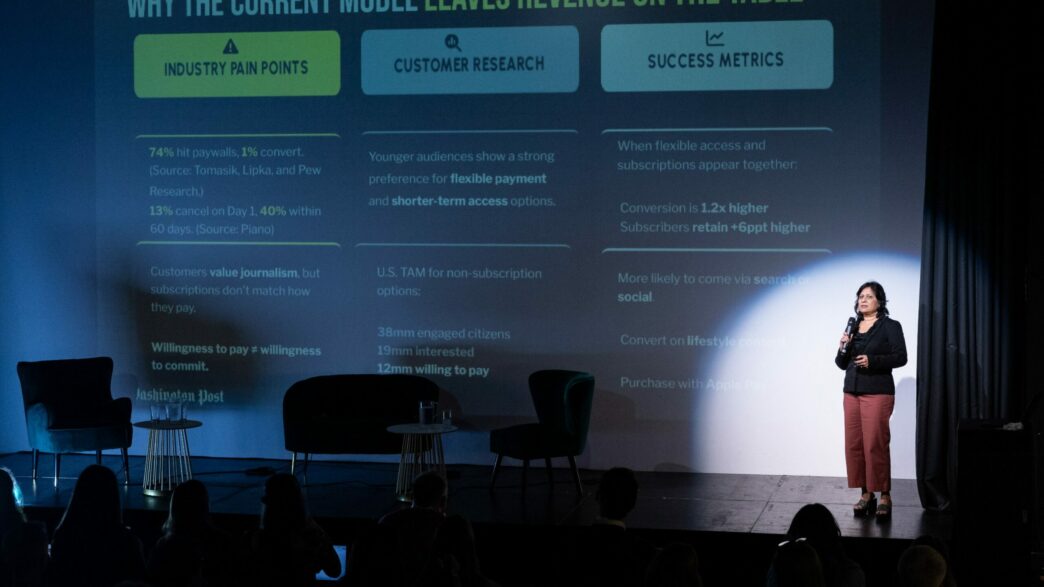
Anjali Iyer, Global Head of Subscriptions at The Washington Post, delivered a session at the Audiencers’ Festival in London focused on how news organisations must adapt to modern consumer habits by expanding beyond rigid subscription structures.
Invited by event partners, Arc XP, the platform and CMS for media companies, Anjli outlined The Washington Post’s shift toward a broader monetisation strategy centred on flexible access, shifting the way that value is captured.
> Traditional hard paywalls face a bottleneck: out of 100 anonymous readers who hit one, 74% abandon the site. Only 1% subscribe, and of that tiny fraction, 13% churn on day one because they only wanted that single article

> The data exposes a massive gap between the willingness to pay and the willingness to commit. Modern readers, particularly younger cohorts, operate in a fragmented digital landscape shaped by streaming services, search loops, and social algorithms. They demand short-term choices and are often willing to pay a premium price for temporary access over a recurring subscription package

> The Washington Post's solution is flexible access models. By testing micropayments (weekly and pay passes, as well as pay-per-article with an in-paywall mobile payment module), they're uncovering an untapped market: 42% of flexible access buyers are brand-new, anonymous users outside the existing ecosystem

> While core subscribers buy for politics and opinion, transactional buyers over-index heavily on lifestyle, wellness, and investigative deep-dives. These users arrive via search/social, and 50% checkout via Apple Pay (compared to just 30% of standard subscribers)

> Interestingly, this also serves as a nurturing mechanism for long-term subscriber growth. Over a 180-day period, up to 8% of week-pass buyers, 4% of day pass buyers, and 3% of pay-per-article buyers eventually became full subscribers
The incomplete subscription model
Publishers share a collective obsession with subscriber growth. However, maintaining and expanding this base is becoming increasingly difficult as churn grows more expensive. Over the past few decades, media organisations built vast digital subscription operations by asking their most loyal readers to commit long-term.
While successful, this framework is facing a critical bottleneck. Industry data reveals that out of 100 anonymous users who hit a hard paywall, 74% will simply abandon the site, while only a single reader (1%) will convert into a subscriber.
Of that tiny conversion pool, retention is highly fragile:
- 13% churn on day one, meaning the user bought a subscription solely to access a single, moment-driven story, and immediately cancelled once their immediate need was met.
- 40% churn within the first six months.
This reality exposes a massive gap between the willingness to pay and the willingness to commit. Modern readers, particularly younger cohorts, operate in a fragmented digital landscape shaped by streaming services, search loops, and social algorithms. They demand short-term choices and are often willing to pay a premium price for temporary access over a recurring subscription package.
Defining the flexible access market
To capture the vast audience that traditionally walks away from a hard paywall, publishers must widen their monetisation funnel. The Washington Post’s market research in the United States identified a substantial untapped addressable market:
- 38 million engaged citizens are actively interested in news.
- 19 million of those consumers express explicit interest in flexible access options.
- 12 million are actively willing to pay for the right short-term product at the correct price point.
When publishers offer flexible access side-by-side with standard recurring subscriptions, overall user conversion increases 1.2x, and long-term subscriber retention improves by 6 percentage points.
Testing the flexible access products
To determine how to capture this demand without devaluing their core subscription model, The Washington Post conducted extensive customer testing across three primary transaction models:
- The week pass: Appealing to 62% of surveyed consumers, this product is highly popular during intense, moment-driven breaking news cycles where readers want to follow a developing story for a few consecutive days.
- The day pass: Appealing to 57% of consumers, this option provides a friction-free, low-commitment window for casual site visitors.
- Pay-per-article: Appealing to 46% of consumers, this model allows readers to immediately unlock a single piece of journalism via a frictionless digital wallet transaction.
During live pricing experiments for the week pass, the team tested price points at $4, $7, and $10 as standalone, one-time payments shown side-by-side with recurring monthly and yearly subscription prompts.
For the pay-per-article interface, they deployed a highly optimised widget directly inside the paywall layer. A reader can enter their email address and use a frictionless mobile payment method (such as Apple Pay or a credit card) to execute a one-time $2.00 purchase (plus local sales tax) that unlocks access to that specific article for one calendar year.
The profile of a flexible access purchaser
The data explicitly proves that flexible access buyers are not just early-stage subscribers who are downscaling their commitments. Instead, they represent an entirely different audience profile that hard paywalls completely lock out.
- Content preferences: Unlike core subscribers who are driven primarily by heavy politics and opinion pieces, flexible access buyers over-index significantly on non-political lifestyle, wellness, deep investigative features, and historical archive content.
- Device and payment footprint: This audience is heavily mobile-first, with more than half visiting via mobile devices and purchasing via Apple Pay compared to subscribers.
- Discovery pathways: They are 1x to 2x more likely to discover articles via search engine optimization or social media channels, arriving with highly specific, momentary search intent.
The pathway to long-term subscriptions
While flexible access is built to capture transactional, short-term demand, it also serves as an elite nurturing mechanism for long-term subscriber growth. Over a 180-day horizon, there is a strong statistical probability of transactional buyers upgrading to recurring, full-time subscriptions:
- 8% of week pass buyers transition into full subscribers.
- 4% of day pass buyers upgrade to full subscriptions.
- 3% of pay-per-article buyers eventually become subscribers.
When evaluating who is performing these upgrades, the lifecycle acts equally as a net-new acquisition tool and a win-back loop:
- 40% of upgraders are existing site registrants
- 35% are entirely new registrants
- 25% are previous subscribers returning to the brand.
Furthermore, these flexible entry points attract high-intent customers, with 13% of all upgraders bypassing the basic subscription tier to jump directly into the highest-yield premium tier.
While approximately 91% of flexible access buyers remain single-use transactions, a growing, habitual cohort is developing, with 9% of pay-per-article buyers, 8% of week pass buyers, and 5% of day pass buyers demonstrating repeat purchasing behavior.
Driving overall organisational growth
When evaluating total paying user growth across the entire funnel, pay-per-article options deliver the highest overall volume lift at 83%, followed by the day pass at 35% and the week pass at 19%. Because pay-per-article operates as a frictionless entry point, it yields the highest efficiency and retention results among readers who are structurally unready to commit to a long-term media subscription.
Ultimately, this represents a major philosophical pivot for modern publishing groups. Rather than treating monetisation as a choice between a hard subscription paywall or zero return, organisations must build a diversified revenue tier:
- Off-platform partnerships & licensing: Reaching audiences beyond owned and operated properties.
- Flexible access: Transactional, non-recurring options designed to monetize an untapped, high-intent audience.
- Core subscriptions: The foundational, enterprise, and standard domestic news consumer.
- Premium subscriptions: Higher-yield tiers that include multi-account sharing capabilities.
- WP Intelligence Subscriptions & Councils: B2B analytical products for subscriptions and invite-only councils specialized executive loops tailored for policy and corporate leaders.
Implementing this layered approach transforms user monetization from a simple transactional gate into a holistic, long-term ecosystem. It effectively captures diverse consumer demands across different points of the user journey, creating a sustainable foundation for modern newsrooms.
Thank you to Anjali for sharing these insights, and to Arc XP for supporting our event.
About Arc XP: Arc XP is a cloud-native enterprise content management system (CMS) built for publishers and broadcasters. Designed as a complete media operating system, Arc XP connects content, identity, personalization, monetization, and AI — empowering media brands to own their audience, activate first-party data, and build sustainable, independent revenue. Media companies use Arc XP to create, deliver, and scale digital experiences across every channel.