What's working this week is Audiencers' weekly round-up of the numbers, tests and benchmarks that show what's working in digital reader revenue right now. It's a curated selection, not a news digest: we only keep insights on the topics we cover, engagement, conversion and retention, and the models behind them, from subscriptions and memberships to registration, newsletters and apps. This edition draws on data collected up to 6 November 2026. Some figures come from earlier reports in our archive, and each one shows the period it covers. Each insight comes with a “What this means for you” takeaway written by the Audiencers team.
Theme of the week: publishers are building around the core content subscription offering…
- NRC (Mediahuis, Netherlands) gave every subscriber unlimited New York Times access. More than half switched it on, cancellations fell across all subscription types, and daily new subscribers doubled during the launch.
- Il Post (Italy) moved its free daily podcast Morning behind the membership, and 70–80% of its listeners paid. Listening to the podcast is closely linked to renewing.
- Stylist (UK) moved 90% of its previously free puzzles behind the paywall, and puzzle players read 51% more articles. App users who listen to any audio are 9 times more likely to come back, and the app converts subscribers better than the website.
- The Hill (US) added interactive election tools to subscription offering ahead of the midterms. More than 75% of trial members of The Hill’s new subscription went on to pay. Subscribers get extra tools such as election dashboards and live race calls, while the journalism stays free.
Number of the week: 40%
According to Piano data, 40% of new subscribers disable auto-renew within 60 days of signing up, and 13% do it straight after subscribing. The same benchmark puts the median publisher’s share of “sleepers” (people who pay but don’t read) at around 40%.
Acquire and register
- El País built 3.7 million registered users before going paid, and about 80% of its first payers came from that pool
El País (Spain) spent a year offering free account creation before its paywall launched, reaching 3.7 million registrations by 2021 (data period 2020-2021). Roughly 80% of early paying readers were already registered. Source: FT Strategies / Google News Initiative
What this means for you: registration is a valuable testing ground to launch pre-paywall, allowing audiences to get used to the value exchange and for you to build a pool of engaged prospects ready to subscribe when you do launch premium. Broadsheet did something similar, and it paid off.
- 21,405 young Belgians took up Mediahuis’s offer of free news until summer 2026
Mediahuis Belgium’s “Wij betalen” campaign opened all its news brands free to 18-26-year-olds (2025-2026), with a €1-a-week youth plan lined up to keep them afterwards. The aim is to move young readers from social followings onto owned platforms. Source: Mediahuis Annual Report 2025
What this means for you: NTM grew its young subscriber base by 500% with the same strategy
Convert
- ABC lifted conversion 46% by showing its paywall on every article to its most engaged readers
Spanish daily ABC (Vocento) tested a full lock for highly engaged users against its standard editorial lock of around 30% of content; conversion rose from 0.26% to 0.38% with little effect on engagement (Subscriptions Academy EMEA 2025). Source: FT Strategies / Google News Initiative
What this means for you: dynamic paywall strategies, where the journey and messaging adapt to the reader’s profile and context really pay off thanks to the improved balance of frustration and engagement.
- A €1 price rise cost Le Parisien 10% of conversions
Le Parisien (France) A/B tested its standard monthly price at €8.99 instead of €7.99 and saw conversions fall 10%. The test followed an 18.5% drop in the package’s ARPU over two years of heavy discounting; the churn effect is not yet known (Subscriptions Academy EMEA 2025). Source: FT Strategies / Google News Initiative
What this means for you: it’s worth evaluating retention and LTV in this situation too however.
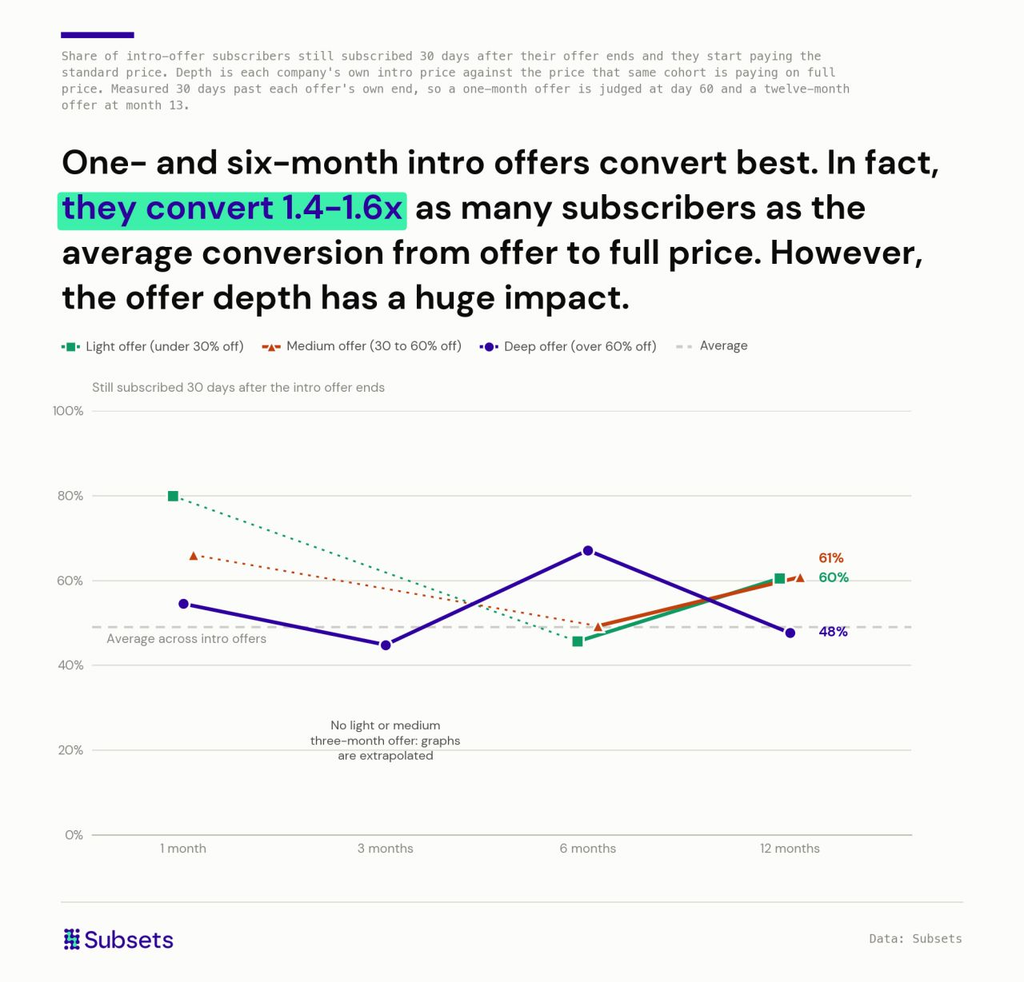
- Short, light intro offers convert at 1.4 to 1.6 times the average rate
Subsets (cross-market trends shared by co-founder and CEO Martin Johnsen, November 2026) finds 1-month light and medium offers and 6-month deep offers convert best. Deep 3- and 12-month offers bring in the most subscribers but convert below average.
Source: LinkedIn (Martin Johnsen, Subsets)
Onboard and engage
- Habitual readers are worth 110 times more than one-page visitors
Piano’s client data (Back to Basics report, June 2025) shows median new subscription revenue per 1,000 visitors climbs from $0.23 for one-off visitors to $25.52 for those reading 5+ pages over 4+ days a month. On average, 65% of visitors read one page and leave. Source: Digital Content Next
What this means for you: traditionally, digital publishers have sought to increase RFV (recency, frequency and volume of visits). However, the AI era and changing consumption habits mean that frequency has come out as the most valuable, alongside range of formats being consumed.
The Economist, for instance, shared: “Just getting someone to consume 50 pieces of content of whatever format might not actually be useful. What’s more useful is the depth of that engagement and how many different formats they are engaging with, even if it means a fraction of that volume.”
- 15-20% of new subscribers cancel within 24 hours
Mather Economics’ client benchmarks (Subscription Lifecycle Playbook, current edition) link these instant cancellations to unclear expectations or accidental sign-ups, and recommend clearer trial terms, early value reinforcement and triggers such as no visit by day 7. Source: Mather Economics, Subscription Lifecycle Playbook
- 40% of new subscribers switch off auto-renew within 60 days
Piano benchmark (no sample or period stated): 13% switch it off immediately. On monthly plans, cancellation offers with 70%+ discounts are accepted about 8% of the time, versus 2% for smaller discounts. Source: Digital Content Next
What this means for you: the moments and days post subscribing are essential! You can find onboarding benchmarks here to help build an engaging first experience with your brand.
Retain
- Madsack’s reason-based cancel flow saved 4,281 subscriptions in 2025
German group Madsack answers each cancellation reason with a matching argument and offer; in 2025 it also moved 906 subscribers onto a discounted annual plan, for €70,806 in attributable revenue (Piano case study, no control group). Source: Digital Content Next
What this means for you: adapting the cancellation steps to the reason why someone is churning will always be valuable, allowing you to offer an alternative that is more suited to this specific reader.
- Two habits halve churn
In Mather Economics’ client benchmarks (Subscription Lifecycle Playbook, current edition), subscribers with two or more recurring behaviours, such as daily visits plus newsletter opens, churn 50% less than those with one. Source: Mather Economics, Subscription Lifecycle Playbook
What this means for you: this makes sense, the focus on “variety” over “volume” by The Economist matches this data point.
Product and apps
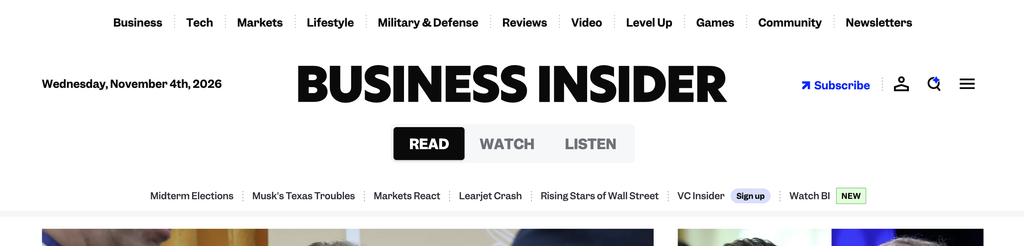
- Business Insider now asks readers to choose between 3 formats before they browse
A Read / Watch / Listen switch now sits under Business Insider’s masthead (US, observed 4 Nov 2026), with Read as the default and a new “Watch BI” section promoted in the trending bar. Source: Audiencers analysis. (screenshot November 4th)
What this means for you: I found this very interesting – it shows a change in reader habits and how media are adapting, with format choice offered from the top menu.
- Mediahuis Belgium folded its news and e-paper apps into one app per title, with 2 million+ monthly podcast plays
In 2025 Mediahuis Belgium merged its apps and added LUISTER, an in-app audio hub, while putting some podcasts behind the paywall. Its titles publish 120+ new episodes a month. Source: Mediahuis Annual Report 2025
What this means for you: apps and podcasts are brilliant tools for habit forming (the all-important frequency we mentioned before), so it makes sense that Mediahuis is spending time optimising these products and putting them behind paywalls.