What's working this week is Audiencers' weekly round-up of the numbers, tests and benchmarks that show what's working in digital reader revenue right now. It's a curated selection, not a news digest: we only keep insights on the topics we cover, engagement, conversion and retention, and the models behind them, from subscriptions and memberships to registration, newsletters and apps. Each insight comes with a "What this means for you" takeaway written by the Audiencers team. This edition draws on data collected up to 20 November 2026. Some figures come from earlier reports in our archive, and each one shows the period it covers.
The number of the week: 40%+
Just over 40% of the time Times readers spend on an article goes on the comments.
The figure covers readers who engage with comments, as stated by The Times and Sunday Times in November 2026. The paper pushes dwell time further by bringing star columnists into the thread, for example Matthew Syed answering subscriber comments for an hour every Sunday morning. Source: WAN-IFRA
Acquire and register
Toronto Star: tying comments to registration lifted sign-ups 72%
After the Canadian daily made a registered account the condition for commenting site-wide and added reply alerts, registrations climbed 72% and logins 405%; commenters now make up a quarter of all registrations. Archive figures, covering the period since its 2022 commenting launch. Source: Kevin Anderson’s newsletter
Go further on Audiencers: Pins, commenting and seamless login: Graham Media, CBC and Toronto Star share registration success stories
Second Chapter collected 1,500+ newsletter sign-ups before going live
The new UK-based title covering European tech is keeping its site free until February 2027 so it can test its proposition on this early list before moving to paid tiers. The founder plans to scale acquisition only once the offer lands with readers. Source: Press Gazette
Convert
Block Club Chicago raised prices up to 67% and still grew new subscribers 17%
In its first price rise since 2018, the Chicago nonprofit lifted its annual price 34% and its monthly price 67%, and added a registration wall and its first hard paywall. New subscribers rose 17% in the following quarter, with monthly retention holding at 98.9%. The move followed 20 interviews and 2,300 survey responses in which readers said the newsroom was too timid in its ask (reported at the NPA Summit 2026). Source: Twipe
Go further on Audiencers: Subscription price increase: the 7 biggest mistakes to avoid
NPR+ donor perks brought in $8M, up from $5.5M
NPR’s perks programme, open to donors giving at least $8 a month and including ad-free podcasts, grew revenue by roughly 45% between FY2025 and FY2026. The figure was shared at NPR’s board meeting on 12 November. Source: Nieman Lab
Ukrainska Pravda: discount campaigns brought in 1,000+ subscribers each
In 2026, two campaigns offering 35-50% off (one timed to Ukraine’s Independence Day) each signed more than 1,000 subscribers, beating bundles. Readers who reach the paywall without converting are retargeted on paid social with a standing discount of about 20%. Source: The Fix
Go further on Audiencers: Strategies to retain subscribers after a promotional offer
Onboard and engage
At The Times, over 40% of article time is spent in the comments
Among readers who open the comments, just over 40% of the time spent on an article goes to reading them (stated November 2026, UK). Getting star columnists to reply to subscribers, such as a weekly one-hour session, pushes dwell time up further. Source: WAN-IFRA
Go further on Audiencers: Community building strategies from The Telegraph and The Times
Cape Coral Breeze’s reader contest jumped to 150,000+ votes from 92,000
The small Florida weekly’s reader-voted Best of Cape Coral contest, spanning more than 200 local business categories, sent voters through the homepage so they saw its news coverage, and drove a traffic spike of about 139% in August (2026 vs 2025, publisher’s own count). Source: Nieman Lab
Retain
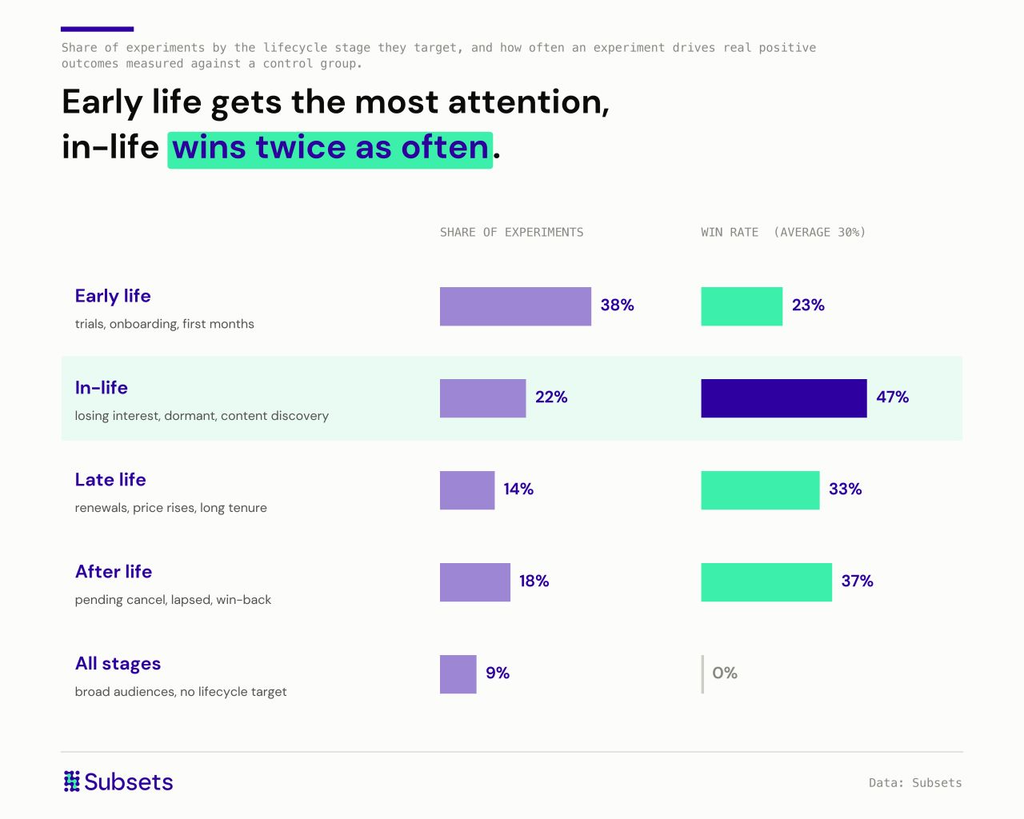
Retention tests aimed at in-life subscribers win 47% of the time, twice the early-life rate
Across 500+ experiments run by subscription publishers on Subsets over the 12 months to November 2026, tests targeting mid-tenure subscribers (fading interest, dormancy, content discovery) beat their control group 47% of the time, against 23% for early-life tests, which still get the most attention (38% of experiments). Broad tests with no lifecycle target produced no significant wins at all. Source: LinkedIn (Martin Johnsen, Subsets)
Amedia: daily readers churn at 3-4% a month, infrequent readers at 7-12%
At the Norwegian group of around 90 regional titles, subscribers who read every day are far less likely to cancel than those reading every three days or less. Its north-star metric is the share of subscribers reading at least one article a day for 10+ seconds (WAN-IFRA, August 2026). Source: WAN-IFRA
Il Fatto Quotidiano saved 38% of expiring cards with one email
The Italian daily emailed subscribers with expired cards a week before renewal, and 38% updated their details, keeping full-price renewals with no negative side effects. A further 30% of cards were refreshed automatically by its payment provider (FT Strategies Subscriptions Academy EMEA 2025). Source: FT Strategies / Google News Initiative
Go further on Audiencers: How to stop subscription revenue leaks: technical and strategic solutions
Product and apps
LA Times planning guide: 42% of savers came back to use it again
Launched in June 2026 and built with generative AI tools, the guide lets users save places and see Metro routes. Two-thirds of those who started saving completed a plan, but only one user in ten was not already signed in, so it proved its value with existing logged-in readers rather than new ones (reported at the NPA Summit 2026). Source: Twipe
Bozeman Daily Chronicle: site relaunch lifted traffic 49%
A redesign with fewer, more intentional categories, lighter pages and faster loading added about 96,000 monthly visits (August vs July 2026, Similarweb estimates). The Montana paper was the pilot for a redesign rolling out across Adams MultiMedia’s 150+ titles. Source: Nieman Lab
Try this
Candidate insights that would make a good test:
- Adding a block of related top-story links to Heraldo’s daily games newsletter lifted its click-through rate 81% (0.21% to 0.38%), with no negative reactions.
- Blick’s A/B tests found paywall copy using article summary ‘cliffhangers’ converts over 20% better than copy listing subscription benefits.
- Second Chapter’s welcome email asks each new reader to name a book that shaped their career, then publishes the answers as a shared library list on the site to build a sense of community from day one.