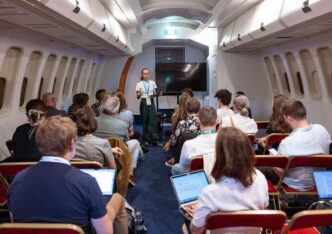

I’m a Senior Product Manager at Sanoma Media Finland, working on its news brands such as Helsingin Sanomat and Ilta-Sanomat. I’m an engineer and a designer by training, and I have spent the past 15 years at five Finnish publishers, where design, technology and journalism meet. Audience Engagement for Journalism began as my capstone for the Executive Program in News Innovation and Leadership at CUNY’s Craig Newmark Graduate School of Journalism. It is now a non-commercial guide with a framework, a toolkit and a feed of industry insights, from the industry for the industry. This article is based on my talk at WAN-IFRA Data Science Day in London on 21 October 2026.
Everything a newsroom does rests on questions someone once answered. Who are we doing this for? What do we make for the audience to engage with? What counts? Whose job is it? The answers end up in habits, dashboards and job descriptions, and after a while nobody asks the questions again.
The ecosystem keeps asking them for us. Every turn in the history of audience engagement has begun outside the newsroom, with search, social feeds and now AI answers. In 2015 Facebook and Google launched their own formats for news articles, Instant Articles and AMP. In January 2018, 38 of the 72 publishers that launched with Instant Articles had abandoned the channel. The format earned them too little and kept readers and their data away from their own sites. The Guardian had already left in April 2017, after its chief executive, David Pemsel, called the returns “woeful”. The paper’s statement explained why. “Our primary objective is to bring audiences to the trusted environment of the Guardian to support building deeper relationships with our readers.” There are also other examples in history where big tech has been signalling that it is after owning the news experience, and now AI is there to add a new layer of uncertainties or possibilities.
The newest signal arrived in October 2026. Meta’s new commercial terms would let it crawl the websites linked to businesses on its platforms. After criticism, Meta removed the word “train” from the terms, but WAN-IFRA says the wording still allows Meta to use the content in its business products, generative AI included, and that Meta’s promise to respect robots.txt is not written into the terms. “No publisher should have to choose between reaching its readers and keeping control of its own journalism,” said Irene Lanzaco of WAN-IFRA. Meta has since pushed the start date back from 30 October to 20 November, to give it more time to explain “what’s changing and what’s not”.
This piece shows a way to let signals from audience and engagement challenge the questions you work from, and a way to sort out the ones that matter. You can use it on your own, to decide where to put your effort. You can also use it to bring a sharper question into your newsroom’s strategy work. In change and stakeholder management, questions and options might work way better than arguments.
> Every shift in audience engagement has started outside the newsroom, from search to social feeds and now AI answers. The questions newsrooms answered years ago need asking again, and a simple scenario method helps you decide which ones matter

> Write down the answers your newsroom works from: who you serve, what you make for them to engage with, what counts, and whose job it is. When a signal challenges one, ask the question again

> Sort the questions you can't answer right away into three groups: fairly certain, truly uncertain and your own choice. Stop arguing about the certain ones, and build your scenarios from the uncertain ones

> Cross your two biggest uncertainties into four worlds, answer your questions in each, and focus your effort where the answers differ most

> Start the moves that pay off in every world, like keeping a direct line to readers and making every story provable. Agree in advance on the signposts that will tell you when to ask again
The questions you already answered