James Webb is a product leader with 15 years of experience helping news subscription businesses boost subscriber retention. Most recently, he served as Apps Group Product Manager at The Economist, and previously as Product Director at the FT. In this article, James looks at the 2026 Pugpig Media App Report and argues that the value is hiding where standard metrics don’t look.
> Nearly half of app users are anonymous, and most publishers barely optimise to convert them. James Webb, formerly Apps Group Product Manager at The Economist and Product Director at the FT, reads Pugpig's 2026 Media App Report and argues the value is hiding where standard metrics don't look

> Offline is not an edge case. At both The Economist and the FT, offline was around 10% of screenviews and cellular around 30%. If half those cellular sessions hit patchy signal, roughly one in four opens happens with the app on the back foot, and session analytics are flaky in exactly those conditions, so it is undercounted

> Digital still prices like it is scarce: one person, one paywall, one login, so a household either buys four subscriptions nobody can justify or three people free-load invisibly. The Times gives subscribers free bonus accounts and found those users 76% more likely to say they would stay, with churn under 0.01%. The New York Times charges for the same idea, three extra logins at $30 a month against four separate $25 subscriptions

> Only 26% of publishers say their app's main job is acquisition, yet apps are full of non-subscribers who hit a paywall after a single article. Habits take months, not one read. The Times' £1 for three months gives someone a chance to form one; a seven-day trial does not
Pugpig’s 2026 Media App Report is, on the surface, a story about apps being taken seriously again. Engagement is up, A/V, games, push and personalisation are the priorities of the year.
However, a few aspects caught my attention: first, how the report handles offline usage; second, what publishers (and this report) seem to be missing regarding household engagement opportunities; and third, how restrictive most publishers are when it comes to sampling.
Take the standard funnel, or rather, loop ;). We’re all familiar with the sequence: acquire, activate, engage, retain etc. It’s surprising that nearly half of app users are anonymous, but that most publishers barely optimise anything to convert them. The habit-forming features sit at the bottom of the adoption table, with games at 16% and video at 22%. Subscriber retention, the KPI that tends to be most important, is one of the least well measured, with only a small fraction reporting advanced capability. I have some thoughts on where publishers could do much better for themselves.
> Audiencers’ summary of the Pugpig Media App Report 2026 is here
1. Offline is not an edge case
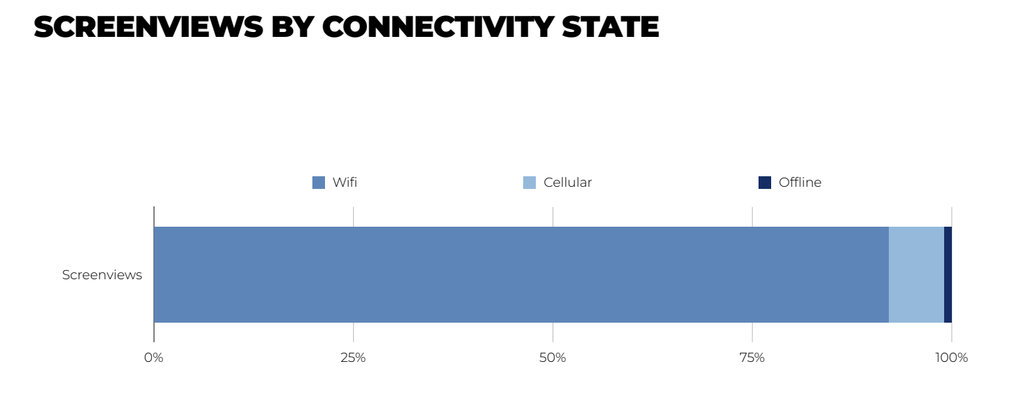
For readers who commute, fly and move through cellular blackspots constantly (at least in the UK), that slice is nowhere near as small as the report suggests. At the Economist offline and cellular usage represented around 10% and 30% respectively, and at the FT it was broadly the same. If half of those cellular sessions hit a patchy signal, then roughly one in four opens happens with the app on the back foot. Before we rebuilt The Economist app natively, that experience was painfully brittle. And our best subscribers were paying the price (and letting us know about it in volumes).
Think about who reads on a tube platform, in a station concourse or at thirty thousand feet. They are people who deliberately brought your content with them, likely your most loyal base, and it is exactly where too many apps still don’t handle things gracefully: articles that half-load, images that spin, editions that won’t sync, glitchy ad reloads, saves that fail without telling anyone.
There is a measurement problem too. Session analytics under these conditions are notoriously flakey, so are probably undercounted. The report’s engagement numbers are likely a floor, not a ceiling, for audiences who read on the move. Treat offline and low connectivity as a retention issue, and test your edition, save and caching with the network switched off, as well as just slow.
Of course, Product Designers always design for state (eg connectivity), but in these constrained times, this is often the polish that gets deprioritised, and then forgotten about, by teams under pressure to deliver to tight deadlines. Publishers who’ve raised the bar won’t necessarily be the ones with the flashiest new formats – though they’ll likely have deeper pockets. Pugpig’s own data half-confirms this: mobile-plus-editions apps, the least fashionable format in the report, still outperform mobile-only apps on almost every engagement measure. My hunch is the same pattern holds for reliability under poor connectivity. It’s unglamorous, it won’t make your slideware pop when selling it to stakeholders, but it’s exactly the kind of thing that decides whether a reader who trusted you on a delayed train chooses to open your app tomorrow, and the next day.
2. Digital still prices like it’s scarce
Pre-internet, it was fair game for anyone else in the house to read the primary reader’s copy of the newspaper. In the subscriptions era, digital has done the opposite from day one: one person, one paywall, one login, and a family of four either buys four subscriptions nobody can justify, or one person subscribes and everyone else free-loads, unconverted and invisible.
Very few publishers seem to have figured out that this is simply a design choice, and a poor one for tracking true engagement behaviours.
There are only three that spring to mind. The Times led with “bonus accounts” some time last year, letting subscribers share access with family or friends at no extra cost, essentially recreating the breakfast-table version of the newspaper digitally. This was inspired by Le Figaro’s play to reduce password sharing. The New York Times has introduced a paid family tier, up to three extra logins for $30 a month total rather than four separate $25 subscriptions, each with its own personalised account and its own Wordle streak.
The Times treats sharing as a retention feature you don’t charge extra for. Everyone in a shared account has their own login. A family plan with individual, personalised accounts isn’t just cheaper access, it’s four separate chances to turn an anonymous user into a known user, to learn what they read, deepen the relationship with features suited to them, rather than one subscriber and one or two freeloaders who never show up in a single engagement analysis.
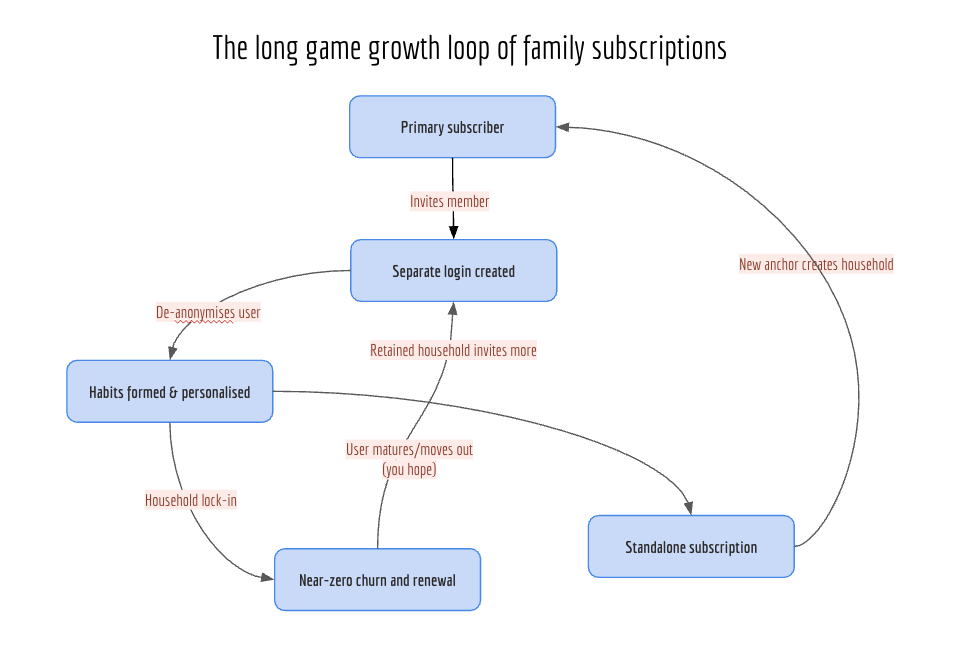
From there a loop forms. An invited member gets their own login, activates on their own terms, and their usage compounds. Household engagement makes cancelling harder, and a member with a year of habits behind them is a far better candidate to subscribe in their own right than a cold prospect.
It may take time, but it works. The Times found people using shared bonus accounts were 76% more likely to say they’d stay subscribed, and churn on those accounts ran under 0.01%. Shared use turns a single subscription into a sticky household relationship.
NYT’s reasoning for the family tier was explicit: people with a lighter relationship to the paper become far more likely to convert once a friend or family member brings them in. When they convert or renew the household plan, they can invite someone else, expanding reach household by household.
Put this next to the anonymous-user problem from earlier and the opportunity becomes obvious. Nearly half of app users are anonymous, and most publishers barely optimise to convert them. A family member added to a household plan is the friendliest version of that anonymous user: someone already inside the tent, already reading, and one step away from being known.
The ones building this loop have figured it out. They’re turning the thing publishers tend to treat as leakage into the fastest lever they have for both retention and growth.
3. Be more generous with sampling/trials
According to the Pugpig report, only 26% of publishers say the main role of their app is subscriber acquisition, yet many apps attract plenty of non-subscribers who are far less engaged than payers. I’ve read countless angry reviews from people who followed a prompt to download the app and hit a paywall after a single article. Habits take weeks or more likely months to bed-in, not one read. The Times’ £1 for three months is a far better way to let new entrants get a feel for the product than a seven day trial ever will.
Apps are getting better at keeping the people they already have. Meaningful opportunities are hiding where standard metrics don’t bother to look: the reader with no signal, the family member re-using a login, and the anonymous user we ask to pay before they’ve had a chance to connect with your journalism. How can we expect younger people to adopt news apps that weren’t even designed for how they want to consume media, if we don’t even give them a decent chance to try it out?
James Webb has led mobile and web product groups at The Economist and the Financial Times. For a deeper look at why 82% of publishers misdiagnose their delivery bottlenecks, read The capacity myth: why your product bottleneck is actually a focus problem, on Substack.