
You're reading The Audiencers' newsletter #99 sent out on September 30th, 2026. To receive future newsletters straight to your inbox every two weeks, sign up here.
We held our Festival in Paris yesterday with over 400 professionals coming from across the French-speaking world. This slide pretty much speaks for itself 😅
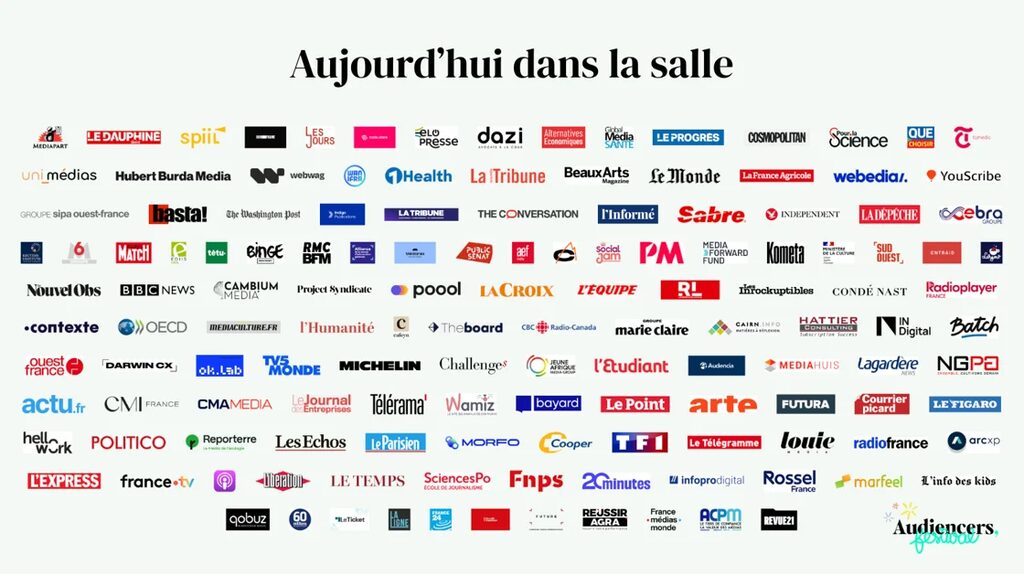
I am however writing this newsletter before the Festival, given that my Tuesday will be a little busy, so a full résumé of the event to follow!
In today’s newsletter:
- The trend is leaning towards smaller, more loyal audiences
- The Economist’s onboarding journey shows exactly where their strategic priorities lie
- How newsrooms can learn from failure without failing in public
- 🔗 Links to add to your reading list
The trend is leaning towards smaller, more loyal audiences
For years, publisher growth strategies were governed by mass reach. But with search engine referrals collapsing under the weight of AI overviews and 40% of desktop visitors no longer scrolling past the fold, the vanity-metric era has officially hit a wall. The reality of modern media consumption is that volume no longer guarantees sustainability. Instead, true financial sustainability rests on a power law: a tiny fraction of highly engaged readers drives a quarter of all pageviews and up to 75% of digital revenue. The strategy needs to shift from chasing passive scrollers to cultivating lasting relationships with active, returning community members.
This transition requires a complete overhaul of how newsrooms define success, shifting focus from raw pageviews to depth of engagement, multi-format consumption, and long-term retention, even if that is from a smaller number of readers. As Wired editor Katie Drummond recently put it: “Ultimately, I am very comfortable with the idea that Wired’s audience in the future is a smaller audience, but we want that audience to be loyal.”
This sentiment is echoed across the industry, with publishers moving beyond simple community features to building habit-forming product ecosystems.
The commercial payback of this shift is already proving itself, with The Economist being a brilliant case in point. By expanding into exclusive Insider videos led by journalists, audio formats, personalisation & more, they’ve driven subscriber retention to industry-leading levels.
Nada Arnot, EVP of Marketing at The Economist, shared that “just getting someone to consume 50 pieces of content of whatever format might not actually be useful. What’s more useful is the depth of that engagement and how many different formats they are engaging with, even if it means a fraction of that volume.”
And we can see this strategic move playing out in their onboarding journey alone…
The Economist’s subscriber onboarding journey shows exactly where their strategic priorities lie
Late 2025, The Economist launched Insider, a premium feature that brings subscribers into the newsroom through editor-led shows, biweekly newsletters, and news-making interviews with global leaders.
At Audiencers’ Festival in London, Principal Product Manager Diana Babei shared that insider is already proving to build loyalty and trust in ways that article text doesn’t, including high engagement with this product (75% of subscribers) and lower churn among Insider viewers.
In June of this year, the brand launched Play, a separate subscription offer that uses the same human-first AV formats that drive Insider’s loyalty, but packages them at a lower price point to build habits and acquire audiences who haven’t yet subscribed (interview with Nada Arnot here).
This pivot to relationship-building, with formats bringing audiences closer to journalists, is clear in their subscriber onboarding journey (I’ve found that you can tell a lot from a publisher’s onboarding journey!)
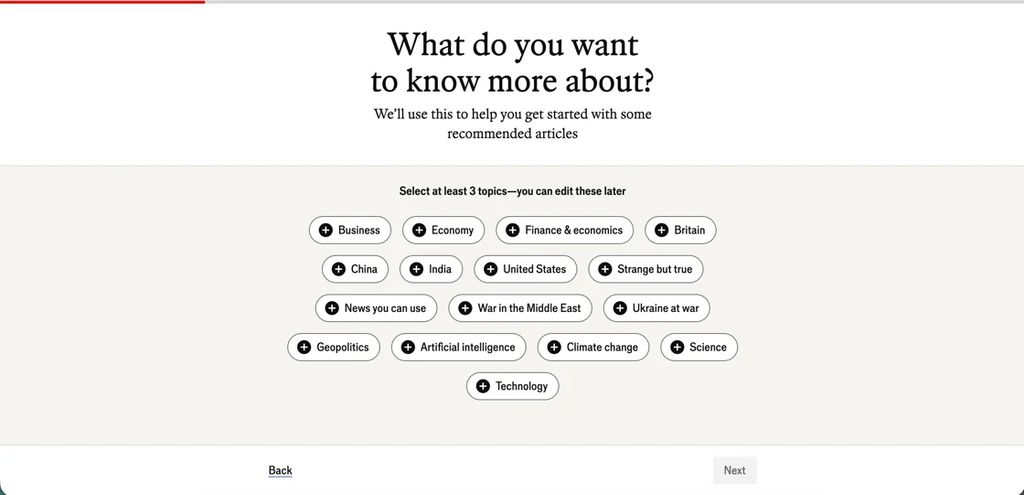
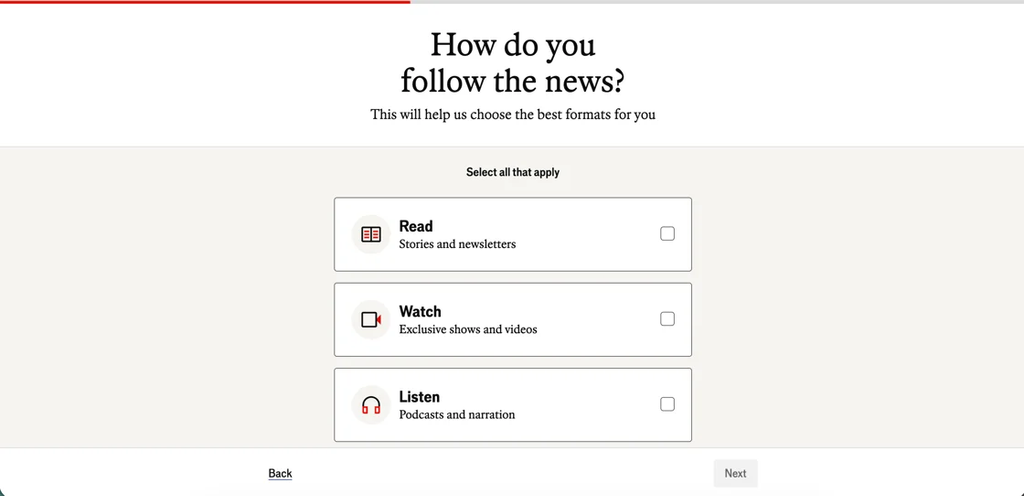
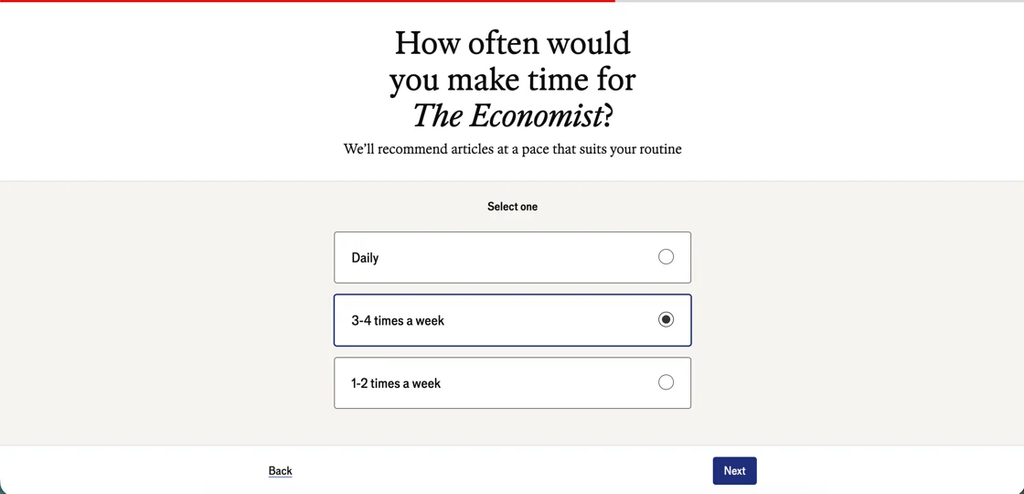
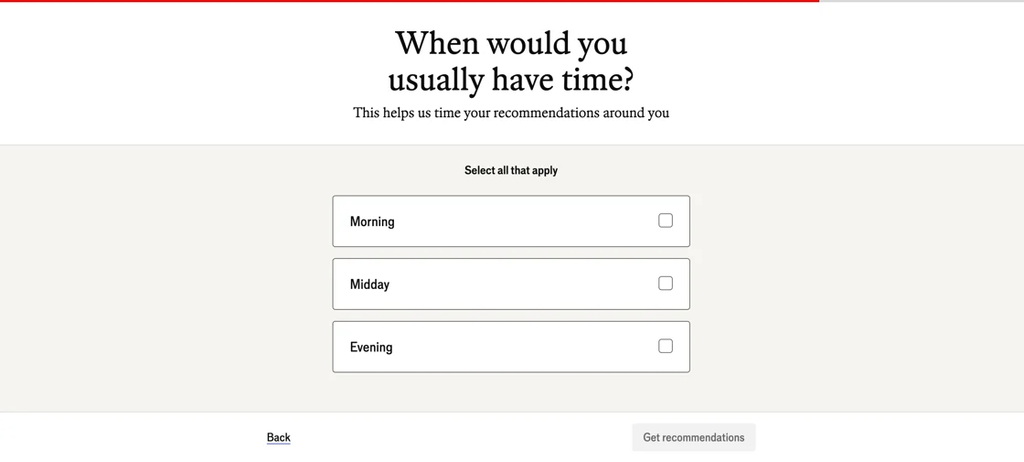
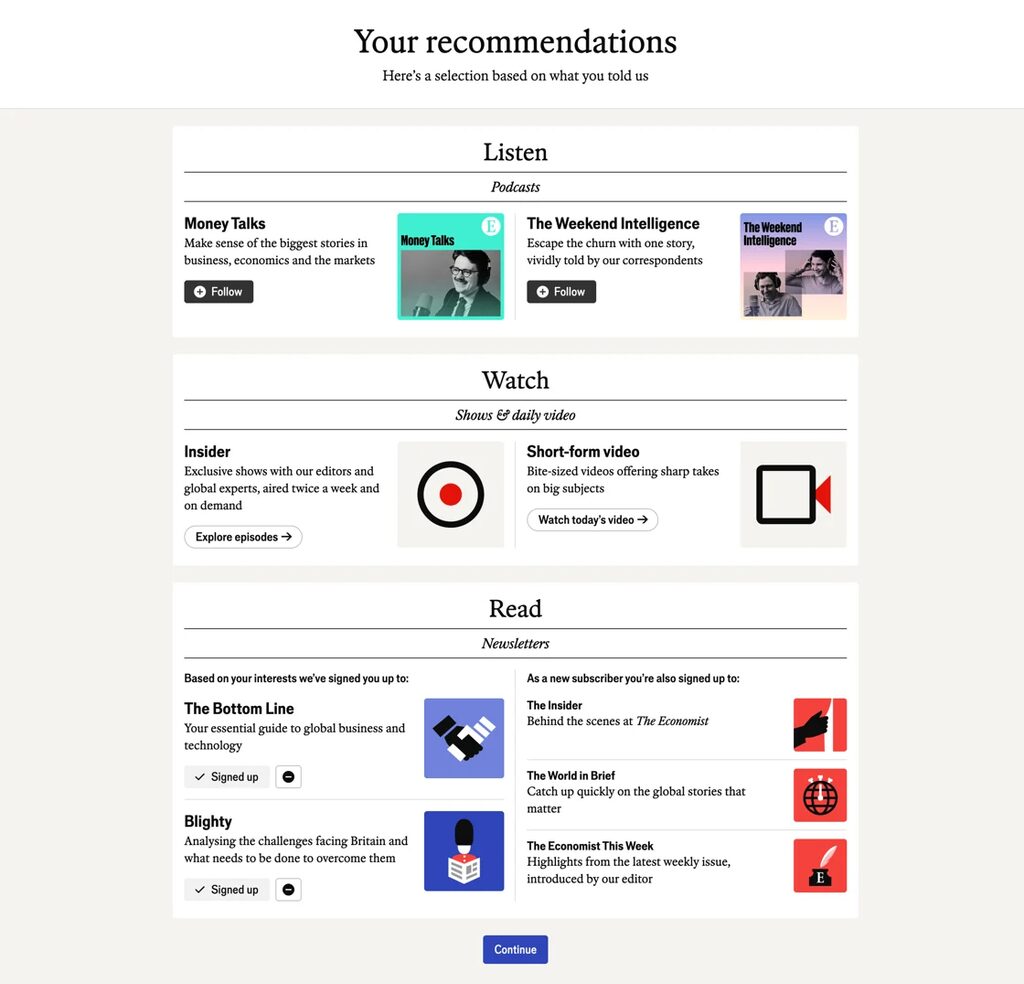
> New subscribers are asked about their interests, preferred format & when they usually consume content, with a final screen pushing the app
> This ticks off a variety of requirements for encouraging return visits. Holly Johnson of Condé Nast put this perfectly into a 5-part return trigger loop.
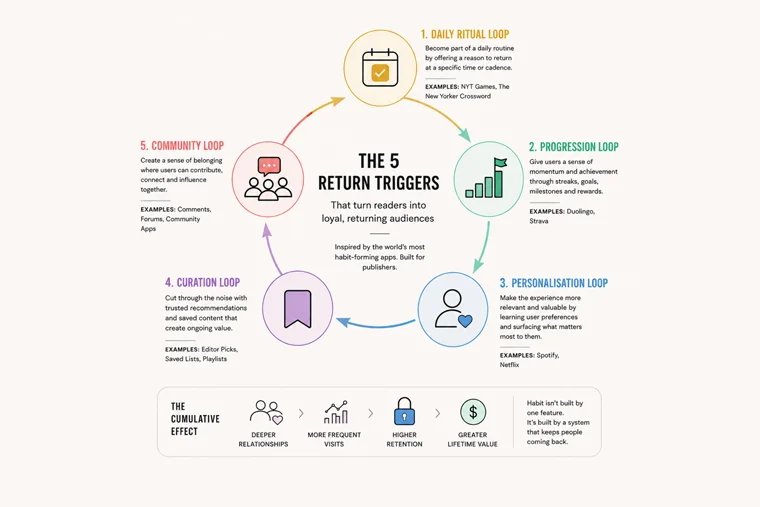
Importantly though, successfully encouraging audiences to return and build deeper relationships requires more than a single community product, such as comments. It should be the entire infarstructure of your product.
🇪🇸 FIPP World Media Congress is back in Madrid!
In its 101st year (!!) the FIPP team are back in Madrid this October 13-15th with an impressive 500+ senior media executives from around the world for three days of insights, innovation, and networking. Some of the sessions I’m looking forward to in particular:
- Getting Paid in the Age of Answer Engines: People Inc.’s AI Model
- From the BBC to Specialist Media: The Next Evolution of the User Needs Model
- How HBR Is Turning Audience Focus into Growth
- Pivot to Premium: Taking Subscriptions Upmarket with The Economist
Use the code AUDIENCERS! for 15% off at checkout here
See you there?
How newsrooms can learn from failure without failing in public
Journalism has to be right the first time. Product work learns more from what doesn’t work.
Frank Bi, AI Strategy and Product Advisor at Hacks/Hackers, argues that when products are held to the journalistic bar, nothing half-baked ever launches, so nothing ever teaches you anything…
So how do you hold the line on credibility while building products you’re willing to let fail?
> Build a public sandbox. A labelled subdomain (beta, labs) resets the expectations readers bring to the homepage while still producing real behaviour data. Frank launched the Minnesota Star Tribune’s AI restaurant guide Culinary Compass on the main domain instead, where readers judged a four-week experiment as a Star Tribune guide
> Set the end date before launch, ideally by picking something with a natural start & end. Frank’s Fair Bot ran only the 12 days of the Minnesota State Fair, so nobody ever had to make the call to shut it down
> Show your work. Newsrooms already have a practice for issuing corrections, so extend a version of it to experimental products and publish what the team believed and why, before that thinking disappears at launch
“We work in an industry that expects transparency from the people and institutions we cover. Holding the products we build to some version of that standard is a reasonable place to start, and it’s the part of the journalistic mental model that experimental products should look to keep.”
> Full article from Frank on Audiencers
Links to add to your reading list
- What publishers can learn from creators: be audience, not platform, obsessed
- Steal this strategy: paywall and subscription trends to test to increase conversion rates
- Wired launches new global app
See you in 2 weeks for our next newsletter,
Madeleine