

You're reading The Audiencers' newsletter #95 sent out on August 5th, 2026. To receive future newsletters straight to your inbox every two weeks, sign up here.
In today’s newsletter:
- A little Audiencers website refresh is happening ✨
- How the team at Funke Media make better decisions with a KPI tree
- Broadsheet is yet another publisher proving the value of registration in a subs model
- 🔗 Links to add to your reading list
✨ A little website refresh ✨
I don’t know about anyone else, but with fewer emails and no events, summer is always the best moment to dig into some of the projects that have been on the sidelines for months. For me, one such project has been to spruce up the website
The goal: to be as useful to you as possible
How: by helping to surface the right case studies, benchmarks and best practices when you need them, instead of having to dig through pages of articles
The solution (or at least one of them): a tidier menu, with a stronger focus on tools and community over articles

And something I’ve been dreaming of for a while, a filtered case study list 😍
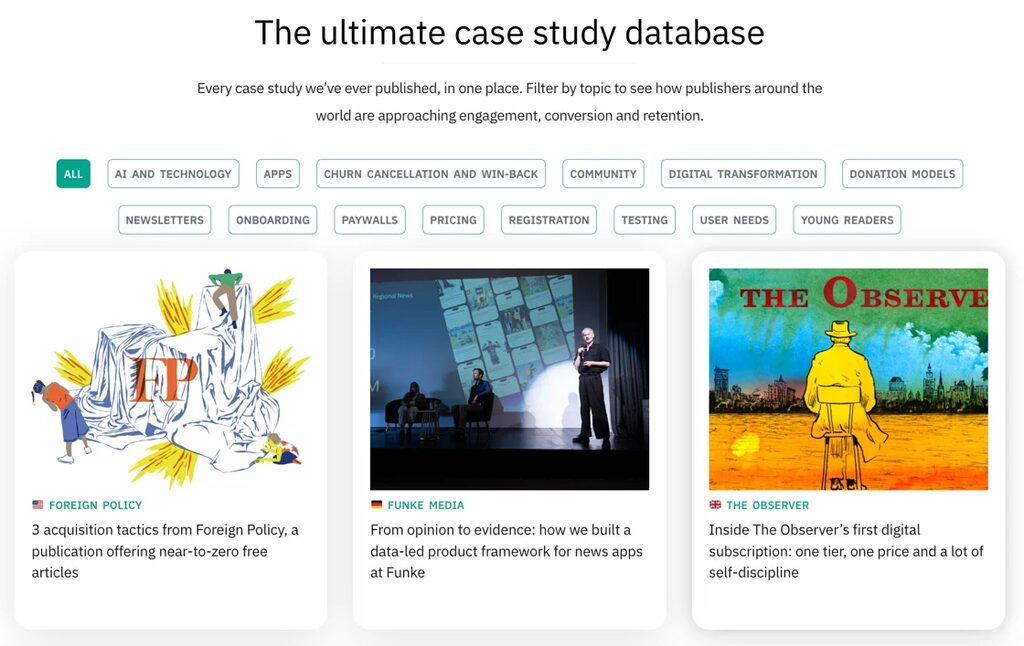
There’s still a lot of work needed to continue to build out these pages, and our products, but I’d really appreciate your feedback, thoughts and ideas already! Just hit reply to this newsletter:)
(And if you’ve been working on something that would make for a good case study to add to this database, I’d also love to hear from you!)
How the team at Funke Media make better decisions with a KPI tree
Product decisions at most news organisations get made by whoever’s loudest in the room, or by instinct built from experience. Stefan Schneiderbauer, Senior Product Manager, FUNKE, built a framework to replace that with more structured, evidence-led decision-making instead.
Introducing, the KPI tree:
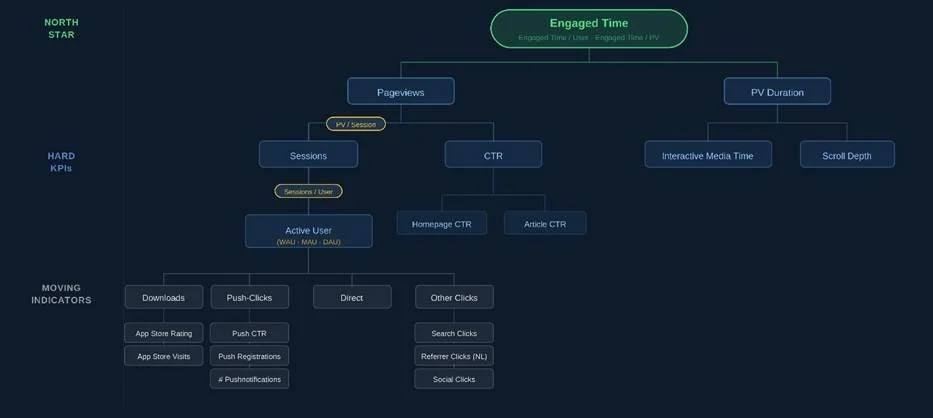
The goal is to ground product decisions in evidence, not to take judgment out of the process. And luckily for you, the tree is pretty easy to replicate in your team.
🌳 Start with one metric (not dashboard) at the top. Funke picked Engaged Time, then broke it down layer by layer: what drives sessions, what drives active users, what drives new vs. returning. Each layer down gets more specific, until you hit a movable metric, one a single product decision can actually shift.
🔍 One of the most useful things a completed tree enables is simple calculation.
Once you have even a partial tree, you can start to model the relationships between metrics. Take any KPI in the tree that is influenced by two variables below it. Increase each of those variables by five percent in isolation and see what happens to the KPI above. Which one has the bigger effect? A basic sensitivity analysis like this tells you quickly where the highest-leverage opportunities are in your product, and where effort is likely to be wasted.
🏗️ Only after the tree exists, build the org around it. Funke’s four pillars (Reach, Engagement, Monetisation, Infrastructure) came directly from the tree’s branches
🚫 Don’t start with the whole tree. Stefan’s advice is to instrument one branch, show your team what it reveals, and let that build the internal case before you expand
> Find Stefan’s full piece here, originally shared at Audiencers’ Festival London
Broadsheet is yet another publisher proving the value of registration in a subs model
The team at Broadsheet, Australia’s leading cultural publisher, now with a London edition, chose to implement a registration wall a few months ahead of their subscription launch.
Aside from setting the tone for a value exchange and guiding product strategy, the goal of this strategy was to:
1. Unlock engagement features to increase user exposure to the upcoming paywall
2. Secure marketing permissions to establish direct communication channels which heavily influence later conversion to subscription.
Despite being in the early stages of the paywall rollout, Broadsheet data has already brought in key insights on user behavior, and the value of this model on the reader revenue funnel:
- Registration captures high quality readers: Superfans register at a rate 127x higher than casual readers, making them prime target for direct relationships
- Newsletters initiate the conversion journey: registered newsletter subscribers over-index on paywall hits by 10x compared to the average user
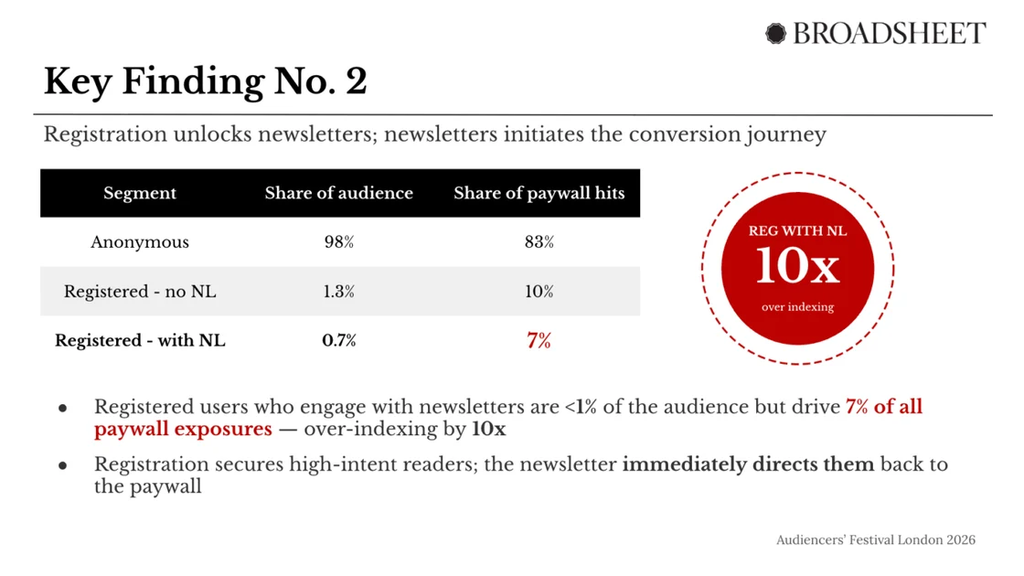
- The newsletter is the core conversion engine: a daily newsletter serves as an automated nudge that yields 3.5 paywall hits per unique visitor, a 35x higher exposure rate than anonymous readers.
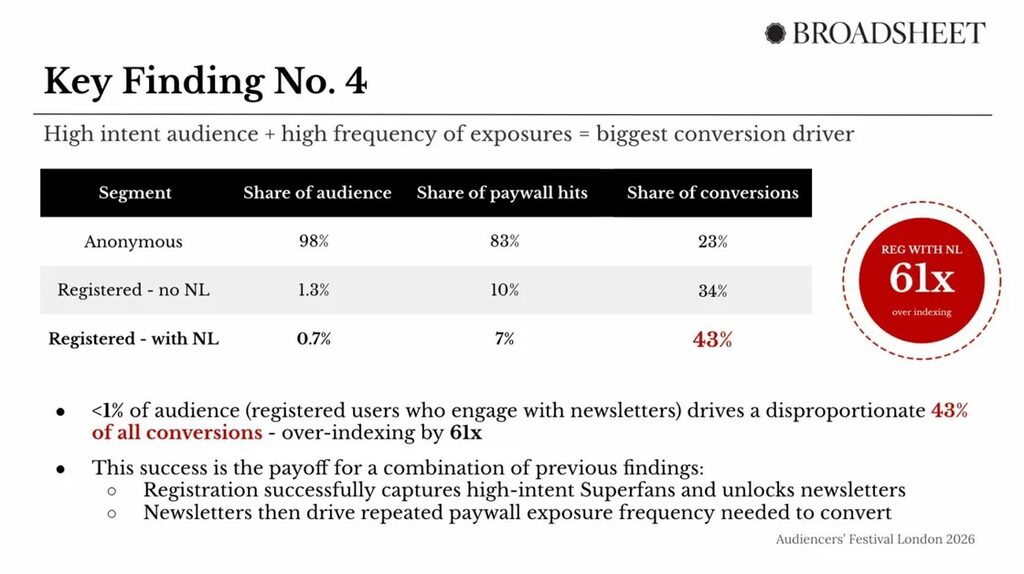
- The compounding effect drives the majority of subscriptions: the micro-segment of registered, newsletter-engaged users (just 0.7% of total audience) drives a massive 43% of all digital subscriptions (a 61x over-index).
- Registration unlocks direct offer emails: Registration captures critical marketing consent, enabling direct sales offer emails to convert warm leads. At Broadsheet, immediate sales emails successfully account for 18% of all subscription conversions
It’s certainly the kind of data that should encourage you to consider a registration wall strategy!
Links to add to your reading list
- The Observer UK, a 233-year-old title, launched its first-ever digital subscription. Jack Riley, Chief Customer Officer, explains why simplicity beat segmentation at launch, and why the hardest part hasn’t been the tech.
- 3 acquisition tactics from Foreign Policy, a publication offering near-to-zero free articles
- In Sweden, VK Media has blended marketing and newsroom to increase its audience
See you in 2 weeks for our next newsletter,
Madeleine