You're reading The Audiencers' newsletter #97 sent out on September 2nd, 2026.To receive future newsletters straight to your inbox every two weeks, sign up here.
It’s September!? Hope you had a great summer and are surviving the return to work ok!
In today’s newsletter:
The next engagement shift: from strong products to experience systems
Why Hearst-owned SFGATE launched an app instead of a paywall, and called it “Friends”
Findings from the 2026 Media App report: super users, non-text formats and measuring the value of your app
🔗 Links to add to your reading list
The next engagement shift: From strong products to experience systems
The bridge connecting audience value to commercial value is experience, and many publishers are skipping it according to Dina Shatner, co-author of The Age of News Experience.
> A crossword, newsletter, live blog, or short-form video series can each create a strong experience. But strong product-level experiences don’t automatically add up to a strong outlet-level experience. Each may work well on its own while the audience still encounters the publisher as a fragmented collection of products
> Social platforms do this well: experience isn’t a feature added to the product. Experience is the product
What are publishers doing wrong then?
Publishers often move quickly from an audience goal to an output.
“We need to reach younger audiences” becomes “we need more vertical video.”
“We need stronger habits” becomes “we need a daily newsletter.”
What’s the solution?
The book introduces the AXR framework: audience > experience > revenue
AXR connects audience strategy to revenue through the experience layer. That layer defines the audience moment, the promise, how the product fits into a routine, and the behaviour it should create.
For example, “a daily video briefing for younger audiences” is still mainly a format description.
A stronger definition would describe the audience moment, why the briefing is worth returning to, what should follow it, and which elements, such as the host, pace, promise, or format, must remain recognisable across the sequence, beyond this particular item.
What’s different? Formats produce outputs. Experiences create behaviours. Repeatable behaviours (staying longer, returning more often, and moving to the next item) connect audience value to commercial value.
For Dina, the shift from strong standalone products to interconnected experience systems will mark a critical evolution in reader engagement and retention for media organisations.
Why SFGATE launched an app instead of a paywall, and called it “Friends”
Most publishers solve the reader-revenue question by drawing a line through their content. Some of it is free to access, some of it is paywalled. Hearst-owned SFGATE deliberately didn’t do that. Instead, the website stays entirely free, exactly as it’s always been, whilst their new app, focused heavily on relationship-building, is paid.
Introducing, “Friends of SFGATE”
> The name “Friends of SFGATE” beat “subscription” and “membership” in testing specifically because it read as warmer than a transaction but less formal than a cause people feel obligated to fund
> The offer includes pop-up newsrooms, live journalism events, California-themed mini crosswords, audio content and personalization options to match the app to a user’s interests
> Nearly 90% of readers who have taken the 7-day free trial so far have converted to paying Friends, an exceptionally high trial-to-paid rate relative to widely accepted industry benchmarks, though it’s still early days
> The North Star metric shifted from total visits to repeat visits: can a reader who showed up once be brought back a second and third time
> Of course, the move to subscriptions and relationship-building has required org change, not just a new app: a first-ever Community Engagement Program Manager role, a second video hire, and an existing editor with app experience redirected to lead app programming
Drawing on 440 apps and 140 publishers, The Pugpig Media App Report finds engagement is wildly concentrated. 15% of monthly users generate 75% of all sessions, and 6% account for 75% of screen views…
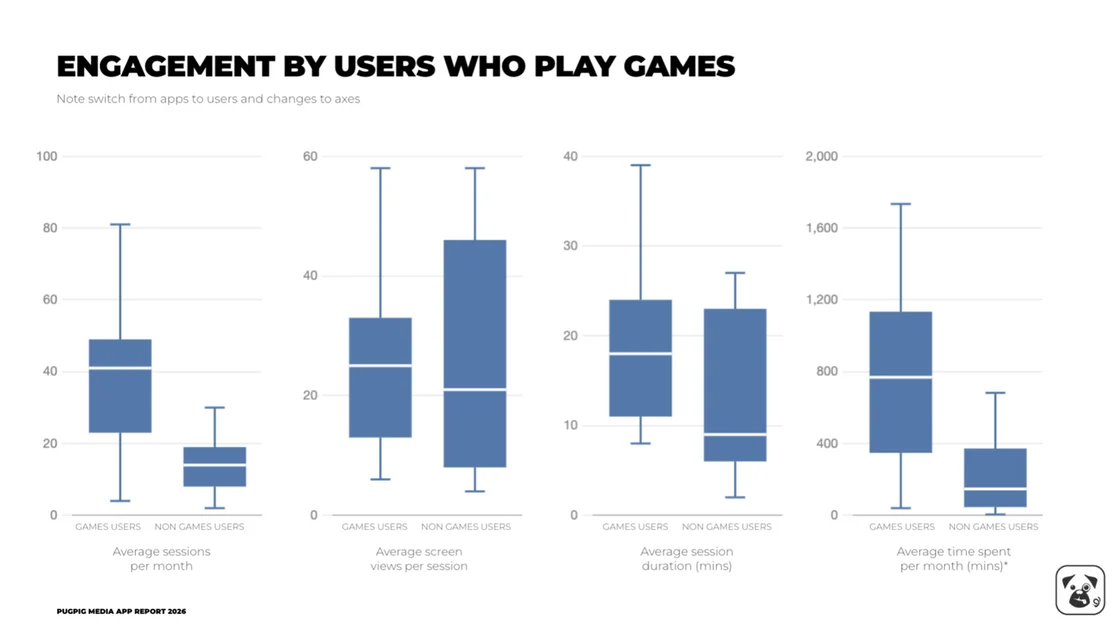
> Games, audio and video are the engagement multipliers. Game players open the app 2.7 times more often, video watchers spend 3.3 times longer in it, and audio listeners 2.5 times longer
Search, save and share tell a similar story.
> Between 11% and 94% of a news publisher’s subscribers open its app in a month. Yet only 26% of publishers say the app’s main job is acquiring subscribers
> Publishers agree on what matters: retention, acquisition, time spent. Far fewer can measure it consistently, which makes it easy for the app’s contribution to be undervalued internally
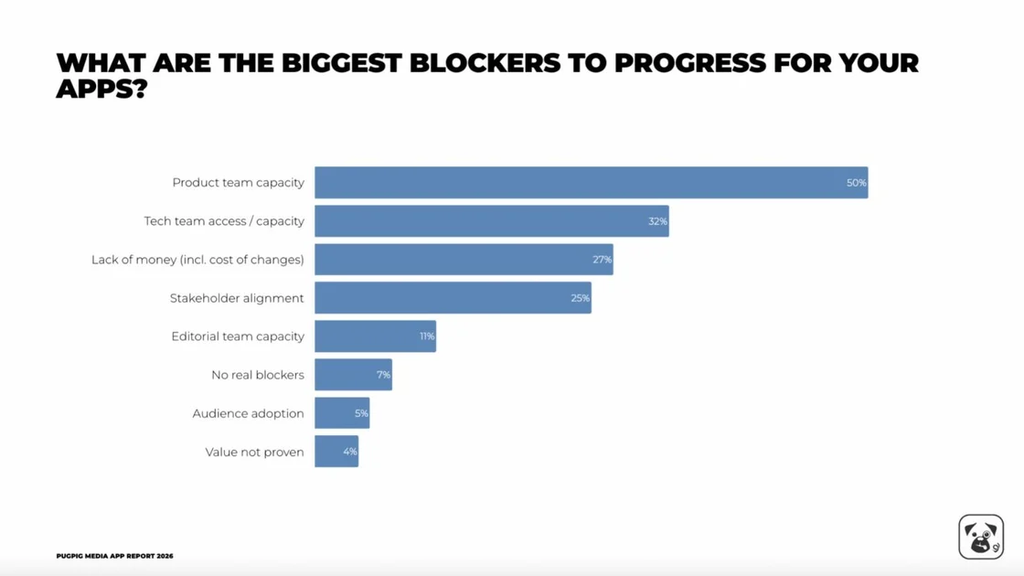
> The biggest blocker is not budget or technology. Half of publishers name product team capacity
But the best-performing apps are usually the ones publishers have consistently given time, resources and attention to, rather than those with technical sophistication.