

You're reading The Audiencers' newsletter #93 sent out on July 8th, 2026. To receive future newsletters straight to your inbox every two weeks, sign up here.
After a packed-to-the-brim month of events, and more networking than I thought was possible in such a short space of time, I’ve resurfaced with a (surprisingly?) positive outlook for the industry. Conversations and recent articles are increasingly agreeing with the necessary direction that the industry needs to take. The connection economy, the community era, whatever we call it, the priority today should be about building relationships with audiences.
So, in my enthusiasm for the topic, it’s taking over today’s newsletter:
- The traditional attention economy is being replaced by a connection economy
- Is frequency the most concrete, easily-measurable metric to build these relationships?
- What does this all look like in practice? How Financial Times already prioritises belonging
- Don’t just take our word for it: other useful links on the topic
The traditional attention economy is being replaced by a connection economy
Back in March, at our Festival in Hamburg, Heiko Scherer, CEO and co-founder of tchop, took to the stage to discuss belonging, advocacy and trust, and how you define, measure and build relationships that last.
What was clear from the conversation was that the traditional attention economy is being replaced by a connection economy. Reach & traffic are now merely necessary, surface-level foundations rather than the end goal. Instead, publishers should be moving towards belonging, measured by return, participation and sharing.
The challenge with these connection metrics is that there are such a wide variety of definitions, as well as emotional and functional layers of a reader’s relationship with a brand.
For Heiko, it could look something like this:
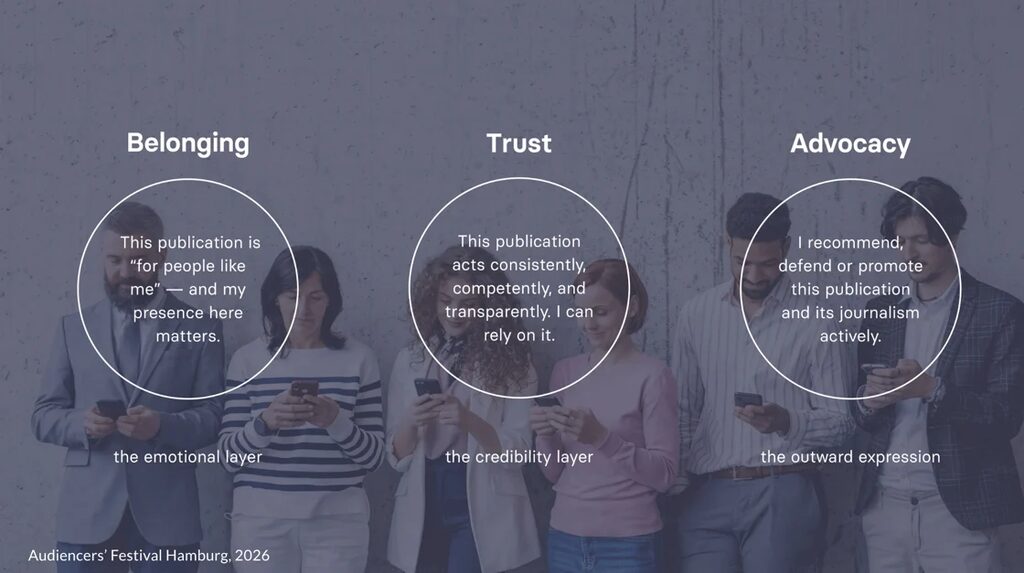
But these types of metrics pose interesting questions about measurement and optimisation…
Is frequency the most concrete, easily-measurable metric to build these relationships?
Whilst belonging, advocacy and trust are hard to define and measure, RFV (Recency, Frequency, Volume) has been a customer-analytics staple for decades. Recency tells you when someone last showed up. Volume tells you how much content they consumed while they were there. But of those three letters, frequency is the one that quietly does the heavy lifting, because frequency tells you whether you have a business.
Frequency is the metric that tracks habit formation, that signals brand loyalty. It’s the leading indicator of customer lifetime value, registration propensity, and subscription conversion. And in an environment where AI is steadily eroding the casual, search-driven visit, frequency is the only metric that compounds in your favour.
What’s more, in an era where AI can summarise, paraphrase and serve without ever sending a click your way, content is increasingly a commodity. Community, however, is not. This is where Frequency lives.
AI can’t replicate the experience of debating a local election with your neighbours in a comment thread moderated by your newsroom. It can’t replicate a live Q&A with the reporter who broke the story. It can’t replicate the feeling of being recognised, replied to, and known by a brand you trust.
When publishers invest in community-building experiences like these, readers stop coming back for the content alone. They start coming back for the conversation. This shift is what Mark Zohar, President & CEO of Viafoura, calls the Frequency Loop.
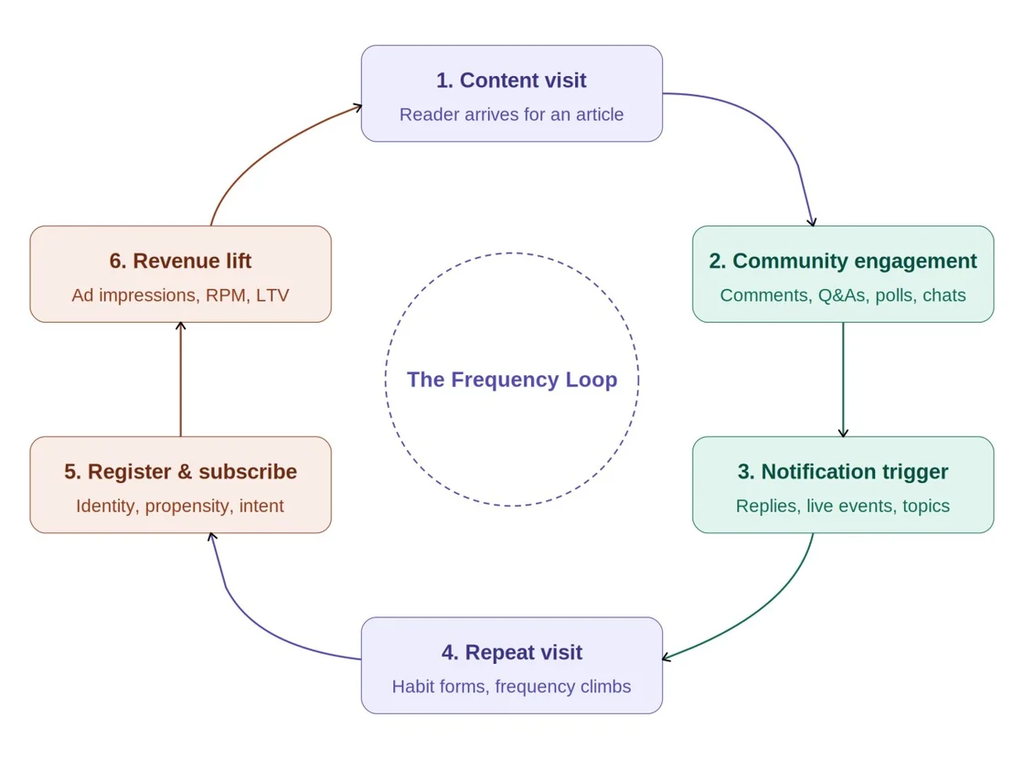
Readers come for the content > they stay for the conversation > they get notified of replies and live events > they return > they register > they subscribe. Every loop tightens the bond, increases the visit count, and unlocks more revenue per user.
As Mark highlights, whilst AI is going to keep getting better at answering questions, it’s not going to get better at being a community. It’s this asymmetry that provides the single largest strategic opening for publishers right now, and frequency is the metric that tells you whether you’re walking through it.
So the next time your board asks how you’re future-proofing the business against AI disruption, don’t show them a traffic chart. Show them your frequency curve.
What does this all look like in practice? How Financial Times already prioritises relationship-building
Lucy Alexander, Director of Analytics & Insights at FT, described how belonging, trust and advocacy sit at the center of the brand, and importantly, are business drivers:
- 58% of subscribers chose the FT specifically because they needed a reliable news source they could trust
- 15% of readers start their journey with the FT through articles shared on ft.com
- Another 11% of new readers begin consuming FT content based on direct recommendations from friends or colleagues.
How is the FT building belonging, trust & advocacy?
> The shift from physical to digital advocacy – historically, the physical pink newspaper served as a visible, integral part of reader advocacy, acting as a badge of identity. As the industry shifts, the FT is replicating this “outward expression” through digital means:
- The emotional layer: Advocacy is defined as the “outward expression” of a reader’s relationship with the brand.
- Signaling identity: Readers share FT content because it “signals who I am” to their professional and social networks.
> Strategic “Trusted Voices” – to deepen this advocacy, the FT launched the Trusted Voices marketing pilot in 2025.
- Personal branding: By elevating individual writers and creating personal brands, the FT encourages readers to defend and promote specific journalists, which in turn reinforces their loyalty to the parent publication.
- Broadening inclusivity: Initiatives to make the FT feel less like a “gendered entity” (moving from 80% male in 2016 to 92% non-gendered perception in 2025) have been essential in making more people feel they belong, thus empowering a more diverse group of advocates.
> Cultivating “evangelical” communities – the FT fosters advocacy by creating spaces for “authentic” and “nerdy” interactions that go beyond standard corporate communication.
The FT Alphaville section for instance has developed a core of evangelical fans by maintaining an authentic tone that appeals to readers on a personal level.
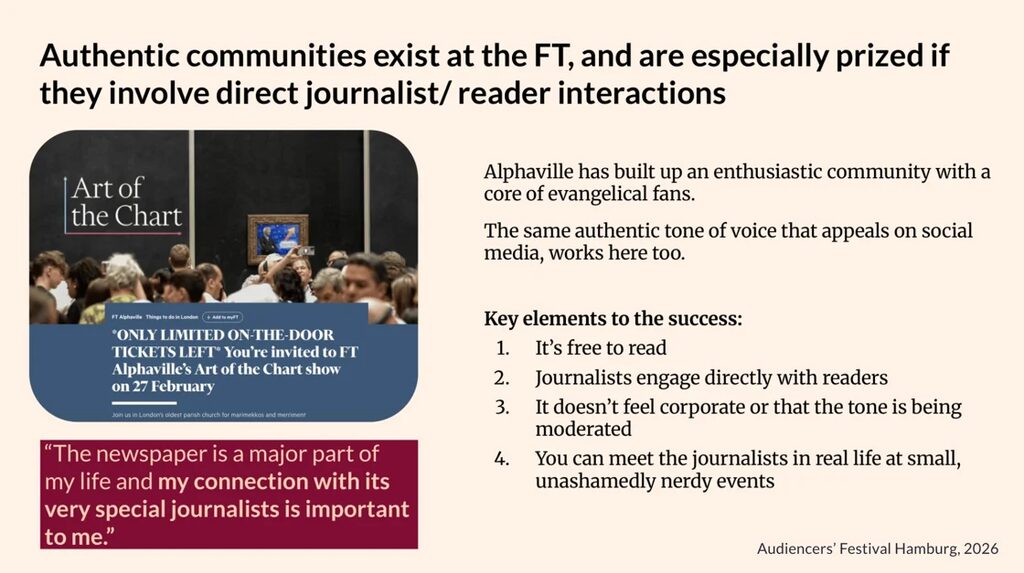
These micro-communities focus on specific niches where belonging forms most naturally.
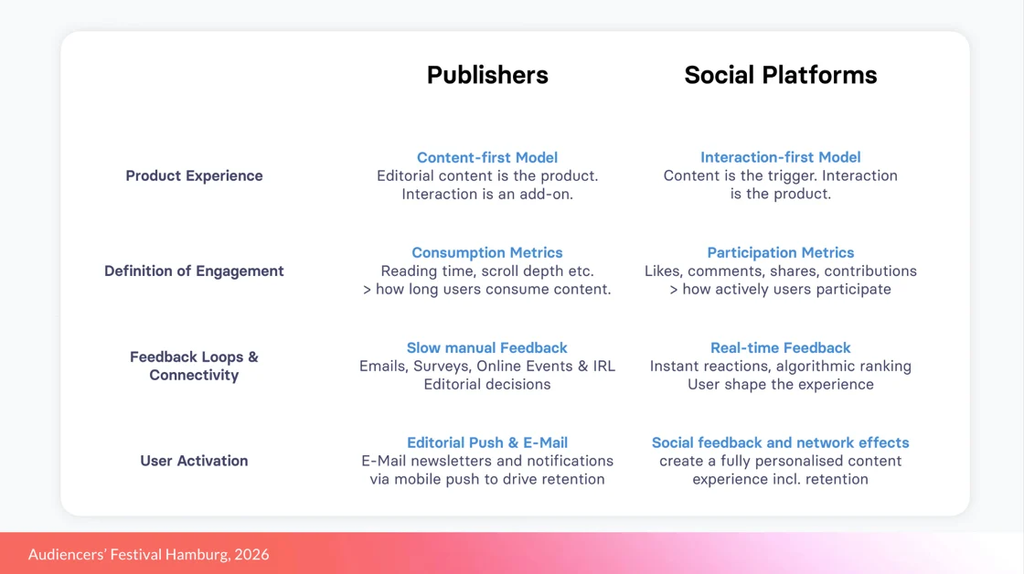
Ultimately, whilst content is the trigger, interaction and participation are the product. Looping back to Heiko’s discussion, it’s in this area that we have a lot to learn from social platforms.
Don’t just take our word for it…
Other links on the topic of trust, advocacy and belonging:
- The rise of explainers as an audience growth strategy: CNN, Bloomberg, Vox and the Financial Times are proving that helping audiences understand complex issues can drive engagement, trust, and sustainable business growth
- In Spanish: ‘La confianza no se automatiza’: humanización del periodismo para fidelizar audiencias
“At The Athletic, individual journalists are usually the main point of contact with readers. In a subscription model, trust is built directly with the reporter as much as with the publication. That’s why we don’t see personal brands as something to resist. Our approach is to align them with the strengths of the company,” – Claudio Cabrera, Vice President of Audience.
See you in 2 weeks for our next newsletter,
Madeleine