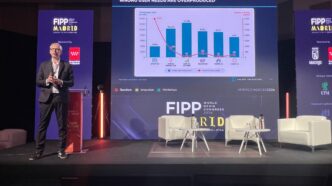
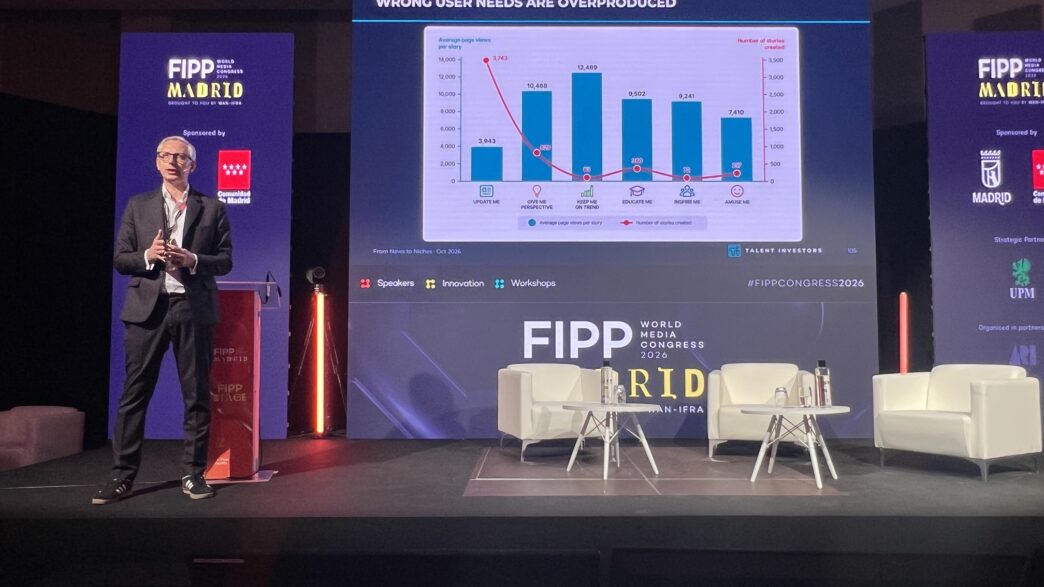
The stories newsrooms publish most are, article for article, the least effective, and Dmitry Shishkin thinks the fix starts with how publishers commission.
Ten years after a piece of BBC audience research turned into the user needs model, its architect used his FIPP Congress slot in Madrid to argue that most publishers still get this the wrong way round. Shishkin, now an independent consultant after senior roles at the BBC, Culture Trip and Ringier, told the audience that topic and format are only two of publishing’s three pillars. The third, the reader’s motivation, drives subscription and loyalty metrics, and most newsrooms still leave it to instinct.
> Article for article, "update me" pieces underperform every other user need, yet newsrooms produce more of them than anything else

> Tag every piece with three things: the subtopic (personal finance, not just finance), the format (Q&A, feature, listicle, data-led) and the single user need it serves. Then commission on all three

> One dominant need per piece. An article that tries to serve every need gets a headline that can only sell one, so most readers never discover the rest

> Don't let the newsroom write its own user needs model: take the needs from audience research. At Ringier, across five countries, conversions, subscriptions and loyalty metrics all increased once teams moved to the model
Measure the angle as well as the story
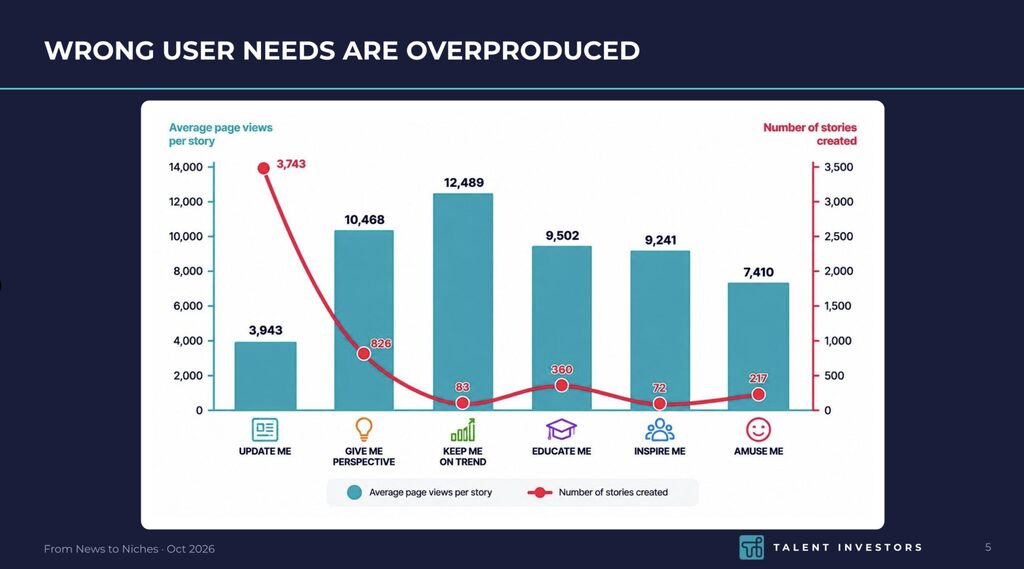
The point, he said, is that publishers have always measured stories, and occasionally formats, but almost never the angle of the storytelling. Once you make the angle measurable, you can make editorial choices about it. “It’s not about what we’re going to cover. It’s how specifically we’re going to cover the story.”
He said the pattern has held in every piece of research since, and the gains aren’t confined to engagement. At Ringier Media International, where he oversaw five countries, every team moved to the model, and conversions, subscriptions and loyalty all went up.
> To read next: How the user needs model increases engagement
The everything article is the weakest article
A natural reaction to the chart is to write pieces that satisfy several needs at once. Shishkin argued the opposite. A piece that tries to update, explain, inspire, and help in one go might seem comprehensive to the editor, but its headline can only promise one of those things, so most potential readers never discover the rest. His rule is that every piece should be dominated by one need. Content built this way, he said, consistently outperforms the general piece that has “a lot of user needs in mind, but not one is dominant”.
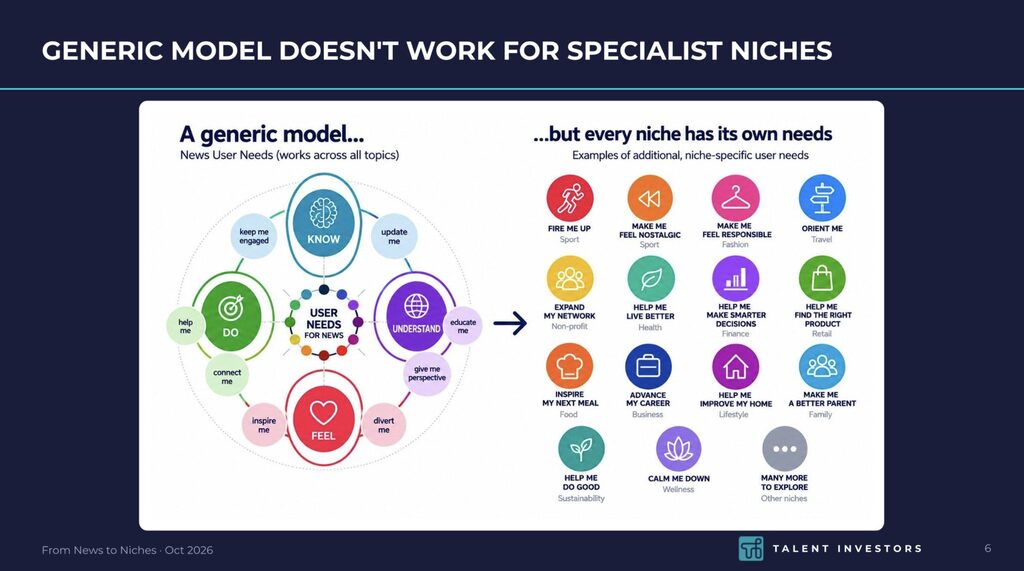
The generic model has four areas (know, understand, feel and do) and eight needs within them. Specialist publishers should not stop there. Sarah Marshall built a fashion version at Vogue; Shishkin built a travel model at Culture Trip; ten months ago he and the analytics firm smartocto published the first sports model. Retail, finance and health, he suggested, are still open. Needs such as “help me advance my career” or “help me find the right product” belong in the publication model that serves them.
Three tags, and a different commissioning meeting
For publishers who want something to implement, Shishkin reduced structured data to three fields. First, the subtopic: “finance” is not enough; the tag has to say personal finance or corporate finance. Second, the format, which he was emphatic is not audio, video or text. Those are content types. Formats are the roughly ten shapes a story can take regardless of medium: Q&A, feature, listicle, data-led piece and so on. Third, the user need.
The commissioning conversation then changes. Using a motoring publisher as a worked example, he listed six ways to cover one car launch: explain it to me, help me decide, protect me, price me, show me how, update me. A publisher might concede “help me decide” to a rival and concentrate on “show me how”.
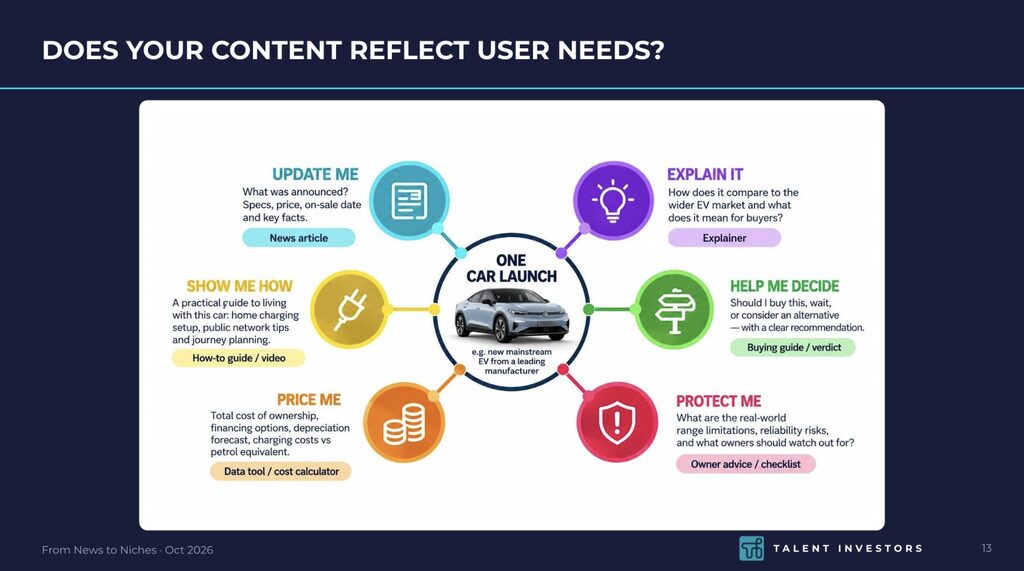
You can use the same tagging to test a mission statement. Most Chief Executives say their publication exists to explain the world, so the share of output tagged “explain to me” should be high. “If your journalism is only 20% explain to me, then your mission statement is wrong.”
Who owns the model
The most pointed line of the session was that newsrooms should be prohibited from writing their own user needs model. A newsroom that sets its own needs and then maps its own output to them is grading its own work. The needs have to come from audience research.
That matters commercially because the model is, in his phrase, the shortest way to unite an organisation. When product people and journalists call the same thing by different names, each quietly stops believing the other. At Culture Trip, his first act was to put senior editors and product managers in one group and get them to agree on the names of things.
Once the vocabulary is shared, product can act on it. If every vertical is producing “inspire me” content, a product manager can bundle it across sport, news and food into one proposition and sell it differently. The harder prerequisite is normalising data across the CMS, email, CRM and video tools; without a single source of truth, any editorial argument can be rebutted with a different dashboard within five minutes.
Beyond content
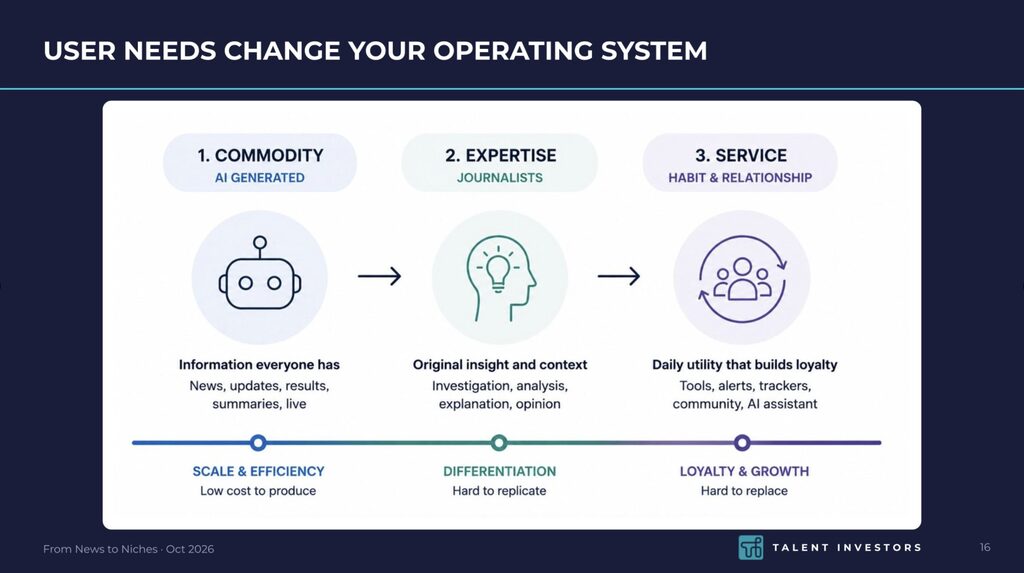
Two closing arguments bear on retention. First, “commodity content”, the material everyone has and nobody enjoys making, should be automated so that human time goes on original work; most publishers have that balance the wrong way round. Second, content alone will not sustain a relationship. “You need to be helpful to people.” His example was a two-person cycling title that maps Tour de France climbs so readers can plan their own rides. Every niche, he argued, needs a utility like that.
He expects AI agents to do the retrospective analysis, scanning a year of output for underserved combinations of need, subtopic, and format.
How to try it
Shishkin’s advice is to start small: pick one title, section or subsection, and work through four steps.
- Ask what needs your audience has. Take them from audience research, not from the newsroom.
- Check whether your content reflects those needs.
- Check whether your taxonomy captures it. A tag that says only “finance” cannot show which kind of finance story is working.
- Analyse your existing content retrospectively against those needs, then start optimising.
For a large portfolio, the prize is cross-vertical bundling that product teams cannot build today. For a single specialist title, it is a defensible position on one or two needs a competitor has left open. His closing question applies to both: if you disappeared tomorrow, what would change in your audience’s life?