
You're reading The Audiencers' newsletter #94 sent out on July 22nd, 2026. To receive future newsletters straight to your inbox every two weeks, sign up here.
It’s mid-July and I feel like I’m mainly speaking with automated OOO replies 😅 Still, the newsletter goes on! At the very least, I hope it helps you to catch up once you’re back!
In today’s newsletter:
- Information fatigue: why Les Echos are betting on « La Sélection » rather than unlimited access
- Why 1.4 million people pay The Guardian for something they could read for free
- Before you bundle: how to find out what your subscribers actually want
- 🔗 Links to add to your reading list
P.S. If you’re an avid Audiencers’ reader and have a bit of time to spare over summer, I’d love 15 mins of your time to improve on what we do! Just reply to this email and we’ll find a slot:) Thank youuu!
Why Les Echos are betting on “La Sélection” rather than unlimited access
How do we deal with information fatigue?
With research suggesting that consumers are becoming increasingly more overwhelmed by too much information, the question is an important one for an industry selling access to it.
At the French daily business newspaper, Les Echos, the answer isn’t unlimited access, but a daily, deliberately limited but highly curated “selection” subscription offer.
“La Sélection” rests on three core criteria.
- Balance: the goal is no longer breaking news at all costs (others do breaking news better than Les Echos), but information that is useful for understanding the world and taking a step back
- Calm: plural voices and op-eds, but grounded in evidence-based, balanced arguments
- Impartiality: the title’s historic value
These break down into three guiding axes:
- Reason over ideology: an economic DNA that calls for a rational, almost mathematical reading of the world
- Optimism over fatalism: giving room to success stories and to solutions that work
- Ambition over declinism: investigations and analysis to handle professional and personal challenges
On the production side, it is a genuine editorial discipline, run by a dedicated team (two full-time journalists, according to our information). Each day, the newsroom produces between 120 and 150 articles; this team selects 9 to 15 of them, spread across a reader-needs grid (inform, reflect, get inspired, develop, unwind) with fixed quotas per category, several times a day. Concretely, “develop” accounts for around 20% of topics, while “get inspired” and “unwind” are capped at 10% each.

> Find the full article on Audiencers, and come back in a few months for the first results!
Why 1.4 million people pay The Guardian for something they could read for free
When you’re working to continuously optimise your paywall strategy and sell access to content, it’s crazy to think about how The Guardian has convinced 1.4M to pay when anyone can read it, whether they pay or not.
But even if you’re a paywalled publisher, Emilie Harkin, SVP of Growth, reminded us at the Audiencers’ Festival in Montréal that access doesn’t need to be the thing you’re selling. For The Guardian, it’s their story of ownership.
> The organisation’s value proposition comes down to three words – global, independent, free. Owned by the Scott Trust, their sole purpose is to ensure The Guardian can keep publishing. It’s this that’s sold to readers.
> One email, built entirely around that pitch, generated $2 million!… When The Washington Post and LA Times pulled their 2024 election endorsements, The Guardian sent readers a simple message – we published ours, and always will, because no billionaire can tell us not to.
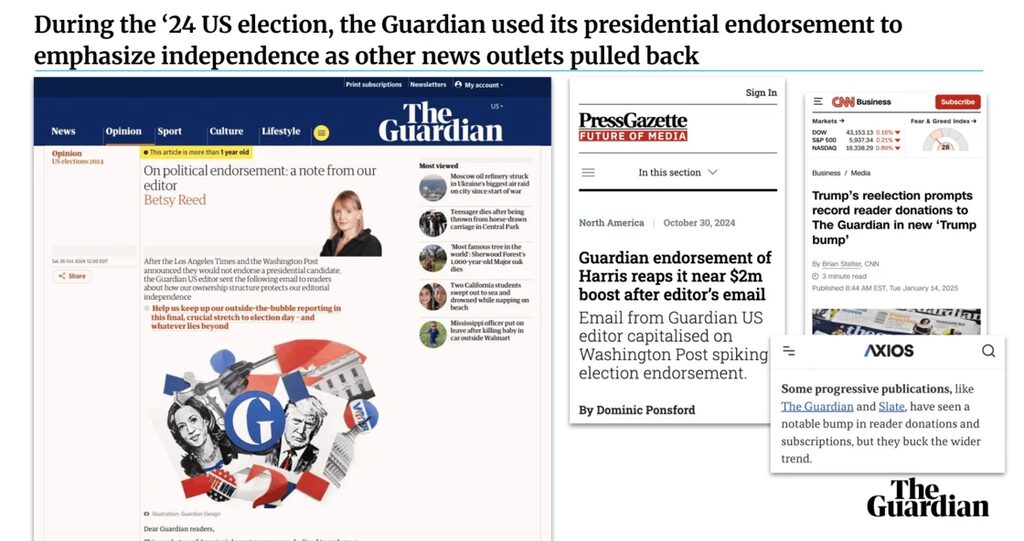
> But it’s the method that’s worth noting rather than the moment: The Guardian surveys readers right after they give, with the goal of understanding supporter motivations. The top answers include protecting the free press, editorial independence, or the journalism itself.
> These surfaced motivations don’t just become a slide that’s presented once to the team, they’re used to build every single message that asks for support. They keep telling the story, deliberately and repeatedly.
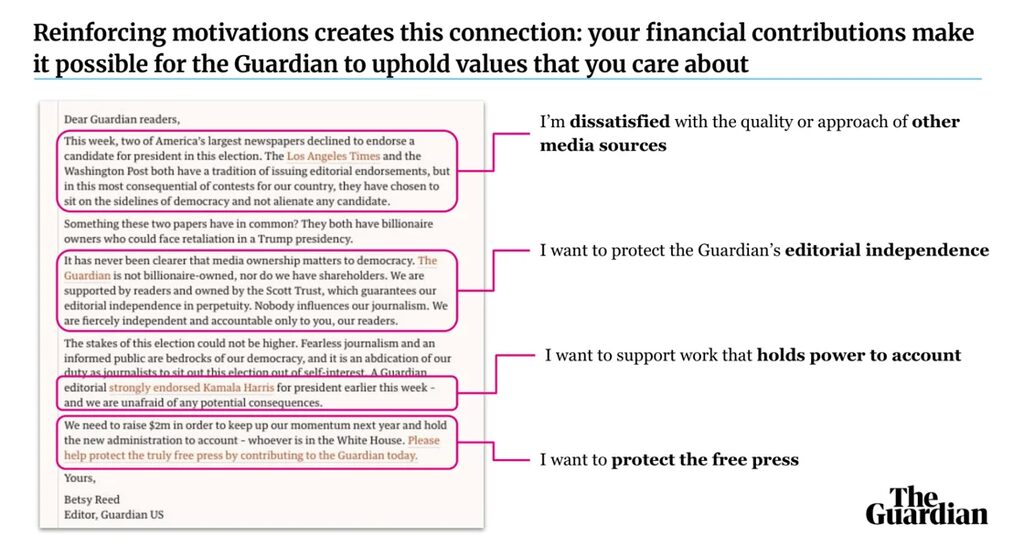
Thanks to this blend of mission + motivation + benefits, people don’t pay for access, they pay to support The Guardian’s story.
For The Guardian, the story is ownership. For your publication, it might be something else entirely, a specific beat, a founding mission, a community it serves. One method Emilie shared is to survey people right after they convert while the reason is still fresh. You can then build your marketing copy around what they tell you, something that works regardless of what that story turns out to be.
> Find the full summary on Audiencers
Before you bundle: how to find out what your subscribers actually want
When you start testing value props and benefits, it’s easy to mix and match features, and try to cram everything onto one page to make subscription “worth the cost”…
But as audience research leader Emily Goligoski and Rachel Mines, Director of Subscriptions at Skift, shared at Audiencers’ Festival Montréal, research has proven that the biggest driver of loyalty isn’t usually price or feature count. It’s a sense of uniqueness, something the reader couldn’t get anywhere else
🔍 Your team can answer this easily, but the real value comes from asking the same questions of the people you’re trying to reach. Emily said that, at a minimum, show your prototype to one more person than has seen it already. You’ll walk away smarter from even one conversation, and people will even thank you for simply asking for their perspectives.
🧩 Once you know your differentiation, packaging decisions get easier. Rachel’s 3-question test before bundling anything: does it strengthen or dilute each product’s identity? Are the audiences actually converging? Can your ops hold it together without the seams showing?
✋ Sometimes the research tells you to do nothing. One of Skift’s four products stayed untouched, on purpose, and it’s now one of their steadiest, best growing subscriptions.
> Full session from Emily and Rachel on Audiencers
Links to add to your reading list
- The Publishers’ Tech Stack Study: findings from the 2026 survey
- The reality check of user needs: “Update me” drives most demand for news
- How publishers are winning back the direct reader relationship
- In Spanish: Los medios tienen audiencia, pero no siempre comunidad: cómo activar a los lectores que siguen las noticias en silencio / The media has an audience, but not always a community: how to engage readers who follow the news silently
See you in 2 weeks for our next newsletter,
Madeleine