

You're reading The Audiencers' newsletter #89 sent out on May 13th, 2026. To receive future newsletters straight to your inbox every two weeks, sign up here.
Hope you’re having a great week! Here in France, May is a weird one as we have an impressive 4 bank holidays (!!) meaning I’m getting pretty used to 4-day weeks 😅 But this is a good moment to relax before a busy June:
- 1-3rd June, Marseille: WAN-IFRA World News Media Congress (Use code AUDIENCERS200 to get €200 off your ticket) and join our dedicated Audiencers’ group if you’re already signed up
- 11th June, London: Audiencers’ Festival (feat. WIRED, WashPost, FUNKE, Ringier, The Economist & more)
- 25th June, Montréal: Audiencers’ Festival (feat. Skift, Postmedia, Les Coops de l’info, The Guardian & more)
Hopefully see you at one of these events!
On to today’s newsletter:
- The reader who left your article early might be your most engaged (and most valuable) user
- Amedia ignored older subscribers to attract younger ones
- If you needed another reason to implement an on-site onboarding journey…
- 🍾”Pay what you can” campaign wins big at INMA
- 🔗 Links to add to your reading list
The reader who left your article early might be your most engaged user
We have more engagement data than ever, and still struggle to agree on what engagement actually means.
The tools aren’t the problem, it’s the assumption behind them -> that engagement is just one thing, and the more of it is better.
But engagement isn’t one thing. It’s the outcome of different reader behaviors, driven by different motivations.
Think about how you consume news. Some mornings you want a quick overview. Some evenings you want to go deep. Sometimes you’re browsing. Sometimes you want distraction.
These aren’t different readers. They’re the same reader in different situations, with different needs.
A short session can mean the reader got exactly what they needed. A long one can mean depth, or friction. High article counts can mean curiosity, or confusion. The same metric means something different depending on what the reader was trying to do. Without that context, you’re pattern-matching on behavior you don’t fully understand…
> The brilliant Regula Marti dissects the topic on Audiencers, sharing her recommendation on what this means for measuring engagement.
Amedia ignored older subscribers to attract younger ones
“You become what you measure.”
In other words, a team becomes an expert in the art of satisfying the audience that shapes its metrics. It’s what Janne Rygh, editorial content developer, and the team at Amedia reminded themselves of when seeking to engage and convert younger audiences.
For them, older subscribers made up the majority of the subscriber base and therefore dominated the dashboards. They were, in effect, the ones who ended up defining what was considered high-performing content.
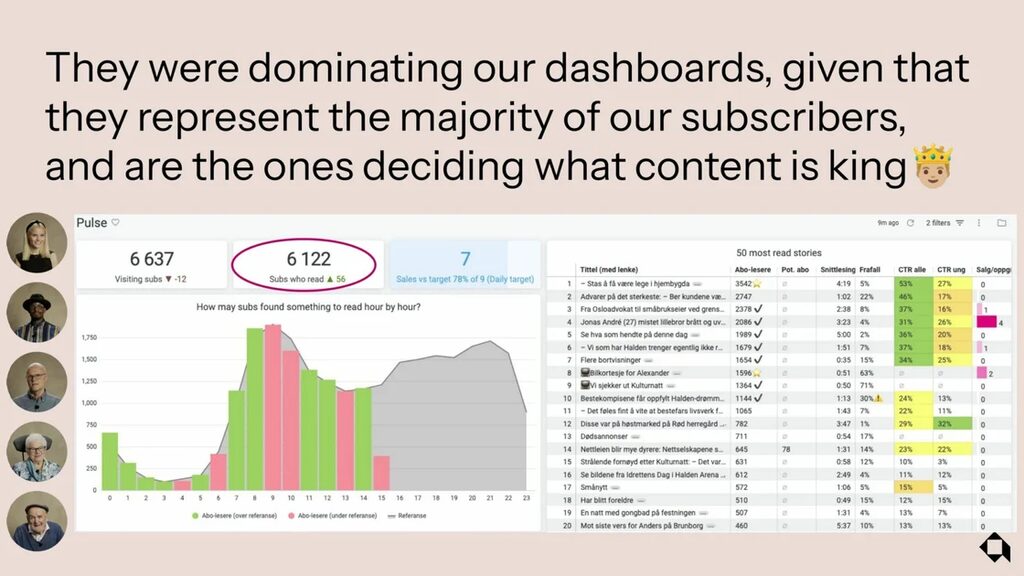
The solution: making 90% of subscribers invisible in analytics tools
The group isolated metrics focusing exclusively on readers under 40, which effectively made 90% of subscribers invisible in dashboards.
The goal:
> To better understand the preferences of young readers
> To adapt editorial content based on these insights, in order to increase engagement and subscriptions among this target audience
Some key lessons:
> Targeting readers under 40 isn’t just about adding a few peripheral pieces of content “for young people.” At Romerikes Blad, the editorial team has thoroughly reviewed its working methods and the topics it considers priorities.
> This refocusing hasn’t driven older readers away. By focusing more on concrete topics that resonate with young adults, Amedia didn’t create a more niche product. On the contrary, the group improved the overall relevance of its journalism.
The results:
> At Romerikes Blad, one of the titles participating in the experiment, the segment of subscribers under 40 grew by 30% in nine months. There was also an overall increase in readership and a significant boost in subscriptions, driven in particular by content targeting young audiences.
If you needed another reason to implement an on-site onboarding journey…
At L’Équipe,
- Simply being exposed to this onboarding journey reduces churn by 7 points after one month
- Completing the onboarding journey while also activating an action (turning on alerts, signing up for a newsletter) reduces churn by 20 points at M+3
- And the more micro-conversions a subscriber completes in those early weeks, the less likely they are to leave
🍾”Pay what you can” campaign wins big at INMA
A special mention and congratulations to Marc Gendron and the team at Les Coops de l’information who won first prize for “Best Initiative to Grow Subscriptions” at INMA’s Global Media Awards!
Their “Pay what you can” campaign, which lowered the barrier to local news while reinforcing the value of independent, cooperative journalism, led to a 4.2% increase in subscribers, 86% of whom had never subscribed before.
Links to add to your reading list
- What The Guardian, Denník N, Uusi Juttu and Kyiv Independent told Perugia about reader revenue
- “The next phase of subscription growth will depend less on tightening paywalls and more on expanding reach, building emotional relationships with audiences, and better serving super users.” – INMA Berlin
- The first 100 days: why most of what we call retention is really just micro-conversions (again)
See you in 2 weeks for the next newsletter,
Madeleine