

You're reading The Audiencers' newsletter #87 sent out on April 15th, 2026. To receive future newsletters straight to your inbox every two weeks, sign up here.
In today’s newsletter:
- The New York Times launches new community features: commenting is bringing reporters closer to their audience
- Gamifying loyalty at Mexico’s Milenio: giving points for engagement
- The pricing page we’ve all built at least once: should we move away from the classic 3-column subscription offers page?
- 🔗 Links to add to your reading list
The New York Times launches new community features
By Kaiden Chandler, Editorial Design & Product Associate, The Ithaca Times
The New York Times has rolled out new commenting features, part of a growing trend toward using reporter interaction to strengthen relationships with readers.
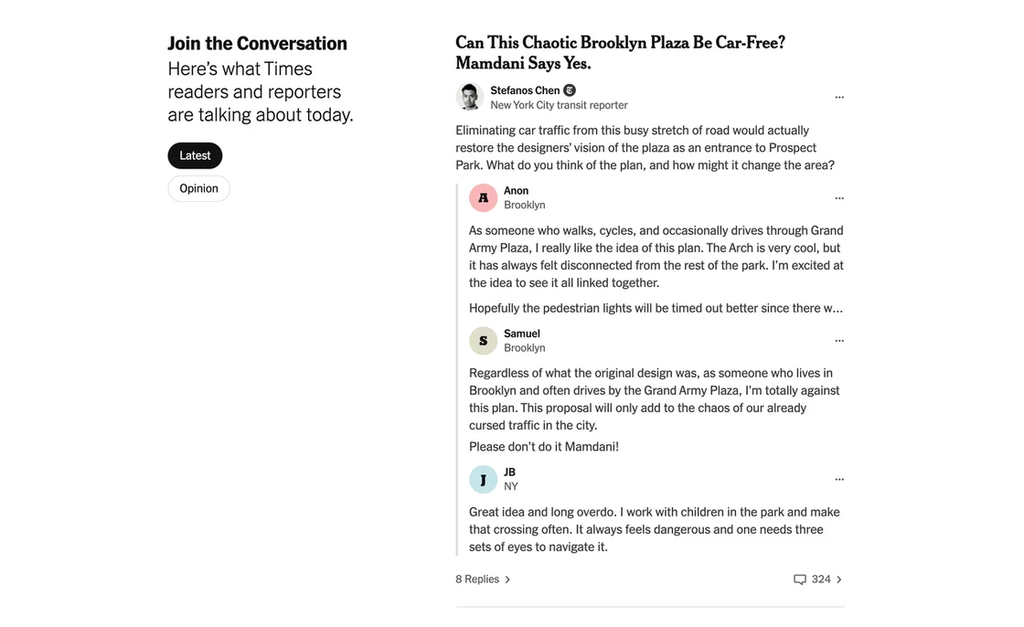
The biggest update for the Times is a new comments hub (for subscribers), pulling together stories where Times journalists are in conversation with readers. On the article page, a featured comment modal directs readers toward the conversation window, which includes a refreshed layout and reader profile icons.
On some articles, Times reporters have shared thread-style breakdowns of their story and reporting process, adding context for readers who jump straight to the comments. These summaries, along with new inline headshots, build on the “enhanced bylines” introduced in 2023, which were aimed at highlighting journalists’ work.
The Times isn’t alone — Wired made interaction with journalists a major selling point of its recent subscription relaunch (being discussed on stage at Audiencers’ Festival London!). The Times of London and Sunday Times found a 119% increase in comments when writers joined the comment section. At the Financial Times, comment readers were 11x more engaged than those who avoided the comments.
Amid volatile relationships with search and social platforms, publishers are turning to their comment sections to connect directly with readers.
Gamifying loyalty at Milenio
Milenio, one of Mexico’s most influential news groups, has very cleverly decided to gamify loyalty, meaning the most engaged are rewarded for high-value behaviors with redeemable points.

Users aren’t aware of how they earn points in detail, to avoid cheating of the system, but internally these are built up by:
> Engaging with content: commenting, reading multiple articles, or reaching specific scroll depth targets
> Watching videos (encouraging long-form consumption)
> Referrals: charing articles to social platforms (to bring in new potential registrants)
Although the project is still in a maturation phase, the initial results already show strong signs of impact:
> More than 2,500 users are currently participating in the program
> They have generated more than 1 million points, mainly by reading news, playing EntrenaMentes, listening to podcasts, watching videos, and commenting on content
-> Full article on how they’re cultivating a highly engaged community within their own ecosystem here
Should we move away from the classic 3-column subscription offers page?
If you’ve ever worked on a subscription business, chances are the pricing page you’ve built looks a lot like the pricing pages we’ve seen across the industry.
Three columns with a “recommended” plan in the middle, a monthly/annual toggle at the top, and a comparison table with a check list of what’s included (we benchmarked 50 of them here)
But Max Moné (CEO at Poool) brings up some important points to make us question this ‘standard’ offer page. Is it the norm because it works, or could we do better?
> Many of the best in the subscription business only show a single offer – Apple, Spotify, the NYT. Other offers (student, family, etc.) are available, but you have to scroll a little or dig deeper. As Max highlighted in Episode 3 of his series: each step should have one single goal
> In 2022, at their Investor Day, the NYT shared that “ARPU is the end game, not conversion.” Ultimately the first paid conversion is just the starting point. The real game is growing the user’s lifetime value over many small, well-timed steps. So maybe this page should just be about getting the user inside the product long enough to start building a habit? The high-value offer can come later
> With all the personalization potential available today, maybe the question should be less about “what are all of our plans?”, and rather “what’s the right offer to show this reader, right now?”
-> Find the full discussion on Audiencers.
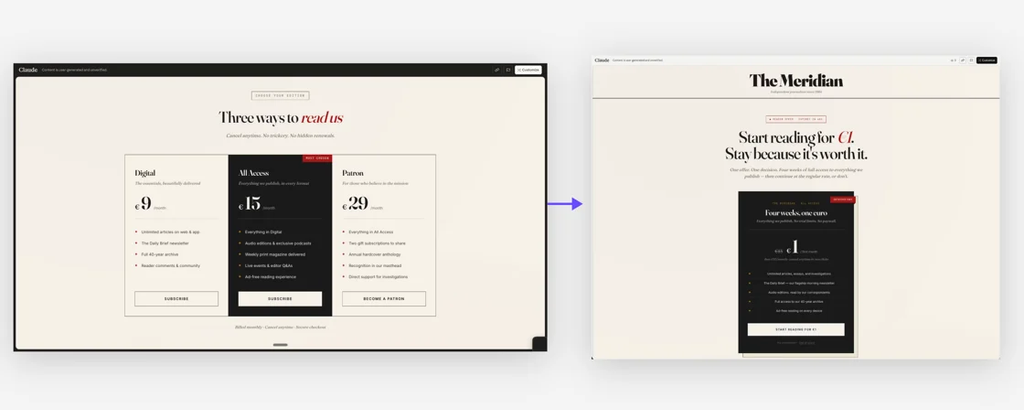
P.s. Max asked Claude to build a subscription offers page for a news publisher (left image) before giving it the advice suggested in his article (right image)… something to think about maybe
Links to add to your reading list
- Guide: how to segment audiences for a dynamic paywall
- Times ‘fewer, better stories’ strategy leads to run of audience growth
Reducing daily output from 200+ to ~150 stories coincided with three consecutive months of record audience growth. Organic search traffic rose 29% year-on-year and Google Discover traffic more than doubled. The Times now has 659,000 digital subscribers, up 7% YoY.
See you in 2 weeks for the next newsletter,
Madeleine