

You're reading The Audiencers' newsletter #86 sent out on April 1st, 2026. To receive future newsletters straight to your inbox every two weeks, sign up here.
Last week we launched the programmes for 2 Festivals coming up this June, one on either side of the pond!
🇬🇧 London, June 11th
Featuring WIRED, FUNKE Media, The Economist, Ringier, Le Monde & more
With the key theme being overcoming subscription saturation: registration, finding new audiences, engaging young readers, community-building, retention-focused products…
🎟️ Full programme and tickets here
🇨🇦 Montreal, June 25th
Featuring Radio-Canada, Ouest-France, Toronto Star, The Guardian, Foreign Policy & more
We’ll be stepping into out-of-the-box thinking with innovative strategies to build a sustainable reader revenue model: looking outside of media subscriptions to the wider subs economy, unique acquisition campaigns (such as “pay what you can”), obligatory registration, unique AI use cases in the newsroom & building outside of news
🎟️ Full programme and tickets here
In today’s newsletter:
- “Pay what you can” campaign- the gamble pays off at Les Coops de l’information
- The Telegraph offers a free trial with app downloads, ‘enforcing’ their highest value action to new subscribers
- 4 categories of content based on willingness to pay & popularity, from a recent German news report
- 🔗 Links to add to your reading list
“Pay what you can” success at Les Coops de l’info
What would happen if you left users to choose the price of subscription themselves?
This is the gamble that Les Coops de L’information, the Canadian cooperative of 6 media outlets, decided to take last year, offering a flexible pricing model for the first three months of a new user’s subscription.
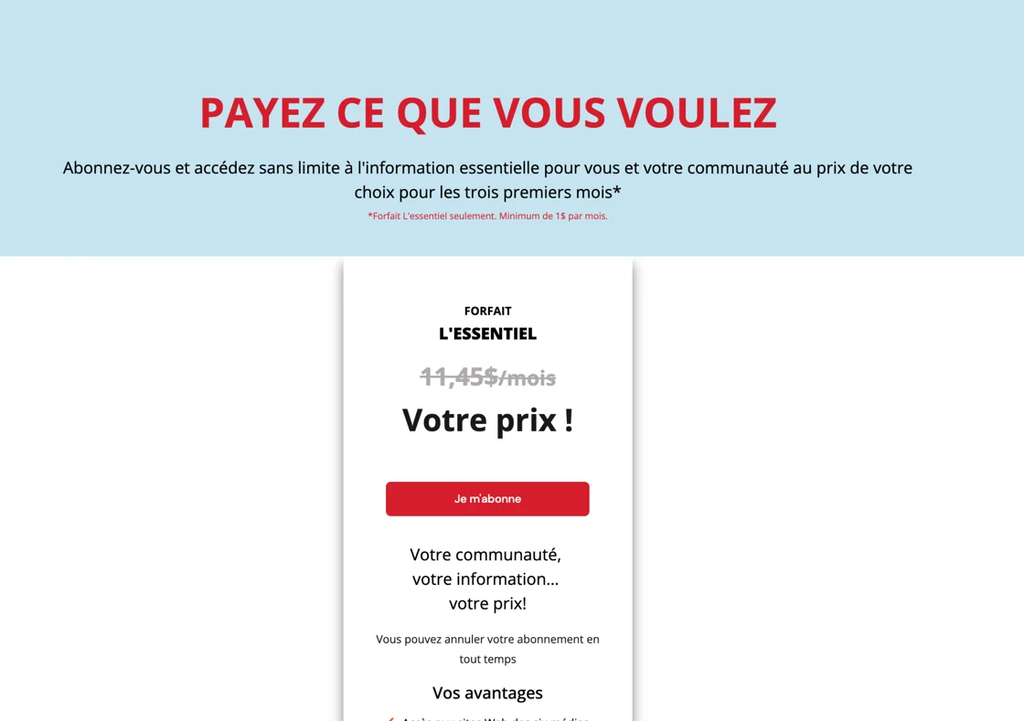
> Designed to coincide with the 2025 Municipal Elections, the campaign aimed to lower the barrier to local news while reinforcing the value of independent, cooperative journalism
> Prospective subscribers were invited to fix the price themselves.
The most interesting part though? As Principal Director, Audiences and Platforms, Marc Gendron shared:
“Despite the minimum amount requested being 1$ per month for the first three months of subscription, the average amount paid was 3.12$ per month. This average increased to 3.39$ when we suggested 5$ in the price field and to 3.50$ when suggesting 6$. Each time we changed the suggested amount, we saw an increase in the number of users choosing to go with the suggested amount.“
> Of course, a promotional project is only as good as the product you’re selling! Les Coops has worked on developing strategic feature gating to build a subscription worth paying for, including interactive engagement features, bookmarking across devices and audio articles
The results: a 4.2% increase in subscribers!
The Telegraph offers a free trial with app downloads
After creating a free account, The Telegraph offers 14 days free subscription in exchange for downloading the app.
This means the user activates a HVA (high value action) before even paying a penny.
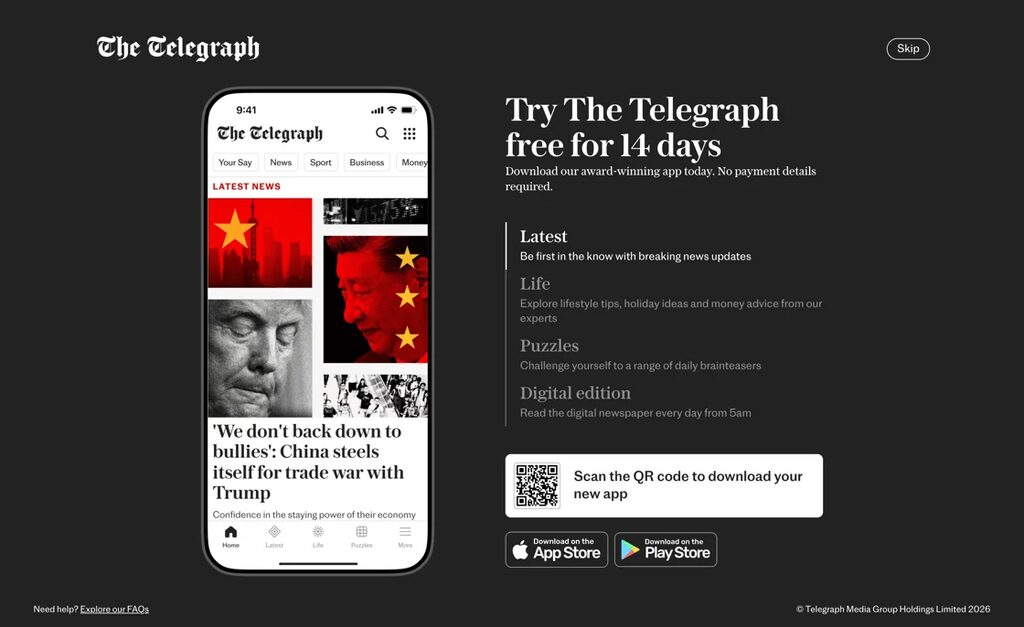
At Audiencers’ Festival in Paris last year, we heard from CPO Mathias Douchet that the app has become the most engaging platform and the best predictor of subscriber retention at The Telegraph
-> The app performs significantly better than the website: 15% more usage, 8% more sessions per week, 6 points higher 30-day retention…
-> And resources are following: approximately 90% of resources are dedicated to the app, and teams have been built around the app product.
-> Matias shared last year that The Telegraph is now aiming for 100% of digital subscribers to use the app, with aggressive promotional campaigns from day one and better-integrated web-to-app pathways. Clearly, the above example is showing this in practice!
Find the summary of Mathias’ session from last year here
4 categories of content based on willingness to pay & popularity
The number of page views doesn’t necessarily equate to conversions, and audiences are less inclined to pay for certain types of content. At least that’s what a recent study, based on a sample of 1,957 participants representative of the German population, suggests.
Included in the report is an analysis of content topics – specifically how a mapping of topic popularity to willingness to pay can provide insights into the best access model by content-type.
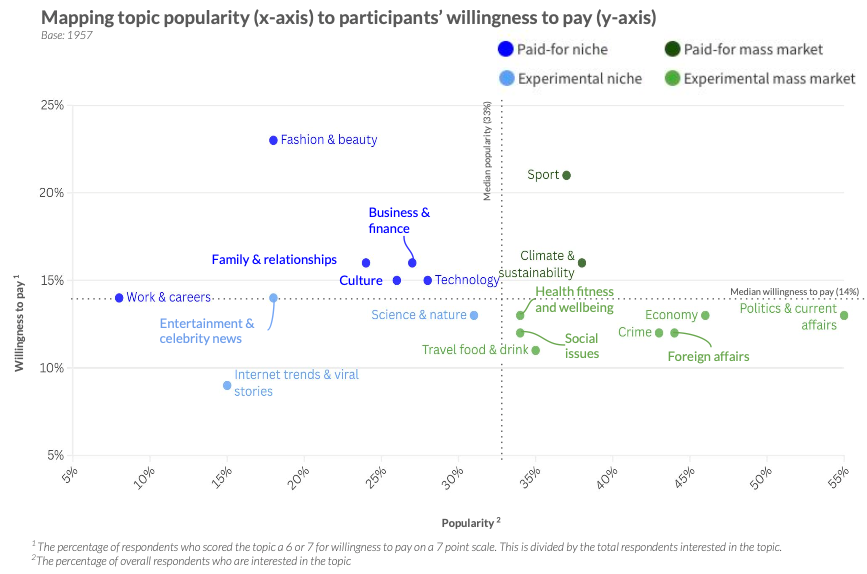
We can see 4 categories emerge that could inform editorial and content access strategies:
- Paid-for-niche: Topics that are low popularity/high willingness to pay which signals a B2B opportunity or a niche vertical for engaged audiences
- Experimental niche: Topics that are low popularity/low willingness to pay which signals high commodification of this type of news. Highly differentiated coverage is the only way to cut through the noise
- Paid-for-mass market: Topics that are high popularity/high willingness to pay signaling an obvious first-mover advantage where brands can reap benefits for becoming known to be the go-to source
- Experimental mass market: Topics that are high popularity/low willingness to pay signaling their importance as ‘service journalism’ stories to put in-front of the paywall
> Find the summary of the report on Audiencers
Links to add to your reading list
“The algorithm tracks your location via your IP address, cross-references this with Zillow property prices to estimate your income, analyses your device (iPhone = higher income), and adjusts the price according to your usage. This logic of “price discrimination” turns access to information into a personalised commodity.”
- The metric that lied to newsrooms: Web traffic, the metric that newsrooms use to prove their value, no longer measures anything real.
- Consumer Reports’ membership model shields revenue as traffic declines (70% of its revenue comes directly from membership)
See you in 2 weeks for the next newsletter,
Madeleine