

You're reading The Audiencers' newsletter #92 sent out on June 24th, 2026. To receive future newsletters straight to your inbox every two weeks, sign up here.
London is a serious contender for our best Festival to date. Brilliant sessions that went right into the operational, nitty-gritty details, great questions & conversations from attendees, and an atmosphere that felt like industry friends coming together to support one another.
Barely down from the high after London, we’re already onto the next with our Montréal Festival happening tomorrow!
But before we jump into Montréal, today’s newsletter. A London Festival special 🎉
The Festival TLDR: The future of subscription growth needs to be focused on building relationships that don’t depend on traffic, nor standard subscriptions that require commitment. We need to build sideways (Le Monde in English), own audiences to bridge the ads vs subs gap (registration), allow for flexible access (Washington Post’s one-time, daily & weekly passes) and create community-focused products & offerings that retain our most loyal audiences (The Economist Insider & WIRED’s subscription relaunch).
Le Monde in English: Already profitable, but it’s about more than just translations
Arnaud Aubron, Director of Diversification at Le Monde
> The why: Le Monde has wanted to launch an English edition for 50+ years, but technological advances (AI translations) and digital subscriptions (delivering value internationally with ease) finally made the project possible in 2022. It’s also an important move for the brand to continue to grow beyond the limited French market
> Content: Le Monde in English doesn’t create original content; it exclusively translates a curated selection of the French edition (30% of all articles from Le Monde).
> Pricing: Because an international reader is highly likely to already hold a primary subscription to a domestic title like The New York Times or The Guardian, Le Monde in English positions itself as a “second read,” with a highly accessible pricing structure (starting at €2.50/month for the first year)
> Performance so far:
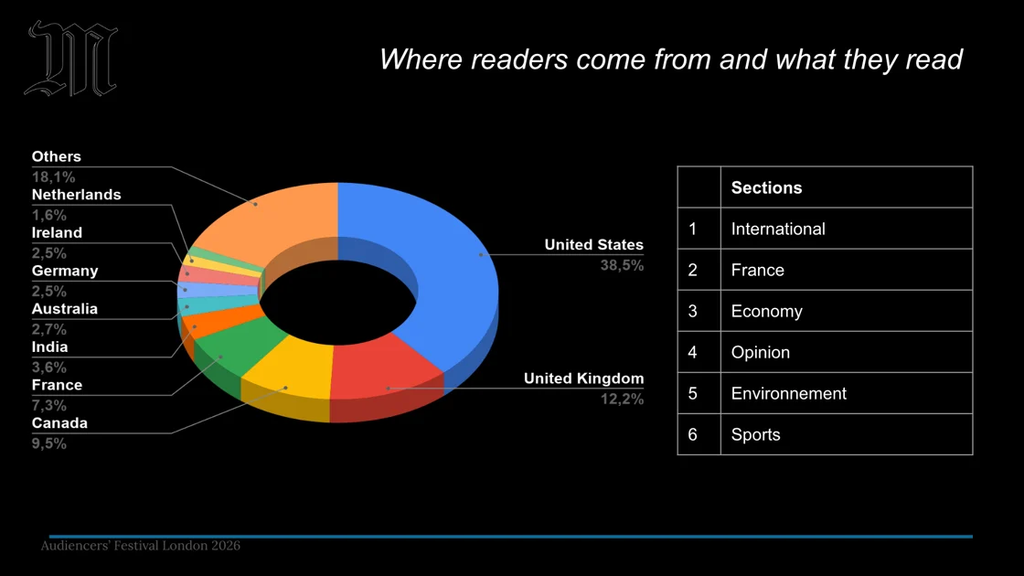
- Le Monde in English has around 16,000 active subscribers
- A staggering 50% of all subscribers come from the US. Aubron attributed this to a stark cultural difference in the propensity to pay for news: while only roughly 10% of French consumers pay for digital news, closer to 20% of Americans do
- Approximately 5 million monthly visits
- Subscriptions are the core business driver, representing 66.2% of revenue, followed by licensing (16.9%), B2B (12.3%) and advertising (4.6%)
> “It’s not about translation”: success comes down to content market fit, product distribution, and understanding the distinct profile of your international audience. And whilst AI has driven productivity gains on this front, it’s also created journalism jobs – AI handles the mechanical translation, freeing human journalists to focus purely on editing, nuance, and curation.
> Full article summary on Audiencers
Registration: can we finally agree that ads and subs can work together
Shirin Shity, Senior Marketing Manager at Project Syndicate, Ross Wilmot, Director Reader Revenue at Broadsheet & Patrick Rademacher, Chief Strategy & Innovation Officer at Ringier
> The myth disproven: Historically, publishing teams worked in separate silos: advertising teams fought for reach while reader revenue teams fought for paywall exclusivity. But data from Ringier Media Switzerland, and a holistic CLV combining revenue from ads & subs, proves this conflict is artificial
> Registration increases CLV: Ringier found that a logged-in user delivers a total CLV well over 30 times higher than a reader who only gives cookie consent. What’s more, securing marketing consent during registration allows publishers to bypass algorithmic platforms and send direct sales/offer emails. Broadsheet found that these targeted sales campaigns drove an immediate 18% of all subscription conversions.
> Newsletters are a core conversion engine: Once a reader registers, getting them onto a newsletter acts as a massive automated nudge. At Broadsheet, registered readers on newsletters accounted for less than 1% of the total audience but drove 43% of all digital subscription conversions.
> Avoid the vanity metrics: Project Syndicate reminded us that registration volume is meaningless without engagement to follow. An active onboarding experience that keeps readers engaged during the critical first 30 to 90 days is essential.
Patrick’s session summary, on their holistic CLV is here, and a summary of Ross’ session, on launching registration pre-subscription, is here (Shirin’s coming soon!)
Flexible access: addressing the gap between willingness to pay and willingness to commit
Anjali Iyer, Global Head of Subscriptions at The Washington Post
> Traditional hard paywalls face a brutal bottleneck: out of 100 anonymous readers who hit one, 74% abandon the site. Only 1% subscribe, and of that tiny fraction, 13% churn on day one because they only wanted that single article
> The data exposes a massive gap between the willingness to pay and the willingness to commit. As Anjali put it, modern readers, particularly younger cohorts, operate in a fragmented digital landscape shaped by streaming services, search loops, and social algorithms. They demand short-term choices and are often willing to pay a premium price for temporary access over a recurring subscription package.
> The Washington Post’s solution is flexible access models. By testing micropayments (weekly and pay passes, as well as pay-per-article with an in-paywall mobile payment module), they’re uncovering an untapped market:
- 42% of flexible access buyers are brand-new, anonymous users outside the existing ecosystem
- While core subscribers buy for politics and opinion, transactional buyers over-index heavily on lifestyle, wellness, and investigative deep-dives
- These users arrive via search/social, and 50% checkout via Apple Pay (compared to just 30% of standard subscribers)
> Interestingly, this also serves as a nurturing mechanism for long-term subscriber growth. Over a 180-day period, up to 8% of week-pass buyers, 4% of day pass buyers, and 3% of pay-per-article buyers eventually became full subscribers
Full article coming soon!
A few extra links if you’re in need of yet more insights;)
- Sun Club at One: what The Sun learned from a year of freemium
- The Digital News Report 2026 is out
- Premium video has boosted subscriber retention for The Economist
See you tomorrow if you’ll be at our Festival in Montréal! Or in 2 weeks for our next newsletter,
Madeleine