

You're reading The Audiencers' newsletter #90 sent out on May 27th, 2026. To receive future newsletters straight to your inbox every two weeks, sign up here.
Hope you enjoyed the long weekend and didn’t melt in this heat!!
(record-breaking May temperatures in Europe for those of you not over this side of the world!)
In today’s newsletter:
- From Melbourne to London: how Broadsheet is scaling culture and reader revenue
- Is The New York Times becoming the ultimate subscription infrastructure for the media industry?
- Should you care about your newsletter open rates?
- 🔗 Links to add to your reading list
From Melbourne to London: how Broadsheet is scaling culture and reader revenue
“by focusing on engagement, everybody wins”
One of the biggest challenges in the publishing industry today is the perceived conflict between advertising and subscription revenue.
For the team at Broadsheet Media, however, these models are complementary, with engagement being the common thread. And it’s been one of the key elements in the recent launch of their reader revenue model.
> An audience-centric approach: A laser focus on the most engaged readers, understanding their motivations, pain points, and what adds value to their lives
> Compelling value proposition: Ensuring the subscription product addresses the needs of engaged readers. Initial research at Broadsheet showed that their readers would be prepared to pay for high-quality content, but that it needed to be combined with unique experiences like exhibition tickets, and perks like free coffee as well as tools to help them curate their Broadsheet experience
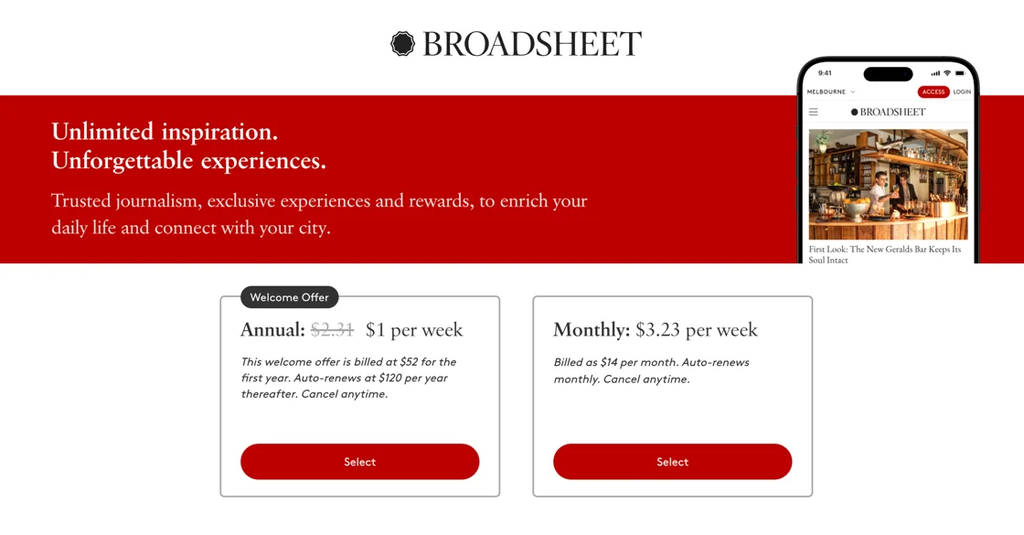
> Cross-departmental alliance: Moving beyond a traditional marketing-led view of subscriptions to ensure buy-in across the entire business, from editorial to product, data, and CRM. At Broadsheet, they already had established ‘Squads’ associated to 90-day, one-year and three-year goals, so when moving to subscription, a new audience monetization squad was formed.
Importantly, engagement is a key focus across the whole business, something that applies across both advertising and subscription revenue goals
> Culture of test and learn: Continuous experimentation with subscriber journeys, funnels, pricing, and offers to drive sustainable growth. A big part of this has been the launch of a registration model prior to paywalls, helping to build confidence internally ahead of their subscription launch
> End-to-end lifecycle marketing: Delivering the right message to the right audience at the right time, supported by a robust data infrastructure and access to the right platforms.
Is The New York Times becoming the ultimate subscription infrastructure for the media industry?
According to FIPP’s latest data, the media landscape is shifting. The NYT is moving beyond just selling its own news, it’s increasingly positioning itself as a foundational product bundle layer for other publishers.
By partnering with international outlets (like El País and Corriere della Sera) and exploring domestic collaborations, they are bundling high-engagement products like NYT Games, Cooking, and The Athletic into external subscription models.
> Beyond news: High-utility lifestyle products are the ultimate top-of-funnel conversion tools (Mediahuis has started bundling beyond journalism too)
> Bundling: As single-product subscriptions hit a saturation point, multi-publisher bundles drive higher engagement and lower churn
> Infrastructure over competition: Scale allows giants like the NYT to act less like traditional competitors (not that this is a highly competitive industry anyway…) and more like a platform economy for smaller publishers
> Great write up by John Rahim on the topic
Should you care about your newsletter open rates?
Yes
Should you care about other people’s newsletter open rates?
No
That’s pretty much the TLDR of Lennart Schneider‘s recent discussion on Audiencers 😅
For Lennart, there’s no such thing as a “good” open rate, and an open rate really says nothing about the quality of your newsletter.
> Since Apple’s Mail Privacy Protection, it’s often difficult to track who actually opens an email
> And you can actually simply improve open rate by sending an email to fewer people (given that open rate is a fraction, calculated by dividing the number of unique opens by the total number of recipients). The quality of your newsletter doesn’t improve, but open rate (quality of your distribution system) does
However, since we don’t have many metrics for email, it’s still a valuable signal, as long as you’re aware of what it tells you, and what it doesn’t.
What you shouldn’t do is compare your absolute open rate with competitors who use completely different tools and whose lead generation works differently.
What you can do instead:
> Remove contacts who don’t open your newsletters, or at least ask them if they still want to receive your emails
> Observe long-term trends, comparing your own newsletters with each other
> Optimize your open rate with A/B testing
> Examine outliers: Were there any particular issues that were opened more or less frequently than average? What can I learn from them?
> Consider re-contacting those who didn’t open the email
> Use net reach (recipients x open rate) as the basis for advertising deals
> Compare segments: When running different lead generation campaigns, you shouldn’t just focus on the short-term cost per lead (CPL), but also consider whether the campaigns generate active recipients in the long run.
> Find Lennart’s discussion on Audiencers
Links to add to your reading list
- The micropayments topic is back (again), with 2 contradicting views:
- Why micropayments can’t save news (some great points here, particularly on relationship-building. I’d add that subs products also go beyond the value put on a single article, they’re about community, features & having continued access)
- Meanwhile, at Washington Post: Unlocking growth with flexible access: A new paradigm for customer-centric strategy
“If we want to be customer-obsessed as an industry, then we should not ignore the customer signals. More options lead to more opportunities. By introducing flexible ways to read and engage, publishers can strengthen customer relationships, diversify revenue streams, and make journalism more accessible to more people.”
- “Affiliation, not just access”: Newsrooms try to move beyond membership to a focus on “belonging”
- Steal this strategy: 4 membership models succeeding for publishers (and how to learn from them)
See you in 2 weeks for the next newsletter,
Madeleine