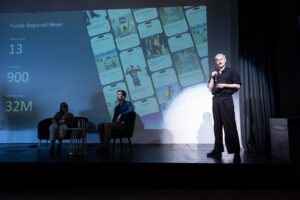
As Head of Product Management at Germany’s NPG Digital, Daniel Geigner and his team have left “one fits all” in the past – they now personalize around 80% of homepage content in their news app for every single user, based on reading behavior, interests, and regional relevance.
In this article, Daniel shares why and how they developed this technology, the huge success from the project, and how they’re building this out onto other touch points.
> NPG Digital personalises around 80% of its app homepage for every user, including readers who aren't logged in. Personalisation is the entry point to the lifecycle rather than a subscriber benefit > The mix matters. Readers explicitly pick a region and topics, while machine learning handles the rest, including surfacing content from whichever audience group they read most, be that parents, sport or crime > Personalised teasers get 10% click-through against 3% for manually placed content. Paywall hits are up 10% and average active days per subscriber up 28% > The clearest example is a local football club. Showing FC Energie Cottbus updates to everyone produced weak engagement. Showing them only to fans identified by reading behaviour transformed it > Their new chat assistant answers only from NPG's own journalism, and doubles as research. When readers ask questions directly, they tell you what they actually care about
Why we believe personalization is essential
We publish more articles than any single reader could ever consume. Our challenge isn’t a lack of content — it’s making sure each reader sees what’s truly relevant to them.
That’s why we’ve made personalization a core principle of our product strategy. And nowhere is this more critical than on the homepage, where readers begin their journey. Today, 80% of our homepage is personalized.
Our goals: Relevance, Conversion, Retention
We’re not personalizing for the sake of being modern. We do it because it works — across every key metric:
- Conversion: Relevant content improves paywall hits and subscriber growth.
- Engagement: Readers return more often when they see what interests them.
- Churn prevention: Retention increases when readers consistently find value.
And this doesn’t just apply to our paying customers. Even non-logged-in users receive a personalized homepage, making personalization the entry point to our customer lifecycle.
How we built our personalization engine
Our personalization is powered by a mix of user-configurable modules and algorithmic recommendations, including:
- “My Region” – users select their preferred local area.
- “My Topics” – users choose their topic interests.
- 1:1 Recommendations – machine learning models predict article interest.
- “7 at 7” – a daily story-format summary with AI-generated snippets.
- Audience-based recommendations – we surface articles aligned to the reader’s most-read “audience group” (e.g. parents, sports or crime fans), based on behavioral data.
All of this is driven by our central data warehouse, where we track reading behavior, user choices, subscription status and more. Our data team creates recommendation models to serve personalized content in real time.
The results: +10% paywall hits and a 3× higher CTR
Since launching our new homepage strategy earlier this year, we’ve seen strong results:
- +10% increase in paywall hits
- Personalized teasers: 10% CTR (vs. 3% for manually placed content)
- +28% increase in average active days per subscriber
One standout example: local football team FC Energie Cottbus. When we showed updates to all readers, engagement was low. Now, we only show the module to fans — identified through their reading behavior — and engagement has skyrocketed.
Every step of our rollout has been tested via A/B experiments. And importantly: we partnered closely with the editorial team throughout. That collaboration was key.
Beyond the homepage: Email, push and conversational UX
Personalization doesn’t stop at the homepage. In fact, it’s working across every product touchpoint:
- Our personalized newsletter is our best-performing email by far (opens and CTR).
- We’re expanding personalization into push notifications and other channels.
- And now, we’re launching a new feature: “Frag mich” (Ask Me) – a chat-based assistant powered by generative AI.
Readers ask questions and get instant answers based exclusively on our editorial content — no hallucinations, no third-party data.
This conversational format opens the door to a radical new type of personalization — one where the user explicitly tells us what they care about. And in return, we get invaluable feedback on which topics truly matter to our audience.
Our next chapter: Personalization everywhere
Looking ahead, our goal is clear: personalized experiences on every page, in every channel — web, app, email, push.
The app is at the heart of our strategy. We see it as the place where we can combine timing, format and relevance into a single product: whether it’s a long-form article, a short summary, a Q&A, a podcast or a video.
Personalization isn’t just a feature. It’s the foundation for modern, user-centered journalism — and we’re building every part of our ecosystem with that in mind.
Want to know more? Feel free to get in touch!