
David Carzon (formerly of Arte, Télérama, Libération, and Binge Audio) is a journalist, consultant, and author. This article was originally published in his newsletter Hupster, and provides a follow up from Audiencers first article on Le Monde in English, published six months after its launch in 2022.
Increasingly more publishers are launching international editions, all looking to capitalize on the potential of AI translation, particularly into English. While these announcements sound promising, I have my doubts about their viability for private media outlets.
To see if there’s real opportunity here, I sat down with Arnaud Aubron, Director of Diversification at Le Monde. Having led Le Monde in English project for four years now, he shares why they launched, the target audience, the work required for this project, and how it’s on track to become profitable in 2026.
Does that make it a replicable blueprint? It’s not that simple. I’ll let him explain…
> Le Monde in English expects to be profitable in 2026, four years after launch rather than the five projected. It got there by growing to 15,000 subscribers and dropping the translation agency it started with

> The workflow is AI first, humans after. Every article is machine-translated, then proofread, then edited by a native English-speaking journalist, with eight of them across Paris and Los Angeles for 24-hour coverage

> AI didn't cost jobs here, it created ten permanent journalism posts. Arnaud Aubron is explicit that without it the project would have been too ambitious to attempt at all

> The product is deliberately a second read. Prices are kept low because nobody is dropping their primary title for this, and students and retirees are overrepresented among subscribers

> The warning for anyone copying it: this works because Le Monde already had brand recognition in the US and UK, and because French to English opens the American market. As Aubron puts it, "the news market remains stubbornly national"
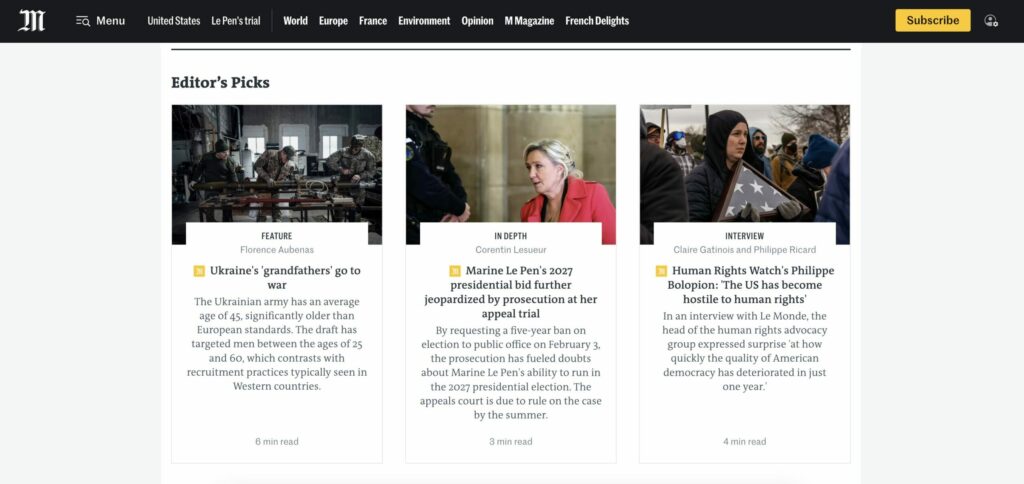
What needs did you identify that led to the launch of Le Monde in English?