Max Moné is co-founder and CEO at Poool, the dynamic journey builder to boost subscription conversion, engagement, and loyalty.

This is the fifth in a 6-part series where I share what I learned from studying 100 subscription business models across 15+ industries.
> Episode one: 100 subscription business, 15 industries, 1 moodboard
> Episode two: What’s free, what’s paid, and why it’s really an engagement trade-offf
> Episode three: Why the best subscription businesses don’t try to sell on day 1
> Episode four: The subscription pricing page we've all built at least once
The cycle doesn’t stop when someone becomes a subscriber
In episode 1, we introduced the idea that the best subscription businesses don’t follow a linear journey (attract → convert → retain) but an infinite cycle of micro-conversions, where each step has one goal and unlocks the next. In episodes 3 and 4, we looked at what happens before the first paid conversion: how these businesses use registration, onboarding, and pricing to guide the user step by step.
This episode covers what happens after someone becomes a subscriber.
And what we observed is that the journey really doesn’t change in nature once the user has paid. After someone subscribes, the next micro-conversion might be signing up for a newsletter. Then downloading the app. Then discovering podcasts or games or a specific section of the product. Then, when the subscriber is ready (and when you know enough about their usage), you can propose an upsell or bundle.
Acquiring a subscriber isn’t the end of the funnel. It’s just one more step in the infinite cycle we described in episode 1. And what most people call “retention” is really just the continuation of the same sequence of micro-conversions, except now you have data about the user and can be much smarter about what you propose next.
The problem is that most of this work needs to happen fast.
Why you have about 100 days (and probably less)
INMA data shows that a quarter of subscribers cancel in the first month, and half are gone by the fourth month. And a Nieman Lab study on The Wall Street Journal’s data showed that the probability of adopting a new habit drops dramatically after about 100 days.
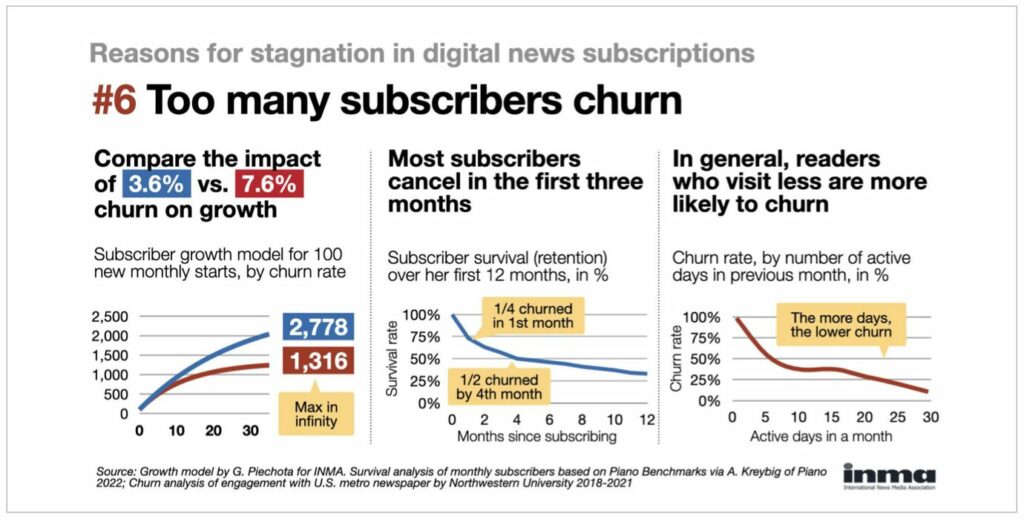
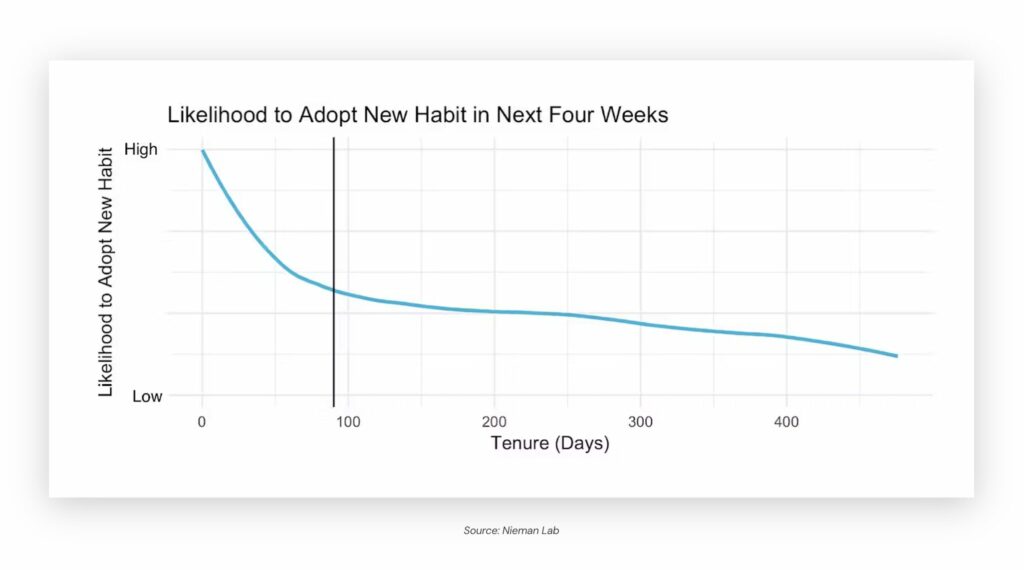
Half of your new subscribers are gone within 4 months, and after about 100 days the window to build a new habit narrows significantly. If you don’t manage to execute enough micro-conversions during those first few months (newsletter signup, app download, feature discovery, habit formation), the probability of keeping that subscriber drops, regardless of how good your anti-churn campaigns are later on.
(I know this isn’t the most cheerful insight we’ve had in this series, but it’s what the data consistently shows.)
What this looks like in practice: L’Équipe after the Olympics
This is where the theory gets concrete. L’Équipe (a Poool client), speaking at The Audiencers’ Festival in 2025, shared how they built 12 post-subscription projects after the Paris 2024 Olympics, which had generated a huge spike in new subscribers, subscribers they needed to keep. I won’t go through all 12 (the full article is worth reading), but the ones that stood out to me are the following.
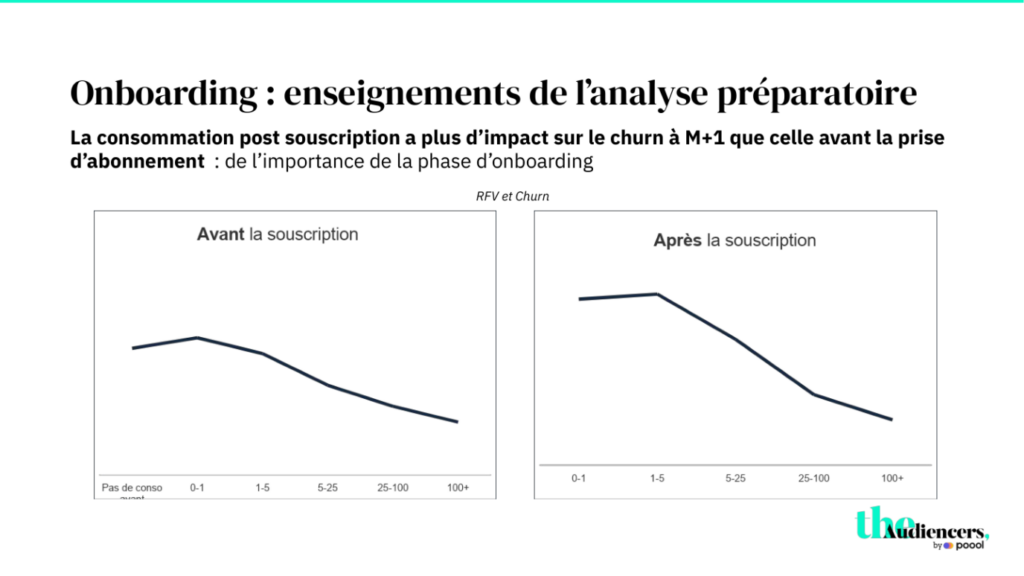
Their data analysis revealed something I found really striking: what a subscriber does after paying has more impact on M+1 churn than what they did before subscribing. When Fabien Mulot showed this at The Audiencers’ Festival, it was one of those moments where you think “of course, that makes total sense” and at the same time you realize that most of the industry’s energy is still focused on acquiring subscribers, not on what happens once they’ve subscribed.
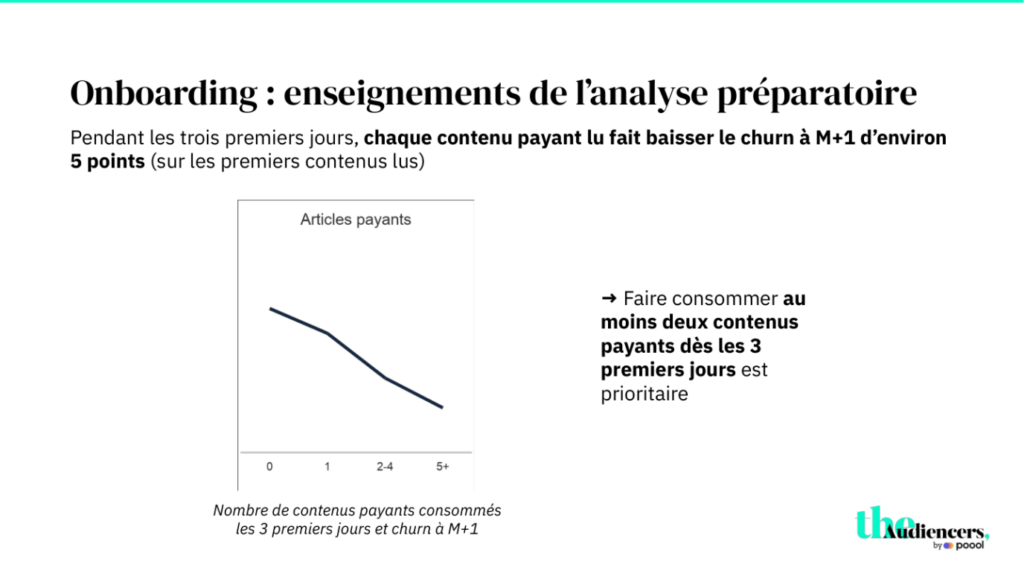
Based on this insight, they focused their onboarding on one specific goal: getting new subscribers to read at least two paid articles within the first three days. Their data showed that each paid article read during those first 72 hours reduces the following month’s churn by about 5 points, so two articles in three days already makes a meaningful difference on the curve.
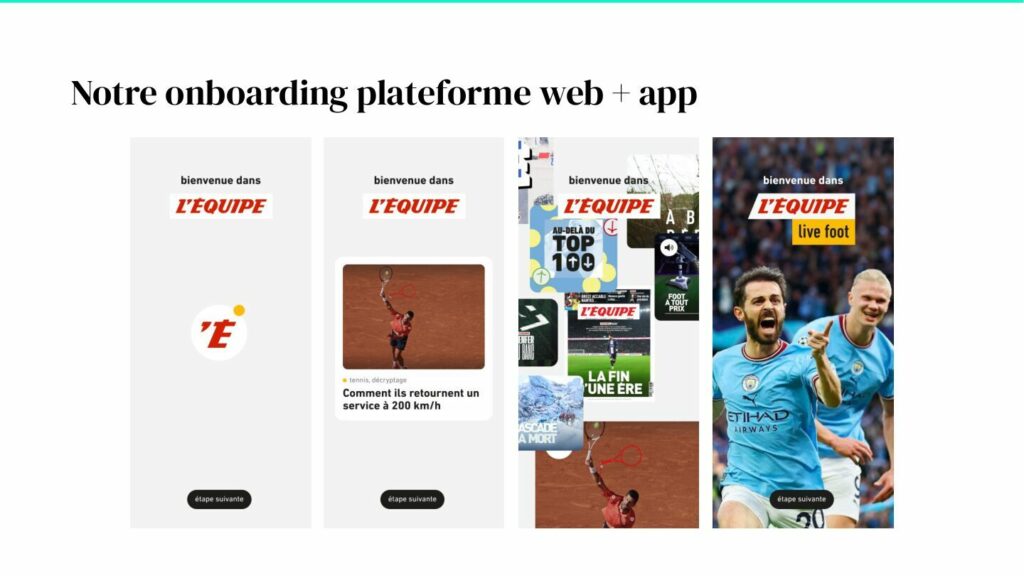
The onboarding sequence they built follows the same micro-conversion logic we’ve been describing throughout this series:
- first, welcome the subscriber and showcase what their subscription unlocks;
- then encourage them to personalize their experience (alerts, newsletters, favorite topics);
- then immediately serve them paid content tailored to their interests. Each step has one job.
The cumulative impact is significant.
- Simply being exposed to this onboarding journey reduces churn by 7 points at M+1.
- Completing the onboarding journey while also activating an action (turning on alerts, signing up for a newsletter) reduces churn by 20 points at M+3
- The more micro-conversions a subscriber completes in those early weeks, the less likely they are to leave.
Beyond onboarding, L’Équipe continued the logic with a newsletter strategy (a monthly preview of upcoming content, plus journalist-led newsletters across four sports verticals where subscribers can ask questions directly to editorial teams), and a new “Games” vertical to expand consumption into other formats. Each of these is another micro-conversion in the sequence, another reason for the subscriber to come back tomorrow.
El País and FT Strategies confirm the pattern at a broader scale
L’Équipe’s data is specific to sports media, but the pattern holds across other publishers.
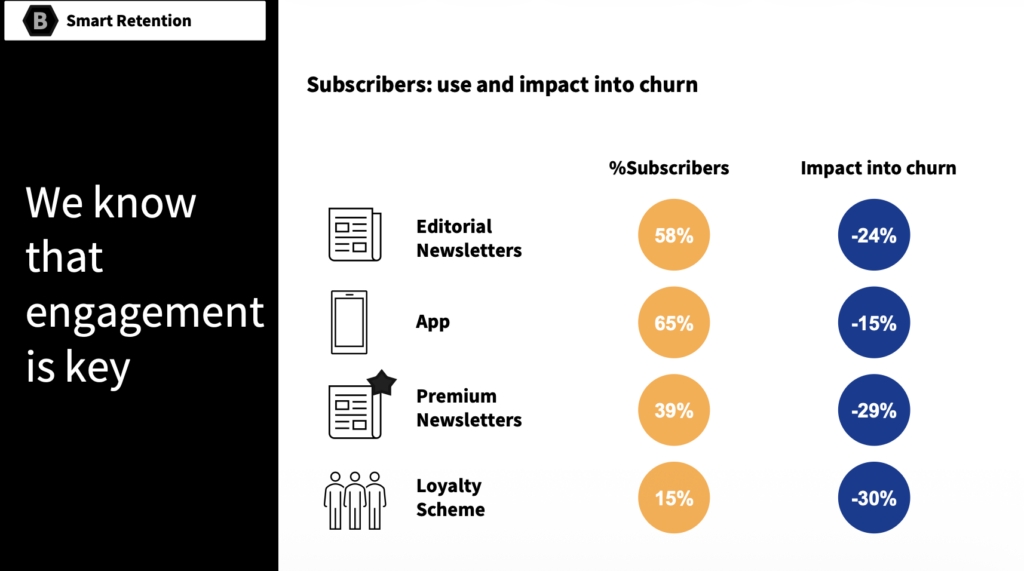
El País shared at a 2024 INMA conference that subscribers who use editorial newsletters churn 24% less, app users churn 15% less, premium newsletter users churn 29% less, and loyalty scheme users churn 30% less. Each one of these is a micro-conversion that happened after subscribing, and each one reduces churn by 15 to 30%.
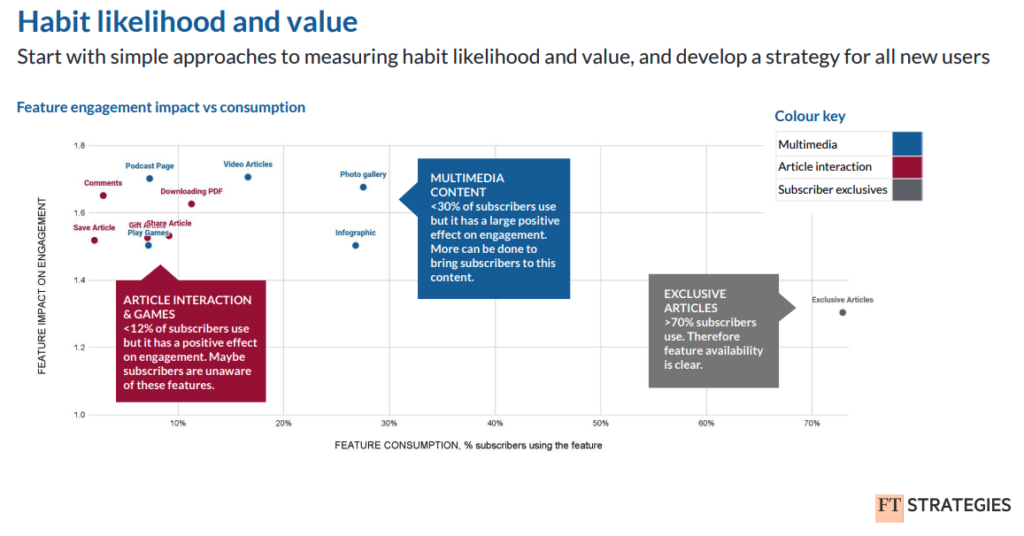
FT Strategies ran some very complementary work, analyzing the impact of each product feature on engagement vs. the percentage of subscribers who actually use it. The features with the highest impact (multimedia, interactive content, games) are also the ones that fewer than 30% of subscribers use. The gap between impact and adoption is where the biggest opportunity sits.
What happens when you get the micro-conversions right: lock-in effects
When the micro-conversion sequence works well over time, you eventually reach a point where leaving becomes genuinely hard for the subscriber. This is thanks to long-term engagement and relationship-building.
But of course, there are other strategies to keep your subscribers retained, ones that can be used in conjunction with the micro-conversions detailed above. When combined, they’re powerful for developing loyalty.
During our benchmark, we saw three main types of lock-in across the 100 businesses:
- Personalization – we talked about Spotify in episode 4, but the principle applies to any product that gets smarter with use, adapting the product to the user
- Multi-accounts – Netflix profiles, Blinkist’s partner account where you sometimes keep the service for the other person
- Bundling with external services – Canal+ with Netflix, Amazon Prime combining shopping, streaming and delivery, Walmart+ bundling grocery delivery with Paramount+
(You can read more about lock-in effects here)
Funnily enough, each of these is really the result of many successful micro-conversions accumulated over months and years. The lock-in is earned, not imposed.
Anti-churn: necessary, but it’s the safety net
And then there’s anti-churn, which is what happens when the micro-conversion sequence hasn’t worked well enough and the subscriber is about to leave.
L’Équipe has been methodical about this too. Their cancellation form (which handles two-thirds of all unsubscriptions) was redesigned through A/B tests: they added an intermediate screen summarizing the benefits the subscriber would lose (+2% retention), and tested personalizing the message with the subscriber’s first name and a specific discount percentage (+1.2 points on conversion). Small changes, but measurable impact at scale (source).
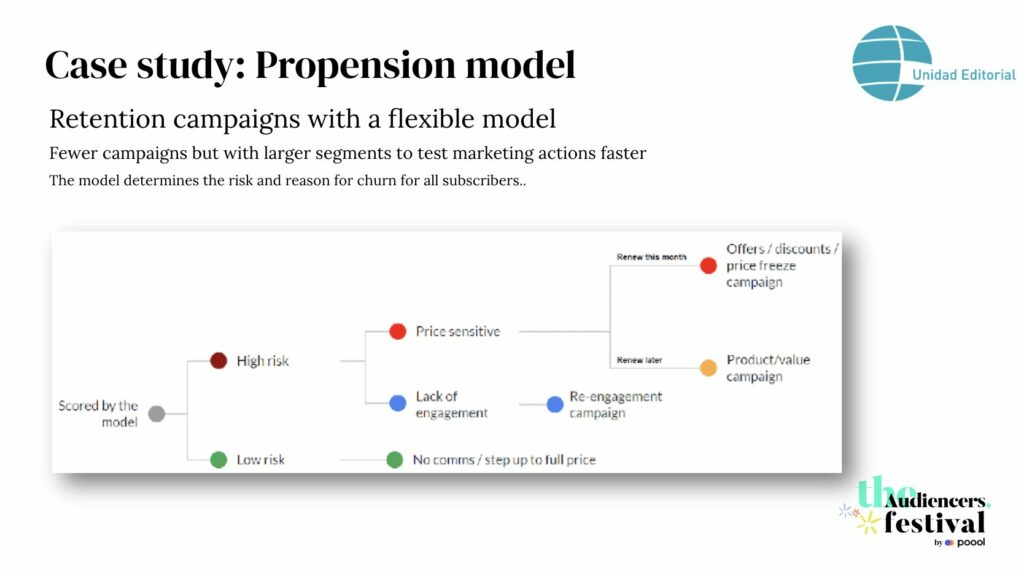
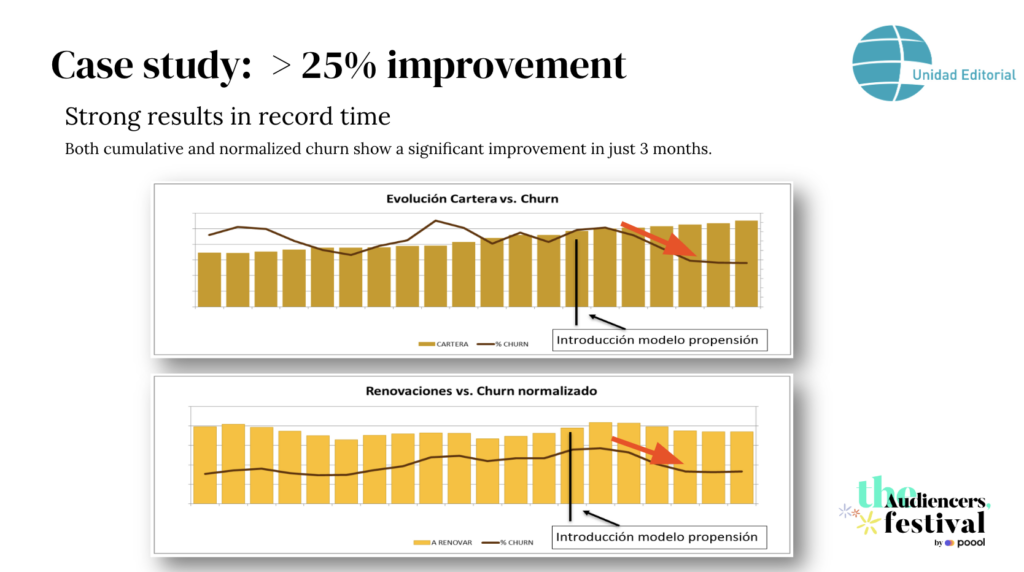
Unidad Editorial took a different approach by building a churn propensity model that predicts which subscribers are about to cancel, triggering personalized actions before they reach the cancellation page. Result: a 25% reduction in churn in three months.
These are well-executed tactics. But in the broader picture, they’re the safety net.
The real strategy is everything that happens before the subscriber even thinks about leaving: the onboarding, the feature discovery, the newsletter signup, the app download, the habit formation. All of those micro-conversions that, together, make the product too valuable to walk away from.
What you can take away from this (and test tomorrow)
Map the post-subscription micro-conversions you want your subscribers to make. Newsletter signup, app download, podcast discovery, games, alerts configuration, etc. based on their value. Then ask yourself: do you have a sequence designed for this, or are you hoping it happens on its own?
Focus on the first 3 days and the first 30 days. L’Équipe’s data shows that each paid article read in the first 72 hours reduces the following month’s churn by 5 points, and a completed onboarding with an action reduces churn by 20 points at M+3.
Check the gap between feature impact and feature adoption. FT Strategies’ framework is a useful lens: if your most impactful features are also the least used, that’s your biggest opportunity. And El País data shows that each additional touchpoint is worth 15 to 30% less churn.
Treat anti-churn as a safety net, not as a strategy. If the majority of your effort goes into save campaigns for subscribers who are already about to leave, you’re fighting the battle at the wrong end of the timeline.
And if all of this sounds like a lot to orchestrate (because it is): that’s exactly the kind of problem we’re solving with Poool and Darwin CX. From onboarding sequences to engagement actions to anti-churn triggers, across web, app, and print. Orchestrating micro-conversions at every step of the subscriber journey is what we do. If that resonates, or if you’re currently looking at your subscription platform options, let’s talk.
Next week, episode 6, the last one: toilet paper, Japanese snack boxes, razor blades, wine, and genealogy. The most surprising subscription models we came across, and what they confirmed about engagement (because at this point in the series, I think you already know what the answer is going to be).