

You're reading The Audiencers' newsletter #74 sent out on October 15th, 2025. To receive future newsletters straight to your inbox every two weeks, sign up here.
It’s our 3rd birthday this week! Have a piece of cake on us 🎂
Also, before the next newsletter I’ll be flying to Chicago for the NPA summit, followed by a few days in NYC (27th-30th). if we haven’t organised a meet-up yet, reply to this newsletter and we’ll get something booked in!
In today’s newsletter:
- How DER SPIEGEL uses its engagement score,
- The Economist’s Substack experiment: building a newsletter product off-platform
- Also from The Economist: a simple but dynamic cancellation journey to inspire your own retention efforts
- What we’ve been reading this week: articles to add to your reading list
How DER SPIEGEL uses its engagement score
The DER SPIEGEL team has taught us a lot about using engagement in a reader revenue model…
📐 We learnt about how they measure engagement with a score ranging from 0 to 100, combining signals such as visit frequency and reading time, providing a holistic view of involvement and defines four audience segments: Occasional (0–25), Regular (25–50), Active (50–75), and Fans (75- 100). (article here)
📈 We also saw how they’ve used this score, alongside user research, to identify the products and features that drive the most engagement (article here)
👷 And today, Alex Held shares some of the use cases where all of this work is being put to use, including:
> Building a dynamic offering system, a strategy that maximizes both initial conversion and long-term retention
In the image below, from left to right:
Paywall with tailored offers for low engaged users
Paywall with tailored offers for mid engaged users
Paywall with tailored offers for high engaged users
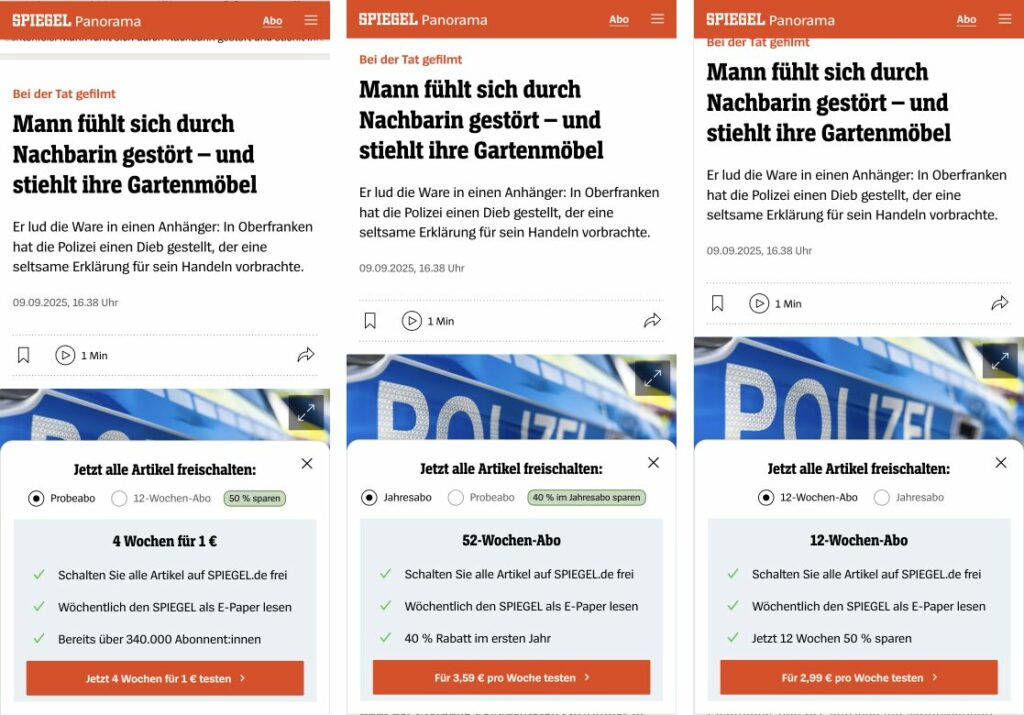
Using the engagement score to adjust access to premium content by reader segments
Increasing interaction with the products and features that drive engagement through product changes, including targeted nudges in onboarding journeys and greater visibility on the front page
Find Alex’s full piece, the 3rd in the series, on The Audiencers
The Economist’s Substack experiment: building a newsletter product off-platform
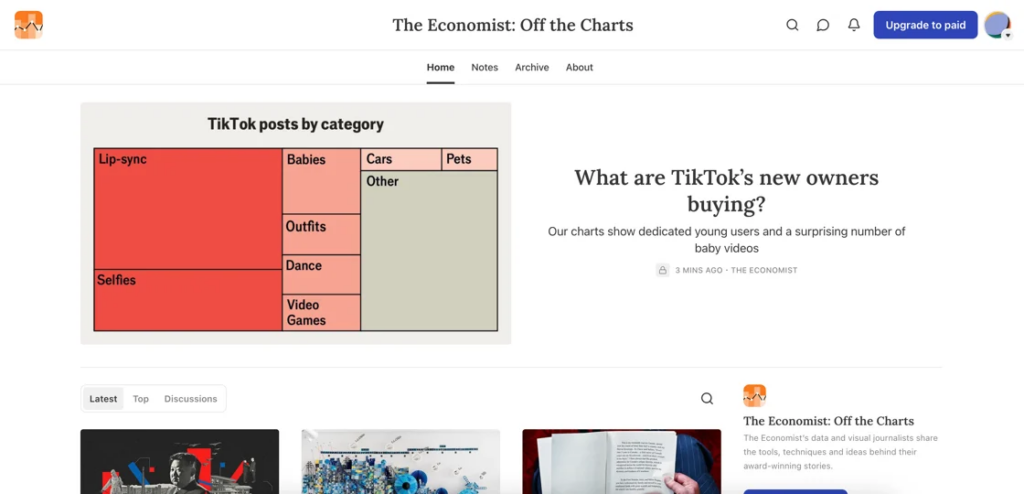
In a strategic move to engage a new and distinct audience, as well as take note from the creator economy, The Economist has launched its data journalism newsletter, “Off the Charts,” on Substack.
🎯 The goal behind this project
To find a new way to reach potential readers who are interested in a specific area of The Economist’s content but might not be ready to commit to a full subscription just yet.
Off the Charts had already been launched as a free newsletter in 2021 before being put behind the paywall as part of The Economist’s core subscription. But the vibrant data journalism community that had grown around it was too compelling to ignore. This new Substack launch, which was in the works for several months, is a deliberate effort to both create a new revenue stream and nurture that niche audience.
⌨️ Why Substack?
It’s all about meeting readers where they are – Substack’s audience is growing fast, with over 5 million users, and many of them are already huge fans of data visualization and journalism. Plus Substack’s unique features for discovery, recommendations, and community interaction played a significant role in this decision.
🤳 Taking note from content creators
The newsletter features a rotating cast of data journalists, each with their own unique style and expertise. This approach means readers get to know the entire team, not just one writer, which reinforces the collaborative spirit of The Economist’s newsroom.
⚖️ A balance of free vs paid
The Economist is being smart about how they balance the free and paid offerings to avoid any risk of cannibalizing their core subscription.
- The free Substack offering includes the weekly newsletter, which is also sent to core The Economist subscribers.
- The paid Substack subscription, which costs £7 per month, offers two additional pieces of data journalism and access to the full archive and a community comments section.
I sat down with Aaron Coultate, Head of Newsletters, about this project to share in our latest interview on The Audiencers.
Also from The Economist: a simple but dynamic cancellation journey
The goal during the cancellation journey is to retain the subscriber whilst not harming potential future re-subscriptions or referrals.
But of course, the reason for cancelling (and thus the messaging, offer or option that will convince them to stay) is different for each subscriber.
Which is why The Economist has built an adapted message for readers based on the reason why they’re cancelling.
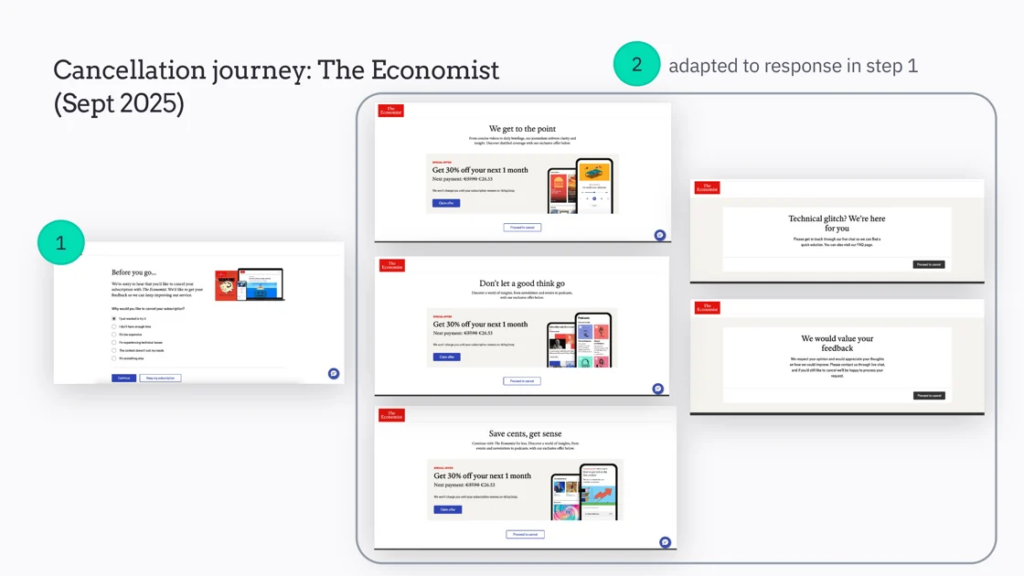
The price doesn’t change, I imagine because someone could try to trick the system, but the adapted messaging alone likely supports retention rates.
If you’re a subscriber to The Audiencers, we’ve built a guide for building a successful cancellation journey, with a collection of benchmarks to inspire your efforts.
What we’re reading this week
- If the product is news: The case for tighter newsroom and product collaboration and a radical approach to building news organizations for the future
- Introducing unfolded.news: rethinking the content architecture of news websites
- Retention benchmarks confirm our view that cancellation should be made simple. From Chargebee’s latest report:
“Pausing, swapping, and downgrading are no longer defensive tactics—they are the backbone of a loyalty strategy.
82% say they are more likely to subscribe if cancellation is easy.
79% want pause options, and 58% have actually paused instead of canceling in the past year.
Among those, 22% paused once, 26% paused two to three times, and 10% paused four or more times.”
See you in 2 weeks for the next newsletter,
Madeleine