

You're reading The Audiencers' newsletter #77 sent out on November 26th, 2025. To receive future newsletters straight to your inbox every two weeks, sign up here.
First Facebook, now Audiencers. That’s right, we’ve dropped the “The” 😎
It’s a small but important step towards the next chapters!
In this week’s newsletter:
- Easy cancellation is the new retention strategy: How Nat Geo Kids uses transparency to win beyond save rates
- 5 ideas of article formats where form follows function
- How NYT Wirecutter shipped a personalized newsletter in 4 weeks
- What we’ve been reading this week: articles to add to your reading list
How Nat Geo Kids uses transparency to win beyond save rates
Retention isn’t about saving, it’s about fostering lasting relationships. And this applies to cancellation too!
At the recent ACE Subscription Summit in London, Louise Ioannou, Publisher of National Geographic Kids, and I took to the stage to share our hot take – that new cancellation laws aren’t a threat, they’re an opportunity.
And Nat Geo proves this.
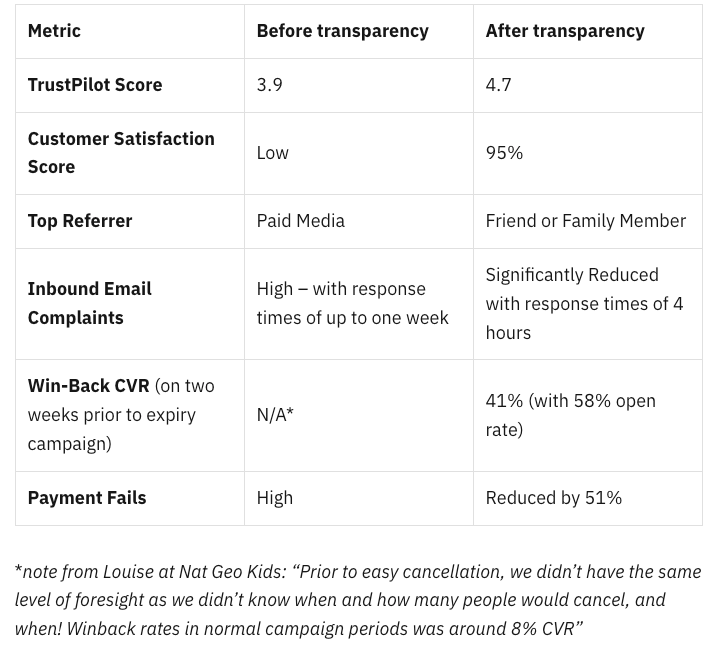
Before moving towards a more transparent model, Nat Geo Kids’ internal metrics told a contradictory story:
> The official retention rates looked good.
> But their customer experience was less successful: inbound email complaints were high, Trustpilot scores had dropped to 3.9, and the in-house customer team was frustrated by having to deal with this.
In short, the false retention gained by these friction points was offset by hidden costs: damaged brand reputation, increased resources spent on frustrated call centres teams, and the destruction of the win-back potential
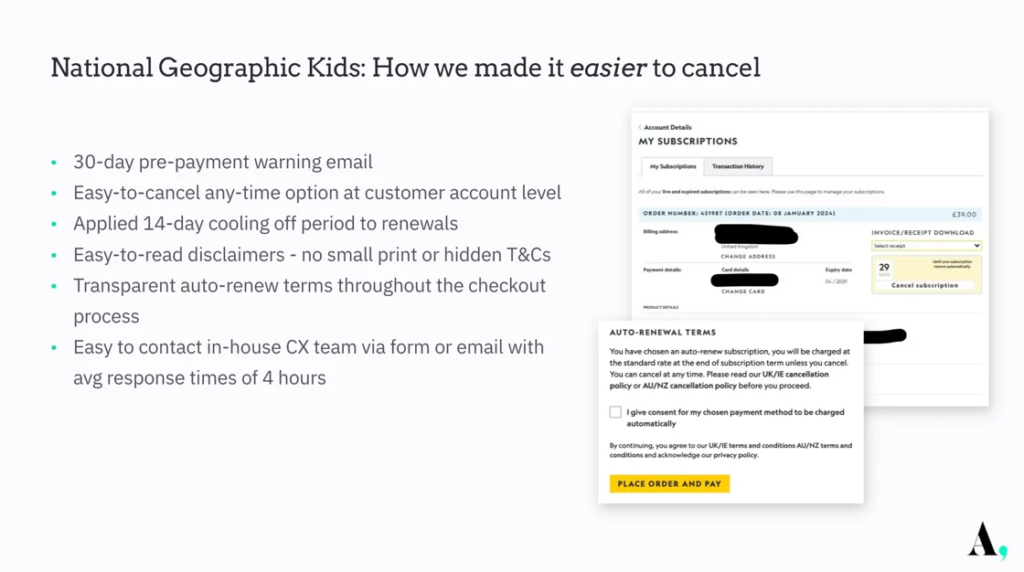
So, Louise and the team made several bold changes:
- Transparent auto-renewals: They eliminated small fonts and hidden disclaimers, sending a pre-payment warning email 30 days before renewal
- True “Cancel Anytime”: They implemented an easy-to-cancel, self-serve option at the customer account level, eliminating the need to call or email
- Positive CX: They applied a transparent 14-day cooling-off period to all renewals, showing a clear commitment to fairness.
The results speak for themselves
- Dramatically reduced operational costs (fewer emails, faster response times)
- Developed a powerful growth engine through high Net Promoter Scores (NPS) and word-of-mouth
- A 30-day pre-expiry email directs them to these options with clear instructions, resulting in a 51% reduction in payment failures, significantly lowering lost revenue and refund fees
But cancellation is also just one step!
Their retention strategy works hard throughout the funnel, from onboarding and in-life to at risk and win-back
> Catch the full article summary of our session on Audiencers
5 ideas of article formats where form follows function
User needs, personalization, dynamic paywalls… the industry is finally becoming more audience-centric.
But the article itself hasn’t changed much – it remains largely static, often text-heavy, prioritizing form over function.
Instead, we should reverse this – we should start with the function of the article (how it will help the reader) and adapt the form accordingly to make it even more useful. This not only benefits the reader, but also us as engagement and subscriptions follow.
To help inspire your team, I collected 5 examples of articles where form follows function:
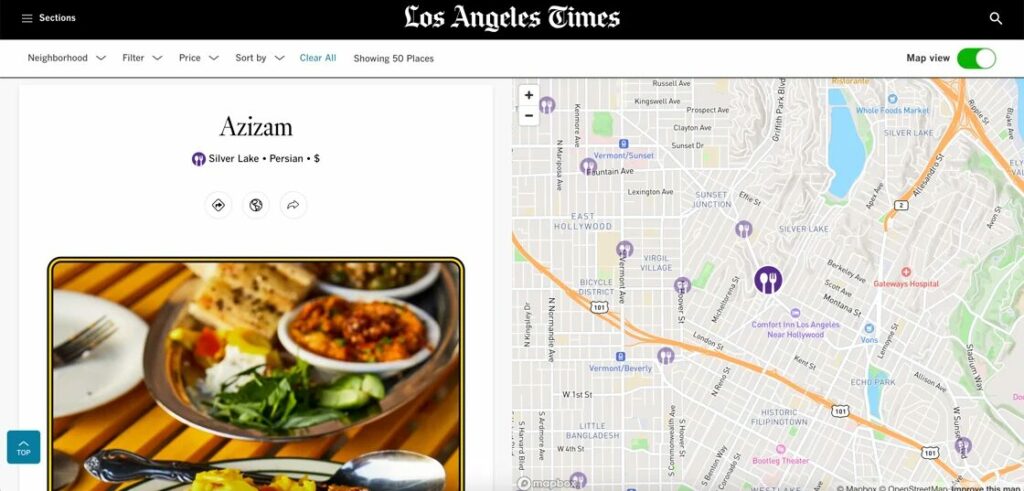
> Los Angeles Times’ interactive restaurant list with an integrated map
Instead of a static list of top restaurants, the screen is split between the article and a map, helping audiences to make a more informed decision on where they’d like to eat based on the location of the restaurant as well as the place itself.
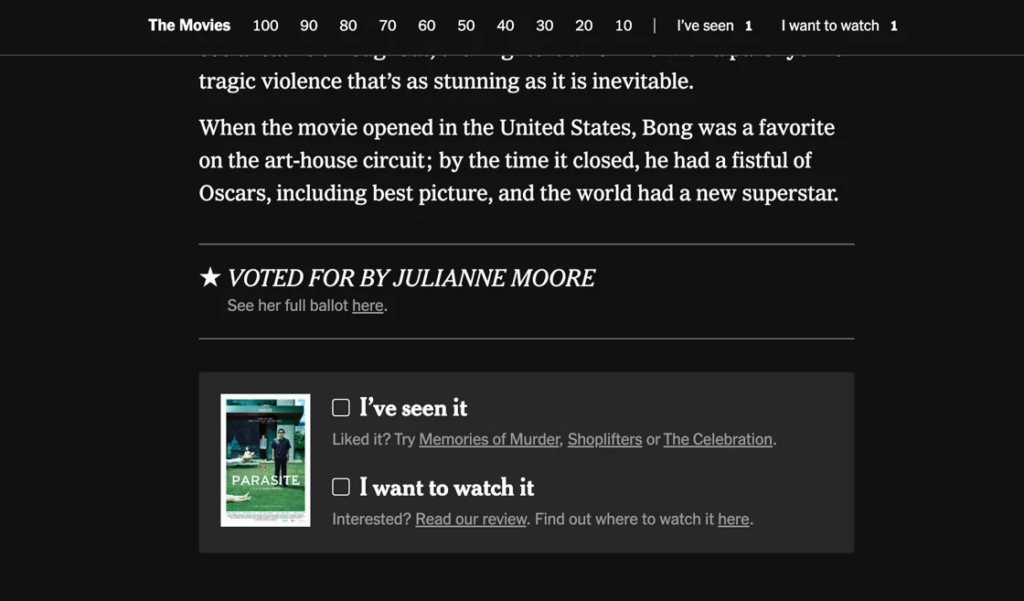
> The New York Times’ top movie check list
Using the NYT article, readers can build a personalized watch list from their recommendations.
For the publisher, this is priceless for engagement – unlike a static article where a user scrolls once and leaves, the checklist requires multiple actions (reading, clicking, checking, scrolling, filtering), increasing the amount of time spent on page.
> Find the full article and other 3 examples on Audiencers
How NYT Wirecutter shipped a personalized newsletter in 4 weeks
Wirecutter, The New York Times’ product recommendation service, is the perfect place for personalization to thrive. And what better place to start than email – a space where teams can test carefully, learn quickly and retain full control over tone and trust.
In an article for Audiencers, Senior Product Manager, Anil Chitrapu, dives deep into the operational choices, guardrails, and tech powering Wirecutter For You, the new email that tailors article recommendations to each reader.
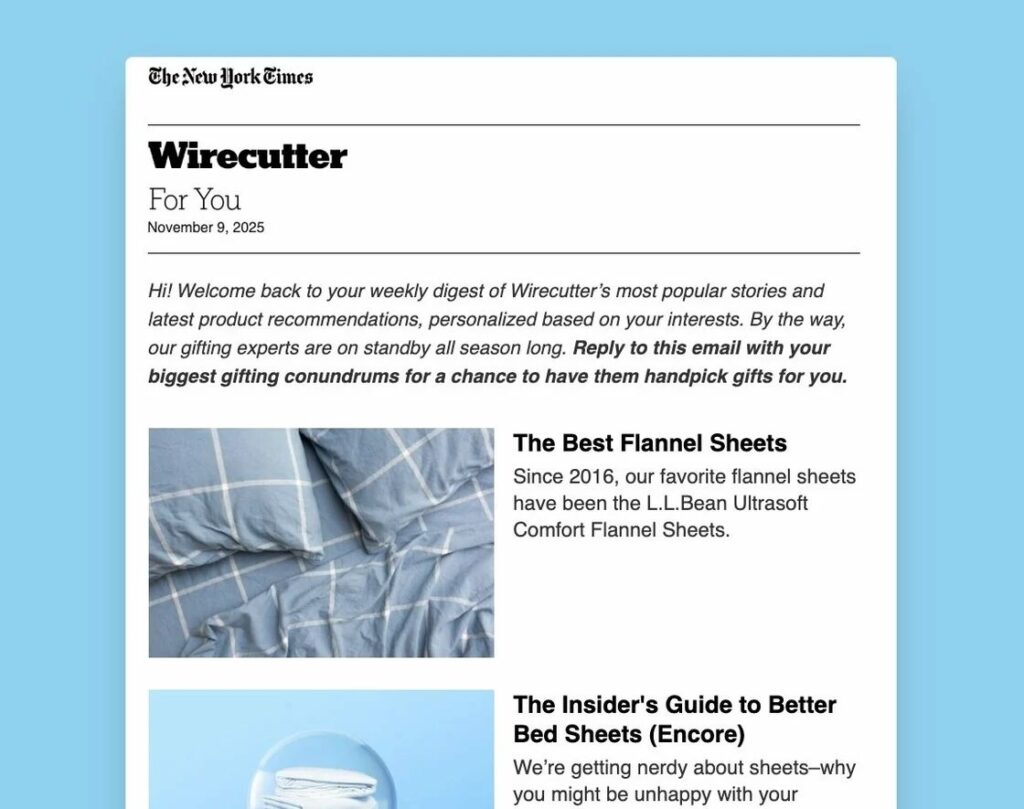
The goal of this project: to help readers find their way to more journalism with a product that could learn from a reader’s browsing history while maintaining Wirecutter’s standards
What goes into the personalization? The machine learning model blends three lightweight signals: reader history similarity (“more like what you’ve recently read”), freshness (new and recently updated), and popularity (“what’s trending right now across Wirecutter”). While the relative weights differ by slot in the newsletter, the guiding principle remains consistent – prioritize content that is similar to a subscriber’s reading history, then stack rank by freshness, and finally tap into overarching popularity signals.
The launch: Starting small, they’ve first launched Wirecutter For You as a weekly Sunday send to a small, highly engaged audience to monitor performance and maintain deliverability whilst introducing a new sender identity
What does success look like? Because this was new territory, success was less defined by traffic spikes and more by durable reader signals: quality over clicks, inbox trust and deliverability, and long-term engagement that deepened – not diluted – their relationship with subscribers.
The performance so far: the program has shown strong performance, with engagement metrics consistently rising across each send, now yielding hundreds of thousands of monthly opens and tens of thousands of clicks per send.
What next? Expanding the audience, adjusting the personalization logic, testing reader-facing cues (“Because you read X, you might like Y” ) as well as applying this framework beyond editorial content, incorporating Wirecutter’s product recommendations into the mix.
What we’re reading this week
- Poool and Arc XP announce integration – Poool’s dynamic journey builder and Arc XP Subscription and Identity are now natively integrated to unite engagement, conversion and content protection, fueling reader revenue growth for media organizations.
- Why and how we built “Ask The Post AI” – The Washington Post just showed the rest of us how to build an AI tool that serves users, builds trust and knows its limits
- Financial Times launches first Substack newsletter (Alphaville) to target younger readers
- Don’t call this a newspaper! The New York Times “is not a newspaper business. Thinking of it that way misses the point. It’s an information-and-utility service for liberal households.”
See you in 2 weeks for the next newsletter,
Madeleine