

You're reading The Audiencers' newsletter #78 sent out on December 10th, 2025. To receive future newsletters straight to your inbox every two weeks, sign up here.
In this week’s newsletter:
- 50x higher LTV than subscribers… Condé Nast builds belonging with membership as a tier above subscription
- Two homepages for two audiences at Finansavisen
- A paywall model adapted for games: The New Yorker shares their strategy for monetizing this key engagement format
- What we’ve been reading this week: articles to add to your reading list
Condé Nast builds belonging with membership as a tier above subscription
When is a subscriber more than a subscriber?
As we all know by now, a small % of our audiences will bring the majority of reader revenue through subscription. But what about those who are prepared to pay more? How can we maximize revenue from, and provide yet more value to, these audiences?
For Condé Nast, this meant creating a “Membership” tier that sits above subscription, building belonging amongst their most loyal users.
The traditional subscription represents a scale/volume tier:
- 🧑 Audience: Broadly focused on volume
- ➡️ Value Exchange: One-way (passive recipient absorbing content)
- 🎯 Goal: Volume and scale-based value – content for scale
Membership is the niche, high-value tier:
- 🧑 Audience: Caters to a very specific segment of the audience.
- ↔️ Value Exchange: Two-way. Members are active participants contributing data, feedback, and engagement. They expect to belong to a community.
- 🎯 Goal: Engagement and high retention, not volume – content is focused on the funnel.
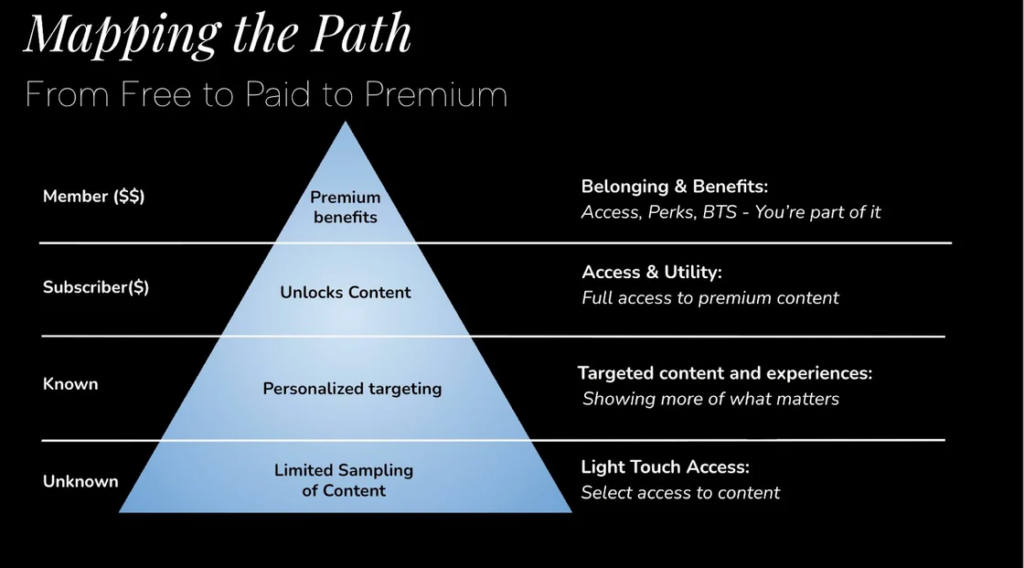
As Holly Johnson, Director of Global Consumer Revenue, shared, the success of this membership hinges on delivering real value and reinforcing the sense of belonging.
- Measuring connection not just conversion: Condé Nast’s Membership Mindset means tracking metrics around loyalty and engagement over volume. The most critical metrics include ARPU (Average Revenue Per User), Renewal Rate, Recency (how recently they engaged), and Feature Engagement (which features are “stickiest”).
- Niche focus, premium price: The most successful memberships, such as the AD PRO Directory (priced at up to $1,500 annually), lean into a specific, high-value niche. People are willing to pay a premium if the value proposition is highly specific and delivers a genuine tool or resource.
- Elevated experience: For high-value tiers, Condé Nast commits to a “white-glove treatment” with a dedicated membership teams trained to provide high-touch service.
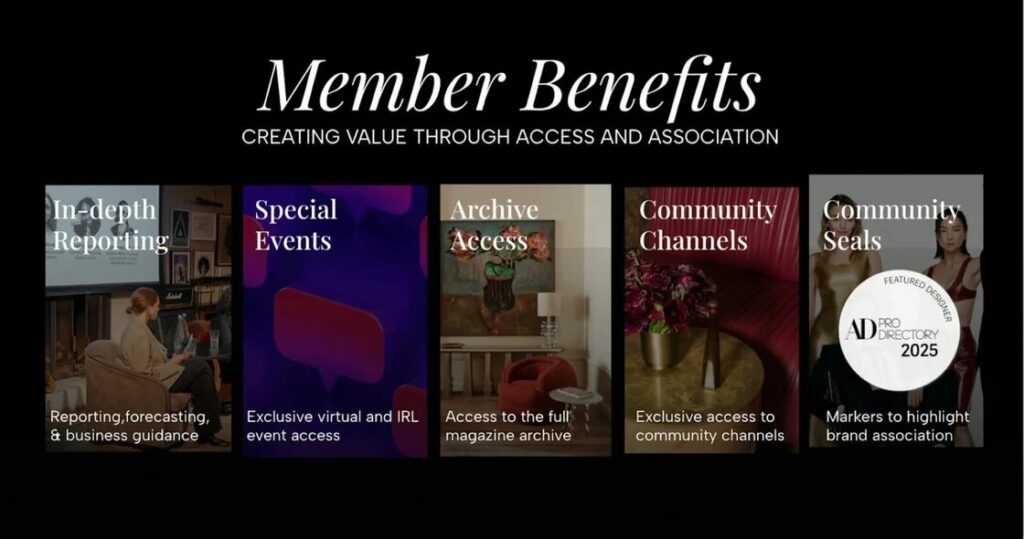
And the model is paying off:
- A member has an LTV (Lifetime Value) up to 50 times higher than a subscriber
- Members are 1.5x more likely to stay than a subscriber
It’s an incredibly smart strategy!
> Read the full interview with Holly on Audiencers
Two homepages for two audiences
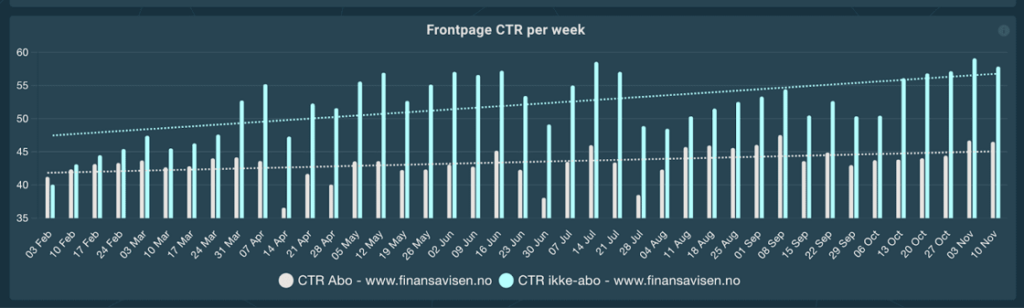
The team at Finansavisen, one of Norway’s leading financial newspapers, found striking differences between the way subscribers and non-subscribers behave on the home page.
Subscribers gravitated toward premium articles and in-depth financial reporting, while non-subscribers engaged more with free stories, introductory coverage, and selected premium articles that had a track record of converting well.
And of course, the business goals attached to these two audiences were different too.
A single homepage just couldn’t fit all of these needs at once.
Two audiences, two goals, two homepages
Working with Kilkaya, Finansavisen developed two separate homepages, one for each audience, with their unique needs and business goals in mind:
The Subscriber Homepage:
> Designed around premium content, expert analysis and longer articles that subscribers consistently consume.
> Thanks to a more suitable mix articles in the top rows, subscriber CTR increased by 10-15%.
The Non-subscriber Homepage
> Built around a mix of free articles and paywalled stories that historically perform well with first-time and infrequent users without impacting the experience for paying readers.
> Subscription sales rose by 20-30% thanks to this change
(source: Pugpig’s bulletin)
How The New Yorker paywalls games
Puzzles and games are a key engagement driver for The New Yorker, and ripe with opportunity for subscription growth…
> The games section consistently ranks in the top three categories for engaged minutes across the site
> Average time spent per user on crossword puzzle pages sits at 25 minutes.
> The games section drives hundreds of thousands of players each month, with well over half of the audience coming directly
But users behave differently while playing a game versus reading an article, so the paywall strategy needs to adapt.
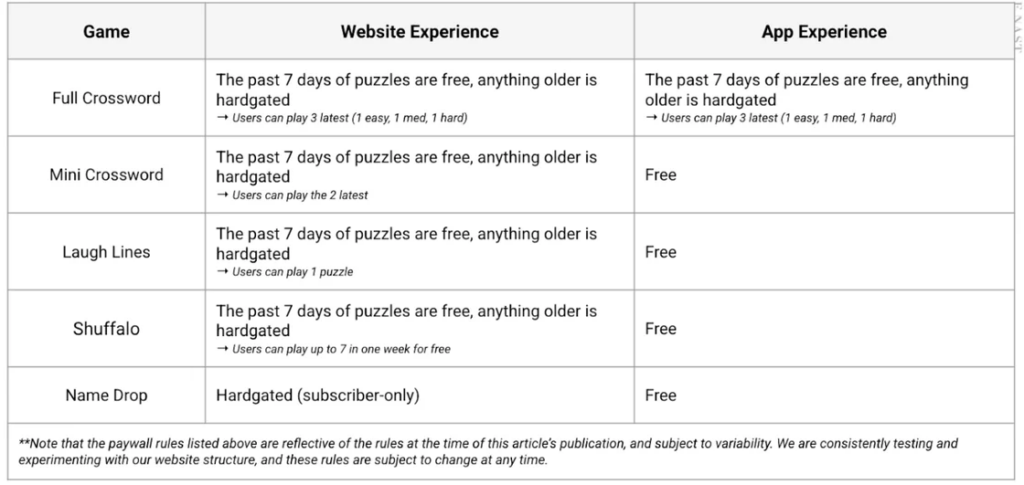
With the recent launch of a new game, Lindsay Ederheimer & the team revised their paywall model, separating the regular site paywall from the games paywall, with a windowed hardgate that meant users could play the most recent 7 days of puzzles for free, with older puzzles fully behind a paywall.
This approach works well for a few reasons:
> It’s a way to “soft launch” a paywall without frustrating loyal users. It also enables the team to get an initial read on engagement metrics as they consider other conversion levers
> Users can still play up to 5 crosswords (3 full, 2 minis) each week, a large sample. Plus, loyal users who are playing “archive” puzzles (any puzzle published more than 7 days ago) are at a higher propensity to subscribe anyway.
> By leaving many of the games free to play in the app, they can incentivize app downloads for users who may not be ready to subscribe just yet. Getting a user to take the action of downloading our app and creating an account is a tall order in the first place. The more users who at least download the app and build a daily habit of playing are more likely to subscribe down the road.
> Keeping the full archive of puzzles as a subscriber-only benefit makes the digital value proposition even stronger
Full article by Lindsay on Audiencers
What we’re reading this week
- Mediahuis Ireland’s journey to 100,000 digital subscribers: Unifying titles to have a single, distinctive brand, Subscriber Attention Time as their North Star, and focusing on the audience in every way
- 8 common misconceptions about donations, debunked
- Nieman Lab predictions for 2026 are out, what are the themes of note?
- Journalism is preparing to move beyond using AI as a tool, and instead structuring content to serve AI systems directly
- The relationship between media organizations and individual journalists is evolving, prioritizing talent and their creative output
- We’ll be combatting news fatigue by recalibrating tone, format, and purpose
See you in 2 weeks for the next newsletter,
Madeleine