

You're reading The Audiencers' newsletter #76 sent out on November 12th, 2025. To receive future newsletters straight to your inbox every two weeks, sign up here.
I have to admit that I totally forgot about this week’s newsletter 😅 It’s been a busy few weeks of travelling (I did though have a very fun time in Cairo this weekend at the Egypt Media Forum & visits to the pyramids!) and Tuesday was a bank holiday in France, so with 30 minutes to write and schedule this newsletter in time for those of you the other side of the world, I’m going to jump straight in! Enjoy!
In this week’s newsletter:
- The homepage isn’t dead, it just stopped being a page
- How to prevent subscription revenue leaks (i.e. people accessing paid content without paying)
- The Washington Post partners with Perplexity, offering audiences free access to the Post after downloading and using the Comet browser
- What we’ve been reading this week: articles to add to your reading list
The homepage isn’t dead, it just stopped being a page
Like a classic Halloween monster, the homepage isn’t dead… it’s just come back to life in a whole new form! 👻 🎃
Yes, so the traditional homepage as the single “front door” may no longer exist – readers typically don’t land on the homepage by typing a URL, they’re being pulled in from alerts, social feeds, AI answers, search…
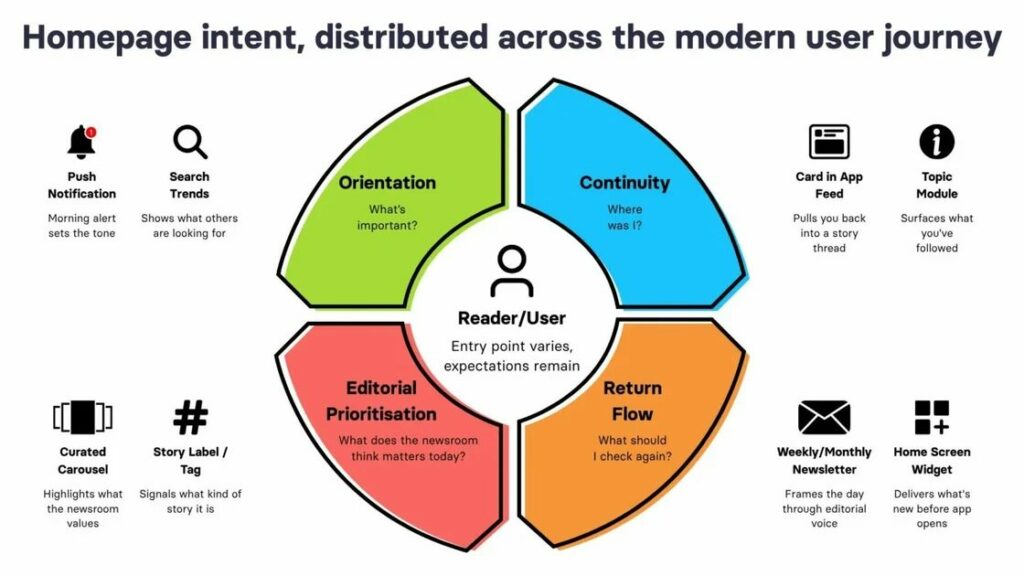
But whilst the true function of the homepage itself – providing context, rhythm, and a clear guide to what matters – isn’t what it once was, this function is now a distributed intent across the entire product.
In short, we should be applying “homepage thinking” to every touch point, instead of fixing it to a static page.
You should:
- Design for flow: Treat every alert, app page, and newsletter as a mini-homepage that offers continuity.
- Build rhythm: Use consistent, recognizable content formats and sequencing to build user trust.
- Ensure context: Make sure every “side door” (like a deep link from search) feels complete, allowing users to easily pick up where they left off.
The challenge isn’t to boost homepage traffic, but to embed the principles of good editorial judgment and guidance wherever the user happens to be.
> Full article by Heiko Scherer on The Audiencers
How to prevent subscription revenue leaks
One of the recent conversations in our WhatsApp group was about how publishers are dealing with “revenue leakage” – i.e. people accessing paid content without paying (or without paying correctly). This not only leaves money on the table, but also skews data on engagement and churn.
The main causes of leakage include:
- Password sharing: One paying account is used by multiple people (family, friends, or colleagues), costing you potential new subscriptions.
- Free-trial abuse: Users exploit trials by signing up repeatedly with throwaway emails or virtual payment cards to enjoy continuous free access.
- Misuse by companies in B2B offers: An entire office shares a single-user login meant for one person.
But Ali Mahmood, Digital News Strategist, came to the rescue in WhatsApp, highlighting that it’s not just about a technical fix, but a question of product design – publishers must build anti-abuse measures directly into their strategy and systems.
🛠️ Strategic Solutions
- Offer legal sharing options: Instead of assuming every account must be single-user, introduce paid multi-user or family/group plans for a higher price. This converts a potential “leak” into an upsell opportunity (The Washington Post introduced this recently for instance)
- Design smart trials: Deter free-trial abuse by requiring users to enter a non-disposable email and a valid, non-virtual payment method (even if they aren’t charged right away).
- Enforce gently: Use friendly on-site notifications or emails, like a notice about an account being “very popular,” before you resort to penalizing or blocking access.
- Use 2FA for friction: Enable Two-Factor Authentication (2FA) or passwordless logins, discouraging casual sharing.
⚙️ Technical Solutions
- Limit simultaneous sessions: Restrict the number of devices or logins that can be active simultaneously on one account (similar to streaming services).
- Monitor IP/Geolocation: Track approximate locations of logins (something Netflix has been using).
- Require re-authentication: Implement session timeouts or require users to log in again after a specific period (like every few days) to expire old sessions and add friction to shared accounts.
- Integrate with CRM: Use an internal dashboard to track high-risk accounts, creating potential B2B sales leads.
> Ali provides a very in-depth list of solutions in his article for The Audiencers
The Washington Post partners with Perplexity to acquire new audiences
New acquisition channel unlocked?
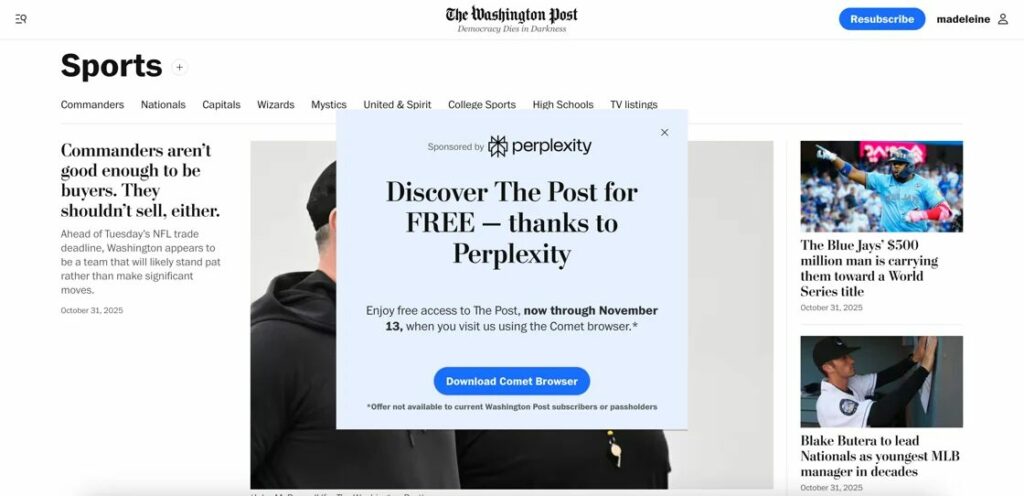
The Washington Post continues to innovate by partnering with Perplexity to offer audiences free access to the Post after downloading and using the Comet browser.
Partnerships are a pretty smart way to engage new audiences and prove the value of the Post’s premium product whilst developing a side revenue stream. We’ve seen it before (“Get 3 months free at X is you subscribe to Y”), but this is an interesting (controversial?) partner….
What we’re reading this week
- When it comes to introductory subscription discounts, it’s all about balancing volume vs revenue goals
- How The City has succeeded by building in community from the ground up
- Your subscription forecast is broken, and maths isn’t the problem
See you in 2 weeks for the next newsletter,
Madeleine