

In this guide, we share the various ways that publishers can segment their audience to develop a dynamic paywall model, with examples for each type of segmentation:
> By content type: free vs premium, user needs, date of publication...
> By user profile: level of engagement, user status, location...
> By acquisition channel: Google, social media, newsletters...

Some quick definitions:
> Audience segmentation: grouping users based on their profile or context, i.e. data that could impact their behaviour, inform us on what could convince them to subscribe or make them more or less likely to convert in that moment
> Dynamic paywall: a paywall that adapts for different audience segments. This could be in terms of the paywall design, messaging or even the journey itself (e.g. seeing a paywall or not). Note that "dynamic" doesn't necessarily equate to AI-driven. It's often rule based - i.e. a user reading a "politics" article sees a different paywall to a user reading a "sports" article.
There are 3 main buckets of audience segmentation with the goal of increasing conversion rates:
- By content type
- By user profile
- By acquisition channel
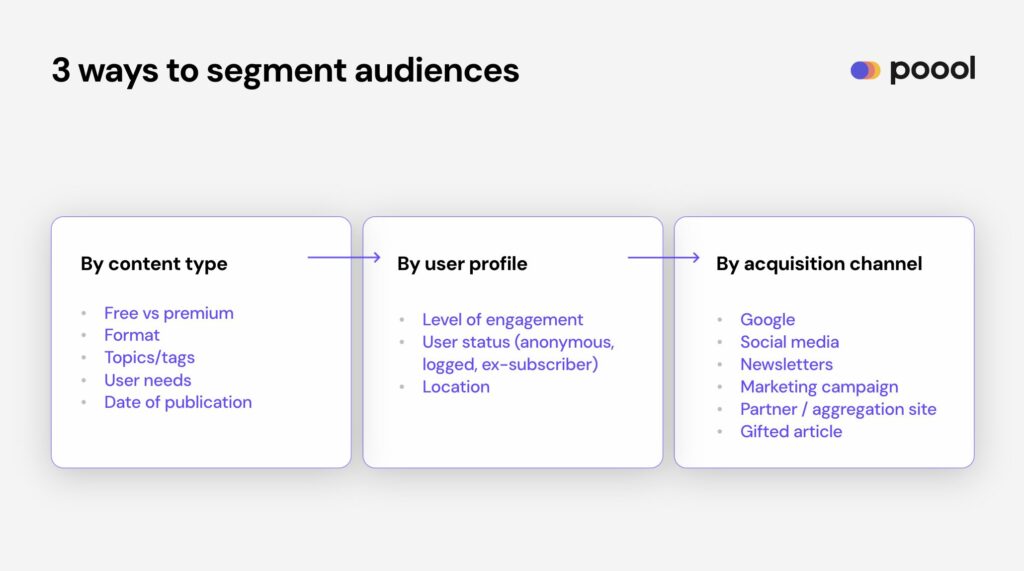
In each of these cases, the form of segmentation dictates who sees or experiences what. For instance, if we segment based on location, someone in Germany might see and experience something different than someone in the UK.
What can change based on the segment, in terms of the conversion strategy?
- The fact that the article is blocked or not
- The conversion journey (e.g. how many articles for free before the paywall, the use of a registration wall)
- The wording on the paywall
- The design (colours, image, etc.)
- The pricing and subscription offers pushed
Let’s dive into these 3 buckets of segments, with examples for each:
1. Segmenting by content type
For many publishers, this is the simplest starting point. It allows for extensive testing to discover what content converts best without risking overall traffic. It also helps to put editorial teams in control (to an extent) as the paywall strategy is based around their work instead of a user’s profile. This can be valuable when first launching a dynamic paywall to get buy-in from these teams.
This form of segmentation can take various forms:
- Content divided into free (often general news or commodity pieces) and premium (generally longer-form, investigative articles which can’t be found elsewhere)
- Format-based: e.g. articles vs games vs videos
- Topic- or tag-based: sports, politics, news, lifestyle
- User needs based: update me, give me a perspective, etc.
- Date of publication: e.g. articles published more than 30 days ago
Free vs premium
Organising content based on its value:
- Free content: keep open to maximize reach (often focused on ad revenue)
- Premium content: close to convert readers into subscribers
Some publishers are developing this a step further by adding 2 additional segments:
- Grey content: sometimes open, sometimes closed (based on editorial decision)
- Super Premium Content: with a hard paywall
This segmentation is often driven by two business goals: advertising and subscriptions. However, the articles used for advertising revenue (which aim to gain page views) can also serve the role of engaging audiences to move them through the funnel toward subscription.
A good place to start is a matrix analysis, placing articles in different buckets based on their “strengths”. A goal can then be established for each bucket, making the most of each article.
For instance, Mather suggests the following matrix:
- Mass appeal / top of the funnel: advertising revenue focus, so left open
- Premium content / bottom of the funnel: subscription focus, so behind a paywall
- Mission journalism: often left open
- Under-performers (that require further analysis)
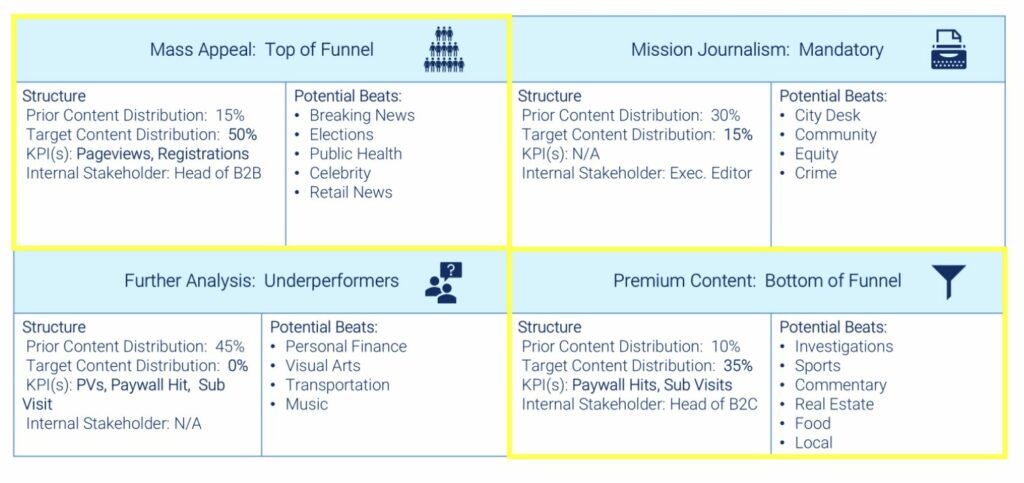
A slightly more complex approach is illustrated by FT Strategies below, who established 4 categories based on topic popularity vs willingness to pay: