
One of Europe’s largest publishers is bundling hiking apps, e-books and masterclasses alongside its journalism. Matthijs van de Peppel, Group B2C Strategy Director at Mediahuis, explains the strategy — and what the data is showing.
TL;DR
-> Mediahuis has built an 'essential subscription' bundling journalism with hiking apps, e-books, masterclasses and the New York Times

-> The bundle is structured around three layers — Inform, Guide and Enable — tailored by brand rather than by individual subscriber

-> Its 777 strategy aims for 70% of operational margins to be from digital by 2030, using the bundle to drive both volume growth and tier migration

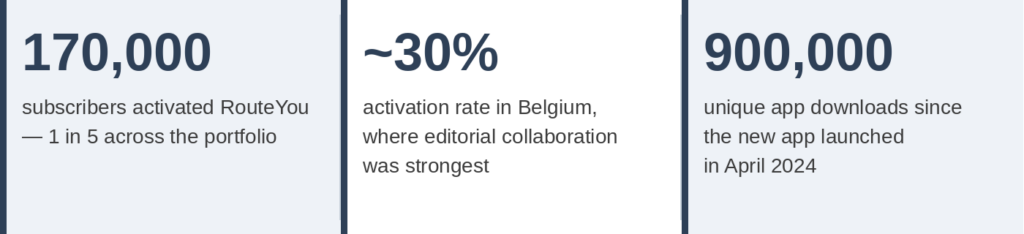
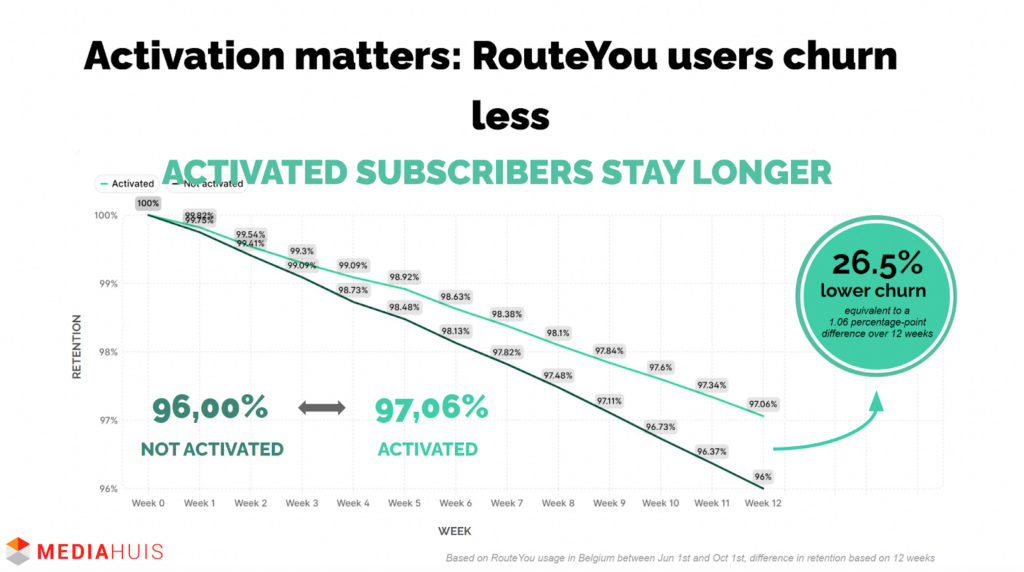
-> 170,000 subscribers activated RouteYou; activated users show 26.5% lower churn, and subscribers log in 2.4–3.0 times per month on average

Key lessons:
-> Stay within one degree of separation from journalism
-> Services that require a bigger conceptual leap tend not to stick

When Mediahuis added RouteYou, a Belgian hiking and cycling app, to more than a million digital subscriptions, it was a signal that something more fundamental was shifting. The Western European publisher, with titles spanning the Netherlands, Belgium, Ireland, Luxembourg and Germany, had been quietly building what it calls the ‘essential subscription’: a bundle that wraps news, practical service content and standalone apps into a single offering.
The goal is to solve a genuine consumer problem, making a digital subscription valuable enough that subscribers use it daily, not just when news breaks. Journalism remains the core, but the strategy rests on the belief that Mediahuis can offer subscribers more value beyond it.
Around 60% of Mediahuis subscribers are now digital, but operational margins on those subscriptions remain lower than on print. The essential subscription is the mechanism for closing that gap, by making the digital offering more compelling and driving subscribers towards the fuller, higher-priced tier.
The three-layer framework
The essential subscription is built around three layers:
- Inform covers the journalism itself, shifting towards depth and away from commoditised news, including what Mediahuis calls ‘signature journalism’: research-led, context-driven reporting that is genuinely core to each brand and not easily replicated elsewhere. Mediahuis runs ‘signature journalism weeks’ to identify what each title does best, redirect resources accordingly, and is shifting from text-only to audio and video as standard practice.
- Guide covers service journalism — restaurant recommendations and personal finance advice — which digital surfaces far more effectively than print.
- Enable is the newest territory: services that let subscribers act directly on what they have read. RouteYou was the first enabling service added to the bundle in 2023.
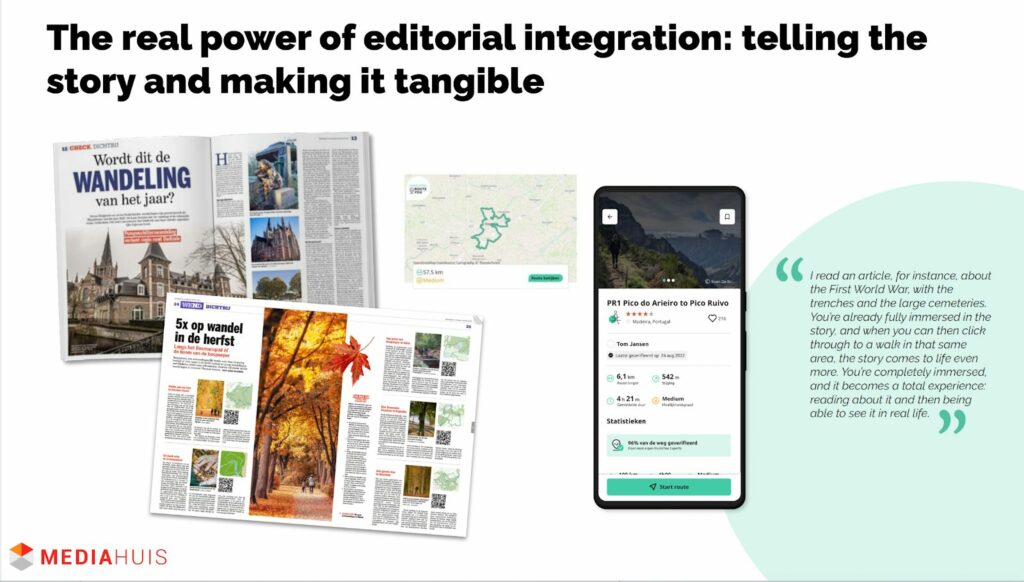
For instance, a subscriber reads about a hiking trail and can now open an app and navigate it. They can read a book review and, as part of their subscription, download it; subscribers in the Netherlands and Belgium receive one e-book per month.

“Stay close to your brand. Stay close to your journalism. Because then it makes sense to the subscriber.”
Brand-by-brand, not subscriber-by-subscriber
Rather than personalising the bundle for individual subscribers, Mediahuis has built different bundles for different brands:
- The New York Times partnership sits alongside the premium titles — NRC in the Netherlands, De Standaard in Belgium, and the Luxembourg brands — where an internationally minded readership sees a natural connection.
- E-books are offered more broadly, with selections varying by brand.
- RouteYou has been rolled out for all titles, but is particularly successful in regional and Belgian brands with strong outdoor and weekend-lifestyle content, where a survey of more than 10,000 subscribers had already shown that 24% wanted a hiking and biking app as part of their bundle.
“Different bundles work better for different brands,’ van de Peppel explains. ‘We try to tailor it really around the brand and make those choices which make sense to the brand.“
The RouteYou acquisition
RouteYou is a Belgian company used by more than 15 million outdoor enthusiasts, with its strongest presence in the Netherlands and Belgium. Since the Mediahuis acquisition in 2023, coverage has expanded into the Irish, Luxembourg, and German markets, where the publisher’s titles already have deep roots. It competes in the same space as Strava, but with a distinctly local character and established relationships with regional tourism boards.
Mediahuis’s regional titles had long published hiking and biking content, especially in weekend editions, but the next step was always missing: readers could learn about a trail, but had nowhere to go from there. Now, a QR code in the article links directly to the route in the RouteYou app. ‘It’s a strong connection with the editorial rooms,’ van de Peppel says. “You can really make a direct connection between the content and then going out and doing something with it.’
The acquisition was not conceived purely as a bundle enhancement — Mediahuis bought a standalone business, intending to develop both sides of the business. Since then, investment in a native app and an expanded RouteYou team has driven +98% growth in standalone subscribers in 2025.
When RouteYou access was extended to over a million Mediahuis subscribers, it immediately dwarfed the app’s existing standalone user base. Those who came through the news bundle were subscribing to journalism; the outdoor features are a welcome addition rather than the draw.
What the numbers show
The activation numbers tell part of the story. The retention numbers tell the more important one. Mediahuis tracks whether subscribers who have activated RouteYou behave differently from those who have not, and they do.
Over a 12-week period, subscribers who had activated RouteYou were significantly more likely to remain subscribers at the end. For every 100 who had not activated, 4 had churned. For every 100 who had, fewer than 3 had churned. At the scale Mediahuis operates, that difference compounds quickly.
The perception data reinforces this.
- Among all Mediahuis subscribers, around 52% consider RouteYou a valuable addition.
- Among those who have actually used it, that figure rises to 82%.
The gap between the two numbers is the central challenge: the product works, but only once subscribers try it. Getting them to that first experience is where most of the activation effort goes. Mediahuis offered exclusive webinars to help subscribers get started; 12% of readers attended, and 54% of those participants were already Mediahuis readers who engaged with the outdoor content in their titles.
Sustained usage backs up the initial activation picture. Active users log in 2.4 to 3.0 times per month on average, with 15% opening the app at least once a week, numbers that predictably spike in the spring and summer hiking season. In total, 49% of eligible Mediahuis subscribers used RouteYou at least once in the past year.
Mediahuis has been drawing lessons from the New York Times, whose bundle is a well-documented case study in how added services drive both retention and revenue per subscriber. ‘They see strong effects on retention and ARPU when people start using more services, van de Peppel says. “We are seeing the same thing, which is really encouraging.’
The 777 strategy
The essential subscription is the commercial engine behind Mediahuis’s 777 strategy: shifting 70% of operational margins to digital by 2030. Currently, the balance runs roughly the other way, at around 60% print and 40% digital.
Van de Peppel frames the mechanism plainly: it works on both Q and P, quantity and price. A more compelling subscription drives digital subscriber growth. And because most additional services are only available in the full premium subscription — not the basic tier — the bundle creates structural upward pressure on ARPU. The full subscription costs roughly twice as much as the basic tier, and as the bundle becomes more valuable, more subscribers opt for the full tier, either at sign-up or by upgrading.
‘We also see a shift from the basic subscription to the full subscription,’ van de Peppel explains. ‘Which in the end means they pay a higher price. We increase value, but of course, the value coming back is also higher.’ Volume growth and tier migration together are designed to get digital subscriptions generating the margins that print once did, and within a seven-year window.
Advice for publishers considering a similar path
Van de Peppel’s guiding principle is staying within ‘one degree of separation’ from core journalism, adding only services that connect naturally with what the newsroom already produces:
- The New York Times partnership works because Mediahuis titles already cover international affairs.
- E-books work because those titles are already reviewing books.
- RouteYou works because brands have always written about the outdoors — and the data already showed subscribers wanted it.
Where the connection has to be invented, it tends not to stick. Van de Peppel’s advice to other publishers is simple: don’t stray too far from what your newsroom already does well.
The lesson he returns to most on RouteYou is editorial embrace. Newsrooms are independent — there is no guarantee journalists will link content to the app. Where they do, the activation numbers bear it out: Belgium, with the strongest editorial collaboration, hit nearly 30% activation, compared with a portfolio average of 1 in 5. The success of RouteYou’s adoption really depends on editorial collaboration.
Van de Peppel’s target is for at least 70% of digital subscribers to regularly use at least one additional service, weekly or monthly. ‘We launched a lot last year. This year, we won’t launch as much. We will focus on what we have and really make it work.’