
In a country with 4 official languages, and in the complex landscape of international public service media, SWI swissinfo.ch is a pretty unique case (to say the least!).
With a mandate to reach the Swiss diaspora and a globally curious audience, the publisher needs to navigate linguistic diversity and localized contexts, all digital- and community-first.
Although you may not relate to their context, Swiss Info’s strategies to achieve all of the above certainly provide important lessons for the wider industry.
We spoke with Veronica DeVore, Head of Audience, to discuss the operational and editorial challenges of adaptation over translation, the role of community engagement across borders, and product-building for different audiences.
Company card:

SWI swissinfo.ch is the international online service of the Swiss Broadcasting Corporation (SBC).

For many national broadcasters, the "international service" is often a secondary consideration. At SWI swissinfo.ch, it’s their core mission. Operating in 10 languages, ranging from the four Swiss national languages to English, Arabic, Chinese, and Russian, the platform serves as a bridge between Swiss perspectives and global conversations, with about 75% of audiences located abroad.

“Our content puts Switzerland in touch with the world and reaches people in all 195 countries recognised by the United Nations.

Thanks to our journalistic quality, our articles are referenced up to 80 times a week in 46 languages and serve as a reliable source not only for diplomatic services and journalists abroad.” - Swissinfo.ch
Tapping into global touchpoints
It’s part of the uniqueness of Swiss info and also part of the challenge: doing right by all of these language markets whilst bringing perspectives from Switzerland. That means reporting always has some touchpoint to Switzerland, but the team looks for points where it’s an internationally relevant conversation.
“We aim to be at the intersection of where Switzerland has an impact on global conversations,” says DeVore. “Whether it’s the pharma companies operating out of Basel, the diplomatic hub of Geneva, or the unique system of Swiss direct democracy, we look for touchpoints that resonate internationally.”
Adaptation over simple translation
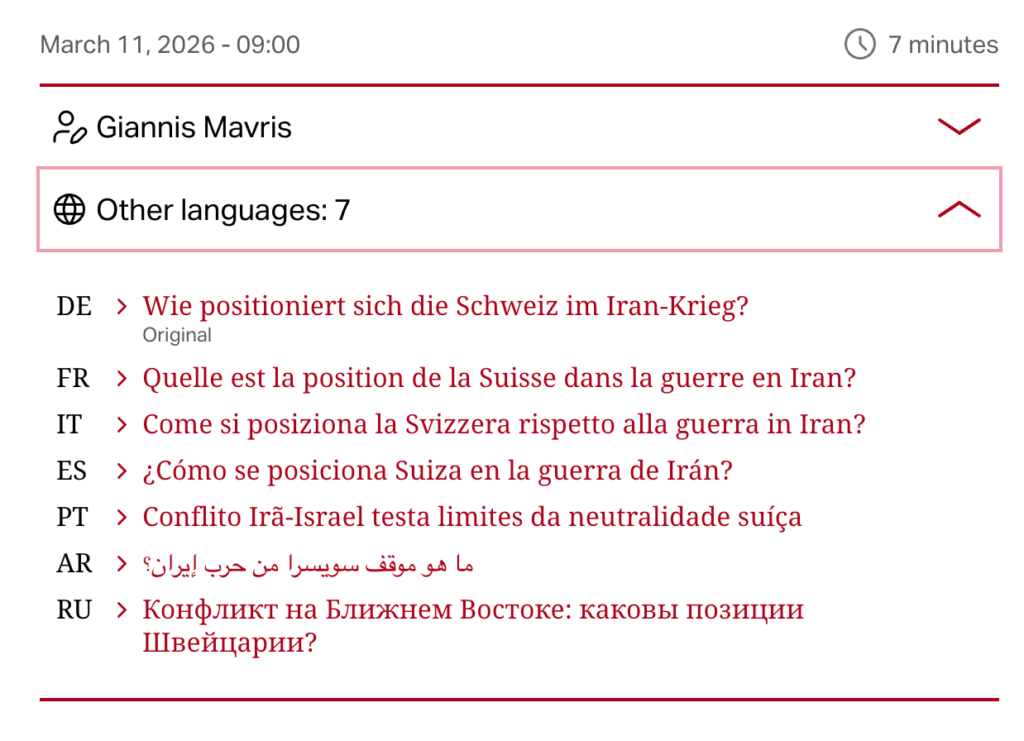
One of the most striking aspects of the swissinfo.ch workflow is the move beyond literal translation. Instead, the team practices adaptation.
With small teams of roughly three people per language service, journalists must act as cultural mediators. “It’s not just translating from English to Chinese – you have to adapt for the context and the market. For example, how do you explain the Swiss Federal Council, a body that has no single president, to an audience in China? Our teams often have to invent lexicons and style guides to transmit these unique political concepts effectively.”
Deep engagement through debating
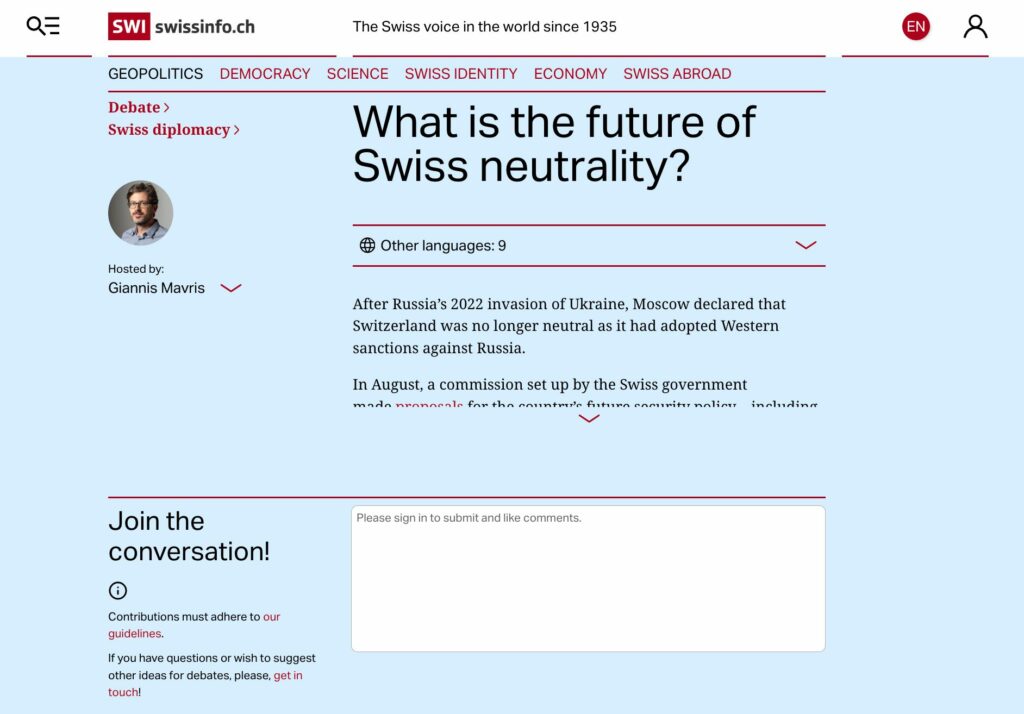
Moving away from a traditional broadcast model, swissinfo.ch has pivoted toward community building to bring these diverse audiences together. Five years ago, they launched a debate format to replace standard comment sections.
Instead of readers commenting in their own language, often sharing information that didn’t really serve anyone’s needs (not to mention the necessity to moderate heavily), journalists now pose specific, theme-based questions seated in a theme currently being explored.
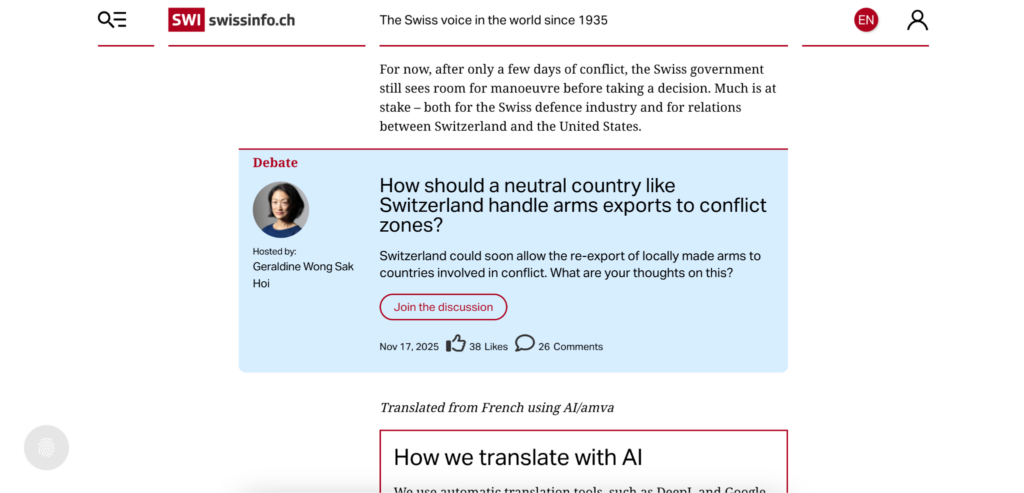
To solve the problem of linguistic silos, they implemented auto-translation within threads, usually using Deepl but not only. The best tool/LLM is chosen per language depending on the feedback of the editors. This allows a reader in Brazil to engage in a conversation with a reader in Russia, both viewing the thread in their native language.
This focus on dialogue has led to long-running, nuanced discussions on high-stakes topics like Swiss neutrality, which DeVore notes has seen consistent engagement for over a year following the invasion of Ukraine.
“On some topics, we get really interesting, nuanced, and sometimes surprising threads going, for instance on things like Swiss neutrality. Of course, it’s a hallmark of Switzerland; people think of that quite quickly alongside cheese and chocolate and army knives when they think of the country, but what does it really mean in practice? Especially after the Ukraine war started. And this thread has had hundreds and hundreds, an evergreen comment section that’s been going for a year or more.”
Products for niche needs
SWI swissinfo.ch also develops bespoke products for specific audience segments. Of course, part of their niche is the Swiss connection, but at the same time they’re trying to fill gaps in people’s media needs in markets where accessibility isn’t exactly a given, or where content might be behind paywalls.
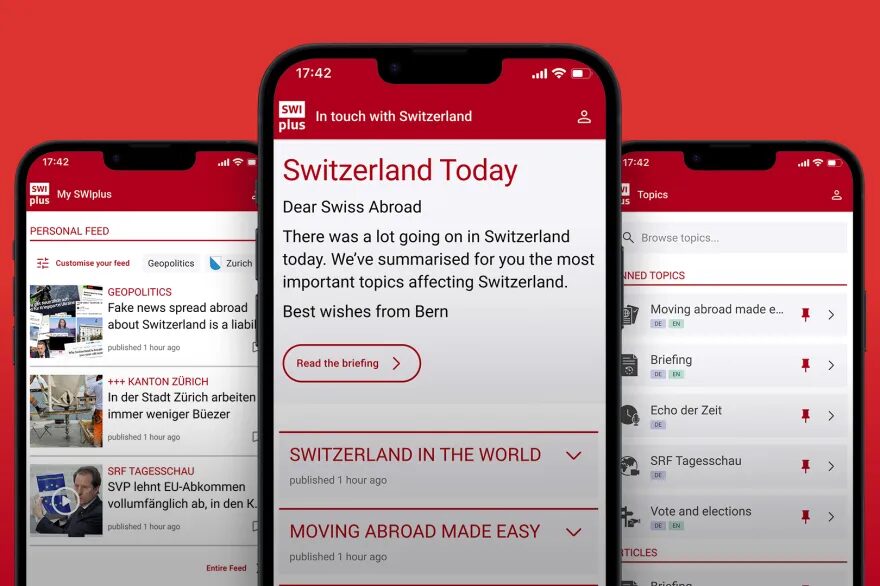
- The SWI Plus App: Tailored for the Swiss diaspora (over 800,000 citizens living abroad), allowing them to personalize their news feed across multiple languages
- The Russian Edition: Recognizing that their website is partially blocked in Russia, the team has leaned into video-based platforms like YouTube, producing long-form, one-on-one interviews (up to an hour) to provide in-depth context to Russian speakers
- ‘Truth or Tale’: A short-form video series focused on myth-busting common misconceptions about Switzerland, designed for social media discovery
Trust in the age of AI
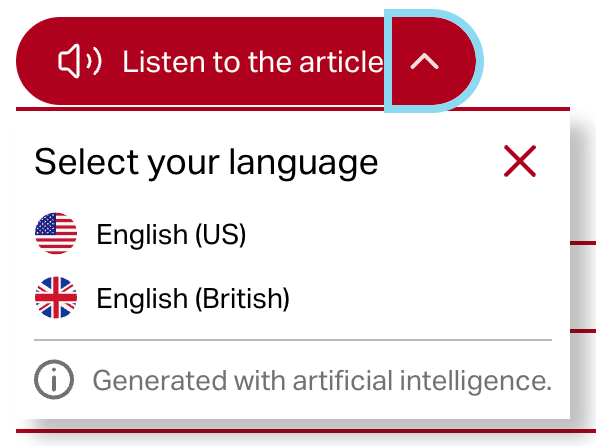
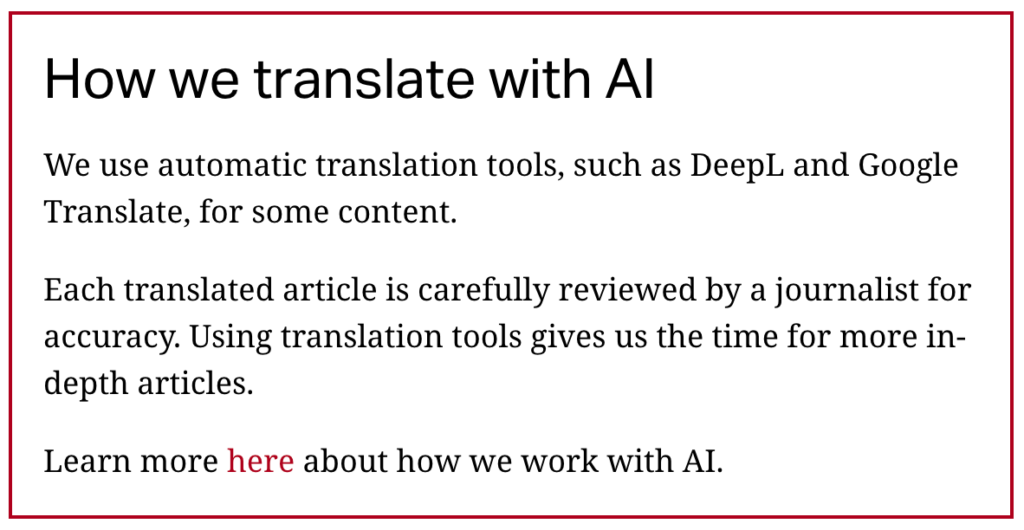
As a publicly funded media outlet, trust is the currency swissinfo.ch relies on. DeVore highlights their involvement with a recent research cohort piloted by the US-based nonprofit Trusting News, which helped them understand audience needs around AI transparency and develop “disclaimers” regarding the use of AI.
“We are a niche media with an international footprint, which makes it even more important to show people at a glance that we are trustworthy.” While the organization uses AI for translation assistance and other tasks to manage resource limitations, they maintain a strict “human-in-the-loop” policy to ensure cultural accuracy and editorial integrity.