

Max Moné is co-founder and CEO at Poool, the dynamic journey builder to boost subscription conversion, engagement, and loyalty.

This article is the second in a 6-part series where Max shares what he learned from studying 100 subscription business models across 15+ industries. If you haven't read the first one yet, start here.
Why we’re focusing on media for this one
In most subscription businesses, the rules for accessing the paid offer are simple. You subscribe to a box, you get the box. You hit a usage limit on Claude, you’re asked to upgrade. You want to get access to Calm for guided meditation? You get 1 week, then have to pay. Each model has its logic, but it’s tied directly to the product.
In media, it’s different.
Media online was historically free (almost always). Then publishers moved to paid models, and products got more complex: apps, newsletters, podcasts, games, bundling, community. Because of this, an enormous variety of access models emerged.
So we decided to go deep into media alone in today’s episode. Because the question “what’s free and what’s paid” is one of the most consequential product decisions in our industry.
And there’s no right or wrong answer. The right model depends on your organization, your editorial DNA, your content, your business model… It’s specific to each media, each newsroom, each audience.
The goal here isn’t to tell you what to do. It’s to show you the range of what exists, so you can figure out where the opportunities are for your unique context.
The engagement-frustration trade-off
The data on this has been clear for a while now.
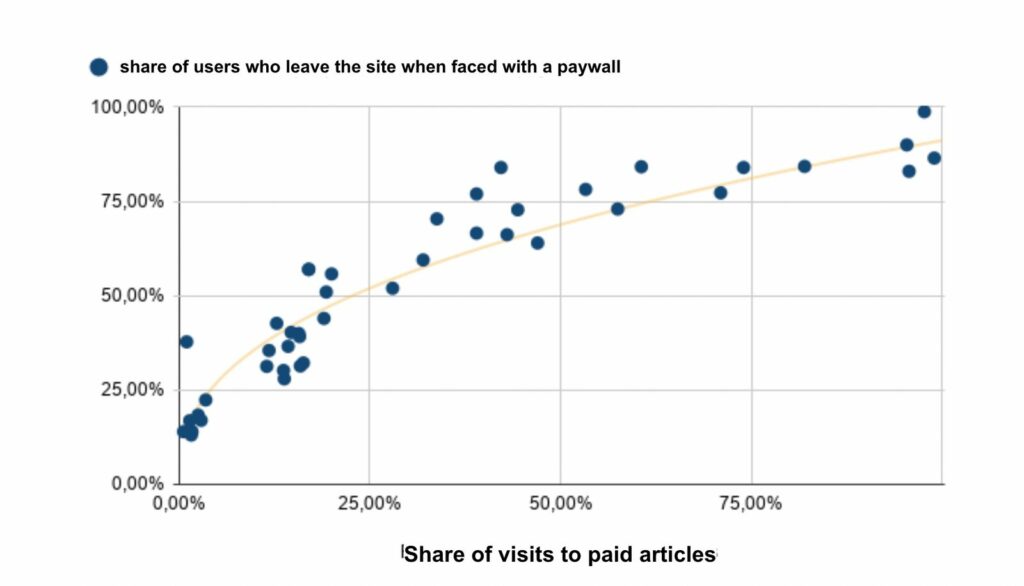
In 2021, we published the Digital Media Review (DMR – a research initiative with Google and Le Geste – a french association for publishers) at Poool. One data point stood out: the relationship between the share of traffic exposed to paid content and conversion. The correlation is clear: the more you expose, the more you convert. But only up to a threshold. Past that, conversion plateaus or falls. Frustration alone is not a sufficient reason to subscribe.
And the other side of the coin is just as important: the DMR also showed a strong correlation between traffic on paid articles and the share of users who simply leave the site when hitting a paywall. The more you frustrate, the more people bounce. That’s not just a missed conversion. That’s a direct hit on engagement, on page views, ad revenue, and your ability to build any relationship with that user.
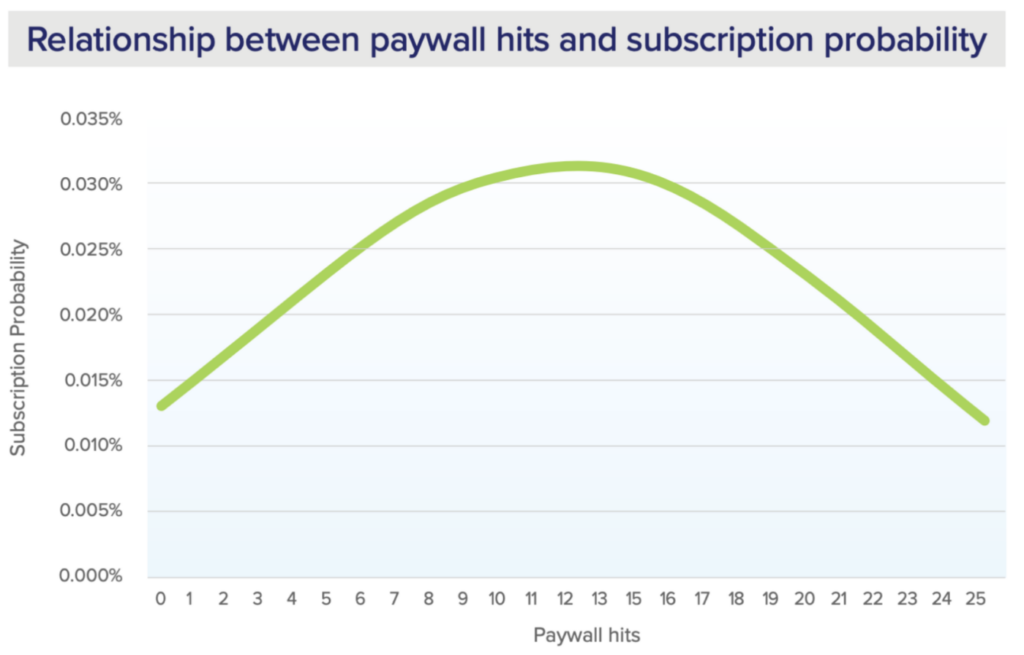
In the same year, Mather Economics published a study (part of a GNI LatAm Subscriptions Lab report) looking at paywall hits per user. Subscription probability follows a bell curve: up with each hit, peaks, then back down. Same conclusion, different data.
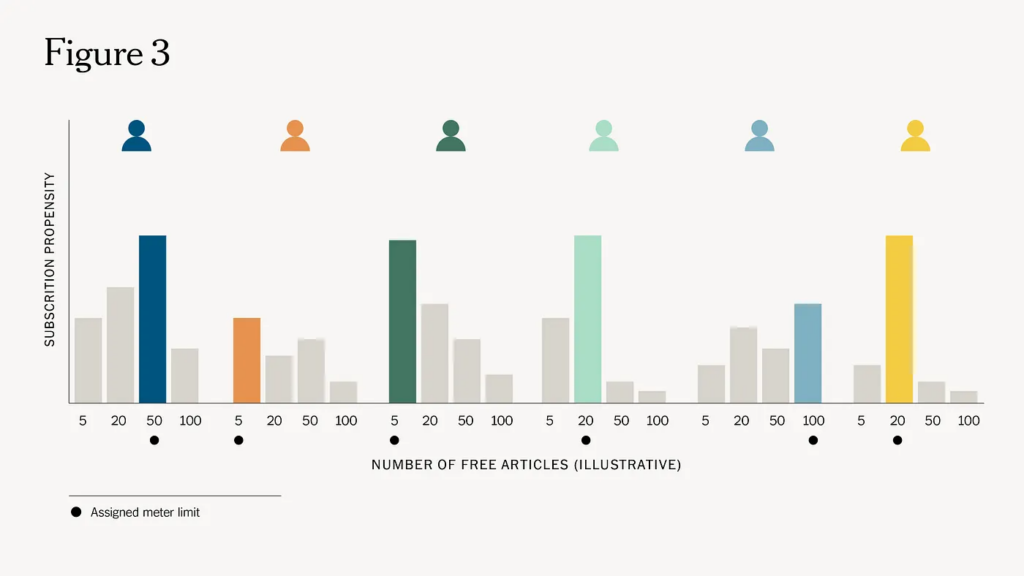
Then in 2022, the New York Times shared what brought all of this together (Audiencers analyzed it here). When they launched their paywall in 2011, the meter limit was the same for everyone: a fixed number of free articles, a regwall, some more articles, and finally a paywall.
Over the years, they developed the Dynamic Meter, a machine learning model that sets personalized meter limits per user.
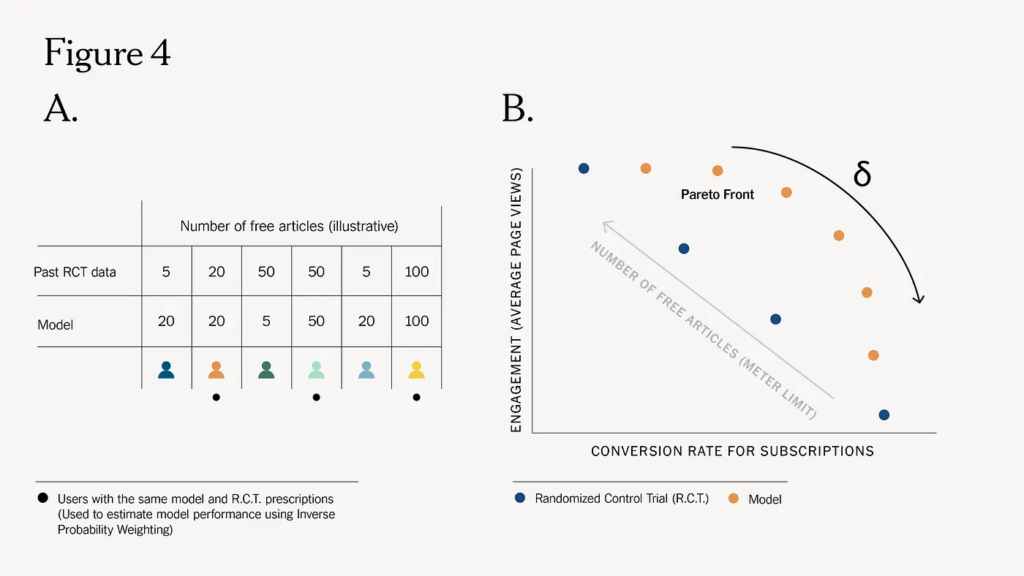
The core insight: the model optimizes for two metrics simultaneously, engagement and conversion. And these two metrics have an inherent trade-off. More paywalls → more subscriptions, but less readership. They proved this with randomized control trials: as the meter limit goes up, engagement increases but conversion drops.
With a fixed approach, you’re forced to choose. Maximize engagement, or maximize conversion. Not both. There’s always a window of lost revenue that a single rule can’t capture. The Dynamic Meter expands that window by personalizing: more frustration for high-propensity users, more openness for low-propensity users.
None of this is new. DMR: 2021. Mather Economics: 2021. NYT: 2022. We’ve known this for years. And yet, the vast majority of publishers still use a uniform paywall for all users.
If you don’t personalize, you’re forced to make a choice between engagement and frustration. And that choice won’t be the right one for all users. That’s why more and more sophistication has developed. And the jump from “manual” to “1-2-1” isn’t binary. There’s a whole spectrum in between.
The 6 levels of paywall sophistication
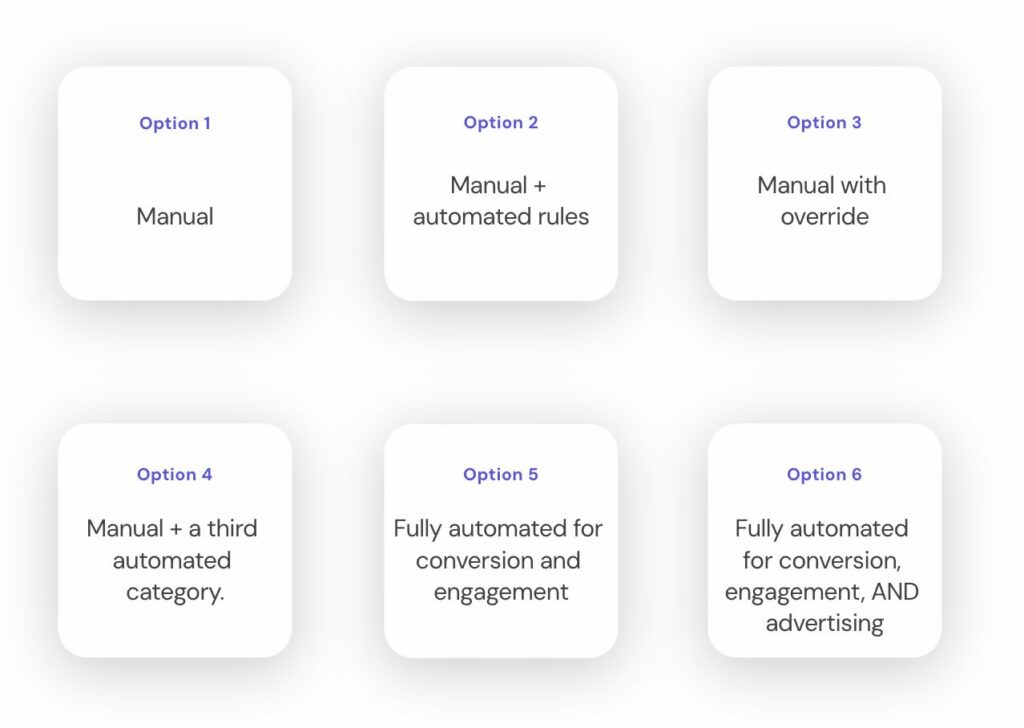
Being at level 1 doesn’t mean you’re behind. But it means there are probably missed opportunities. The question is whether these missed opportunities are big enough to justify the resources needed to reach the next step.
- Level 1: Fully manual
Free and paid decided by hand, article by article. An Atlas & Audiencers’ study confirmed this is still the norm: the decision is based on the article’s perceived value. Breaking news free, analysis behind the wall (to simplify it to its core).
- Level 2: Manual + automated rules. Paid content still decided manually, but rules modify access based on additional criteria.
Foreign Policy shared their approach on The Audiencers. They segment by publish date (under 7 days: hard-walled; older: standard meter), but also by cohort. Users with high search intent and churned subscribers are hard-walled (high subscription propensity). Social referrals see a registration wall with a free page view (low subscription propensity, but conversion on registration is 100x higher than on subscription). That registration data became their strongest conversion driver. No AI needed. Just smart segmentation.
- Level 3: Manual with override.
The base decision is manual, but the system can override contextually: closing a free article for a high-propensity user, opening a premium one for a segment you want to engage. A first step toward personalization without losing editorial control.
- Level 4: Manual + a third automated category.
Free and premium decided manually, but a “grey zone” is managed automatically based on user profile, device, or source. Ideal for publishers in transition between fully manual and more automation, while still giving the editorial team a great deal of control (yes, the business side gets some autonomy, but only on categories validated with editorial).
- Level 5: Fully automated for conversion and engagement.
The system decides everything: whether to show a wall, which type, what meter limit, per user. The engagement/frustration trade-off managed dynamically.
Business Insider does this with AI: reading habits, traffic source, content genre propensity. The algorithm decides: paywall, registration wall, or nothing.
The NYT does it with the Dynamic Meter (as we talked about earlier). It learns from first-party engagement data (no demographic or psychographic features), adjusts per user, and continuously runs randomized trials to improve. This is the model that expanded the opportunity window we described above (source).
- Level 6: Fully automated for conversion, engagement, AND advertising.
The decision also integrates ad revenue. Fortune’s CCO at the time, Selma Stern, explained that if a user’s subscription probability is too low (first-time visit, smartphone, social media), the paywall opens and the page view is monetized through ads. The goal is to maximize total user value, wherever it comes from (which I personally think is an amazing model for short term profitability – because yes, sometimes long-term profitability might require less revenue in the short-term).
What you can take away from this (and test tomorrow)
Figure out which level you’re at. If all your users see the same paywall regardless of behavior, source, or profile: what are you missing?
Try one rule-based variation before thinking about AI. Foreign Policy’s 100x stat didn’t require machine learning. It required a hypothesis and a way to test it.
Start by looking at your bounce rate on paywalled content. If a significant share of users leave the site when they hit your paywall, that’s revenue you’re losing twice: no subscription AND no engagement. The DMR, Mather Economics, and NYT data all showed the same thing: a uniform paywall always forces a trade-off. Even a simple first step (like showing a registration wall instead of a paywall to low-propensity users) can start closing that gap. That’s what Poool makes it easy to test.
See you next week for Article 3, where we leave media and look at how the best subscription businesses across all industries think about conversion.
PS: This article was about the decision logic (who sees a paywall, and when). We didn’t cover the blocking method: how the paywall is technically implemented, front-end or server-side, and what that means for content protection, AI scraping, and SEO. That’s a separate topic, and we covered it here: “Paywalls & SEO“. All 6 levels above work with all blocking methods.