In this article, Davide Liverino, B2B marketing leader focused on subscription revenue growth, uncovers how Netflix has used the release dates of the latest Stranger Things episodes as a strategic lock-in for their subscription model.
-> The clever gap between the first and final episodes being released, ensuring subscribers pass a billing cycle whilst waiting
-> Strategic 'pulses' of releases to build buzz around the series, turning audiences into a free marketing army
-> Playing a defensive strategy by releasing these episodes during the "churn danger zone" over the holidays when consumers tend to cut finances
Finally, Davide shares how subscription leaders can put this to practice in their own model
Netflix’s Stranger Things schedule is a masterpiece of financial engineering. It looks like a holiday gift for fans. It is actually a calculated assault on the monthly billing cycle.
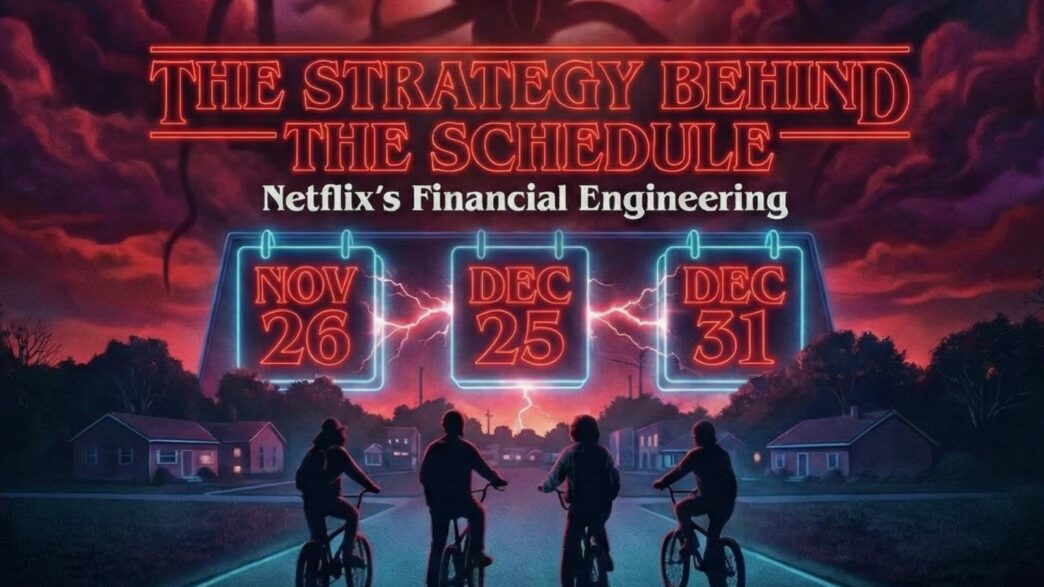
I’ve been analysing the release schedule for the final season of Stranger Things, and the dates (Nov 26, Dec 25, Dec 31) reveal a sophisticated “Subscription Bridge” strategy. By creating a 36-day window for a 30-day product, Netflix isn’t just releasing content; they are mathematically forcing a renewal event.
In this deep-dive article, I deconstruct:
- The “Subscription Bridge”: How a 6-day gap can double Lifetime Value (LTV).
- The “Pulse” Strategy: Why the binge model is dead, and what is replacing it.
- The Defensive Moat: Making use of engaging content releases during churn danger zones
- The B2B Application: How SaaS leaders can use “cliffhanger” mechanics to reduce churn during high-risk renewal periods.
This is a blueprint for anyone managing recurring revenue.
At first glance, the release schedule for the final season of Stranger Things looks like a celebration of fandom. A Thanksgiving premiere (November 26th), a Christmas special (December 25th), and a New Year’s Eve finale (December 31st). It dominates the Western holiday calendar, turning a TV show into a global cultural event.
But if you look past the nostalgia and the Demogorgons, you will see one of the most sophisticated pieces of financial engineering in the history of the streaming wars.
This schedule isn’t about artistic pacing. It is a calculated assault on the subscription model’s greatest weakness: the “transient” user who joins, binges, and cancels in 29 days.


Part 1: The Architecture of the “Subscription Bridge”
In this analysis, we will explore the financial mechanics behind this pulse strategy and the defensive moat it creates during the holidays. Crucially, I will outline an actionable strategy for applying these same retention principles to your own B2B revenue architecture.
The genius of this release lies in the cold, hard calendar math.
The gap between the first episode (November 26th) and the finale (December 31st) is exactly 36 days.
A standard Netflix subscription lasts 30 days.
This is not a coincidence; it is a “Subscription Bridge.” By engineering a release window that exceeds the billing cycle by just six days, Netflix has mathematically checkmated the “tourist” subscriber.
Consider the user journey for the millions of users who will sign up solely for Stranger Things:
- The Acquisition (Nov 26): The user subscribes to watch the premiere batch. Their billing cycle is set to renew on December 26th.
- The Retention Trap (Dec 25): One day before their subscription expires, Netflix drops the second batch. This is the bait. The user watches the Christmas episodes, re-engaging with the narrative arc.
- The Lock-Out (Dec 26): The user’s subscription expires. They have seen the Christmas special, but the story is incomplete.
- The Forced Conversion (Dec 31): The finale drops. To see how the story ends, the user is mathematically locked out unless they trigger a second payment.
The Revenue Impact:
In a standard binge model, a transient user generates £12.99/$15.49 (one month of Standard tier in the UK/US).
In this “Bridged” model, that same user is forced to generate £25.98/$30.98.
If Stranger Things attracts 5 million re-activations or new sign-ups (a conservative estimate given its history), this 6-day bridge alone generates roughly £65/$77 million in incremental revenue, which is pure profit derived solely from scheduling.

Part 2: The “Pulse” Strategy vs. The Binge
For a decade, Netflix defended its “all-at-once” binge model as a superior user experience. Meanwhile, competitors like HBO (House of the Dragon) and Disney+ (The Mandalorian) enjoyed the sustained cultural relevance, and months of retention, that come with weekly releases.
The binge model offers a massive dopamine hit, but the conversation burns out in a week. It creates a spike in acquisition but fails to build a habit.
With Stranger Things, Netflix is deploying a Hybrid Pulse Strategy designed to solve this attention deficit.
By releasing content in three distinct “pulses” over five weeks, they are attempting to capture the best of both worlds:
- Pulse 1 (Thanksgiving): The Volume Drop. This satisfies the binge-watchers’ need for immersion and hooks the audience deep into the ecosystem.
- The Speculation Engine (Nov 27 – Dec 24): This “dead air” is a feature, not a bug. It is designed to be filled by the audience. The gap breeds Reddit theories, TikTok breakdowns, and media speculation. It turns the audience into a free marketing army, sustaining Daily Active Users (DAU) without Netflix spending a dollar on ad spend.
- Pulse 2 & 3 (The Holidays): The Event Drops. By aligning specific high-stakes episodes with Christmas and NYE, they turn streaming into “appointment viewing,” reclaiming the communal experience usually reserved for live sports.

Part 3: The Defensive Moat (Holiday Share of Mind)
The dates themselves are a masterclass in defensive strategy. November, December, and January are the “Churn Danger Zone.” Consumers are auditing their finances for Christmas spending, and discretionary subscriptions are often the first to be cut.
Simultaneously, competitors are aggressive. Disney+ and Amazon Prime save their biggest blockbusters for this window to capture families during their time off.
By claiming the three biggest Western holidays, Netflix is playing defense. During the holidays, consumers have high “Share of Time” (days off work) but fragmented “Share of Attention.” By aligning releases with specific holidays, Netflix positions Stranger Things not just as a show, but as the default family activity.
They are co-opting the holidays to crowd out competitors. If a family is debating whether to keep Disney+ or Netflix for the holidays, the existence of a Christmas Day Stranger Things event makes Netflix the “must-have” utility for that month.

Part 4: The B2B Operator’s Playbook
While most of us aren’t managing billion-dollar media assets, the principles behind the “Subscription Bridge” are directly applicable to B2B SaaS and subscription businesses.
We often make the mistake of front-loading value, delivering everything during onboarding and then wondering why churn spikes at Month 12. We treat renewals as administrative dates rather than strategic opportunities.
Here is how you can translate Netflix’s strategy into B2B revenue protection:
1. The “Contractual Cliffhanger”
The Concept: Never allow a customer to reach a renewal date with “nothing left to see.”
The Tactic: Audit your customer success journey. If you have a renewal coming up in Q4, structure your implementation so that a critical “unlock” (such as a new module, a strategic consultation, or an advanced data report) is scheduled for delivery just after the renewal date.
The Result: You change the renewal conversation from “What have you done for me lately?” to “I need to stick around to get X.”
2. The “Pulse” Release Cycle
The Concept: Avoid the “Big Bang” release that is forgotten in a week.
The Tactic: Instead of dumping a massive feature update once a year, release updates in “pulses” aligned with your customers’ internal budget cycles. If you know your clients review vendors in Q4, ensure you have a “Christmas Drop”, a high-impact feature release scheduled for November that validates their decision to renew right before they make the decision.
3. Engineer the Bridge
The Concept: Use data to predict and bridge churn gaps.
The Tactic: Analyse your churn data. If you see a spike at Day 90 (end of onboarding), look at your product usage at Day 80. Is the user running out of things to do? You need to engineer a “Subscription Bridge” at Day 75. This is something that initiates a new value cycle that cannot be completed until Day 100.
Conclusion
Netflix has proven that release schedules are no longer just about art; they are a function of the billing cycle. As commercial leaders, we need to stop viewing our product delivery as a flat line and start designing it as a series of bridges that guide the customer safely over every renewal risk.