
Spektrum der Wissenschaft, a leading German science journalism publisher, embarked on a multi-phase journey to optimize its digital subscription model, Spektrum+. Facing the challenge of engaging a broad audience with “deep, heavy, nerdy science content,” and understanding the limitations of resources, the publisher turned to a rigorous, data-driven testing strategy to build a product based on actual user behavior rather than internal assumptions (what a crazy thought, I know!).
At Audiencers’ Festival in Hamburg, Ann-Kristin Ebert, ecommerce Manager at Spektrum, shared their two phases of getting started with segmentation.
TLDR: lessons from Spektrum’s journey

- Start by testing everything to understand audiences and prove the importance of segmentation

- Then test what matters based on learnings. Prioritize based on valuable, large and underutilised segments

- Let go of perfectionism! Accept that some things that can’t be done now, and maybe not next month, maybe not even this year. “We can’t bake big pretzels with tiny ovens!”
Phase 1: “Testing Everything” (test like Darwin was watching!)
In the initial phase, Spektrum adopted an exhaustive testing philosophy, described as “testing as if Darwin was watching”. The goal wasn’t necessarily to find a single winning variation immediately, but to build a comprehensive understanding of how different tests performed across diverse user segments.
Strategy and implementation
Spektrum focused on rapid, lightweight tests at the beginning of the purchase funnel to gain quick-win insights while minimizing cross-team dependencies. They initially targeted user groups they already knew well or could reach directly.
Key learnings from phase 1:
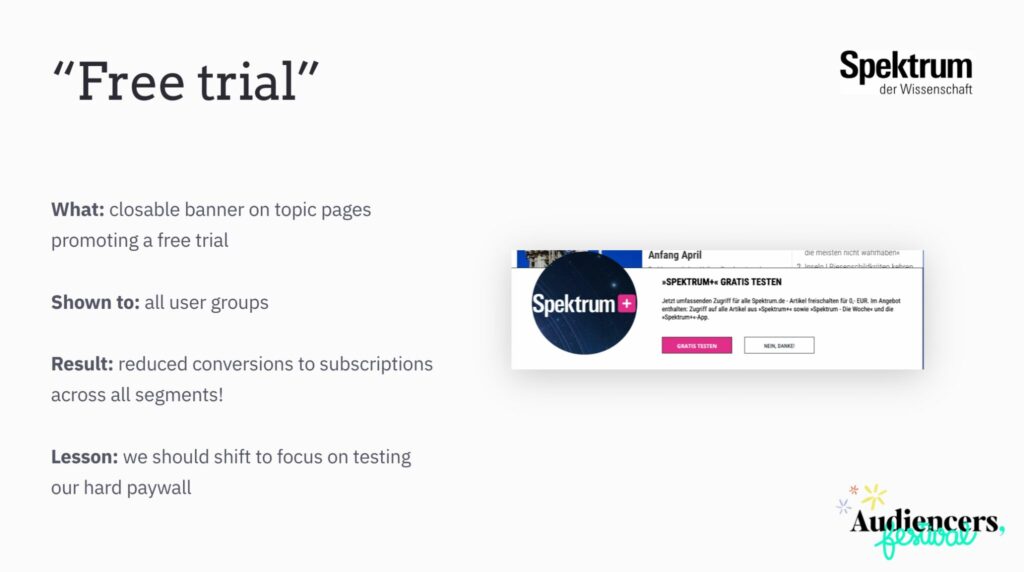
- Free trials: A banner promoting a free trial across all user groups had a significantly smaller impact on conversions compared to blocking walls in any usergroup. This led Spektrum to shift its focus toward testing its “hard paywall”.
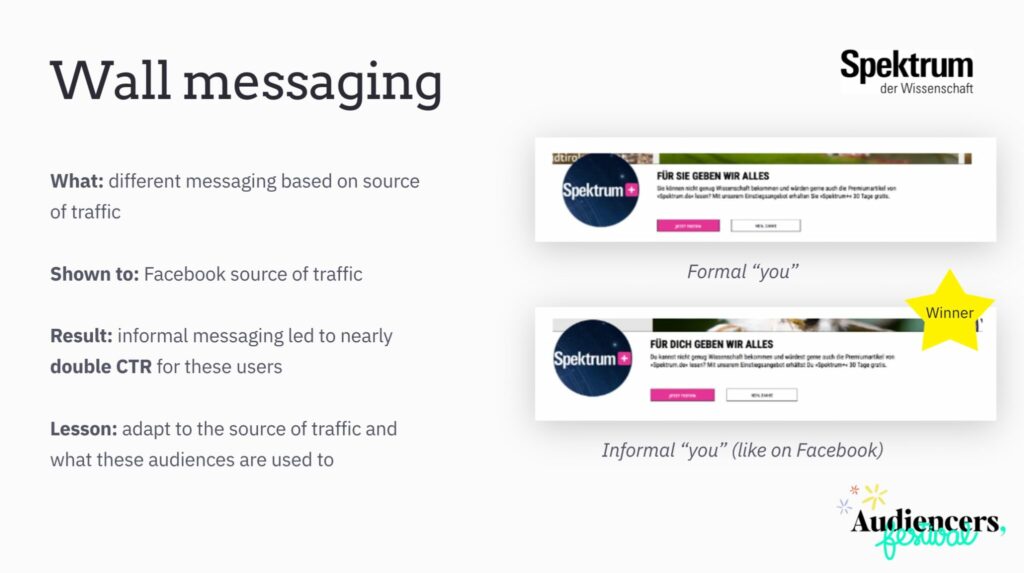
- Contextual messaging (Facebook): Testing informal vs. formal language for Facebook referrals revealed that informal messaging (“Du” instead of “Sie”) nearly doubled click-through rates (CTR) for these audiences.
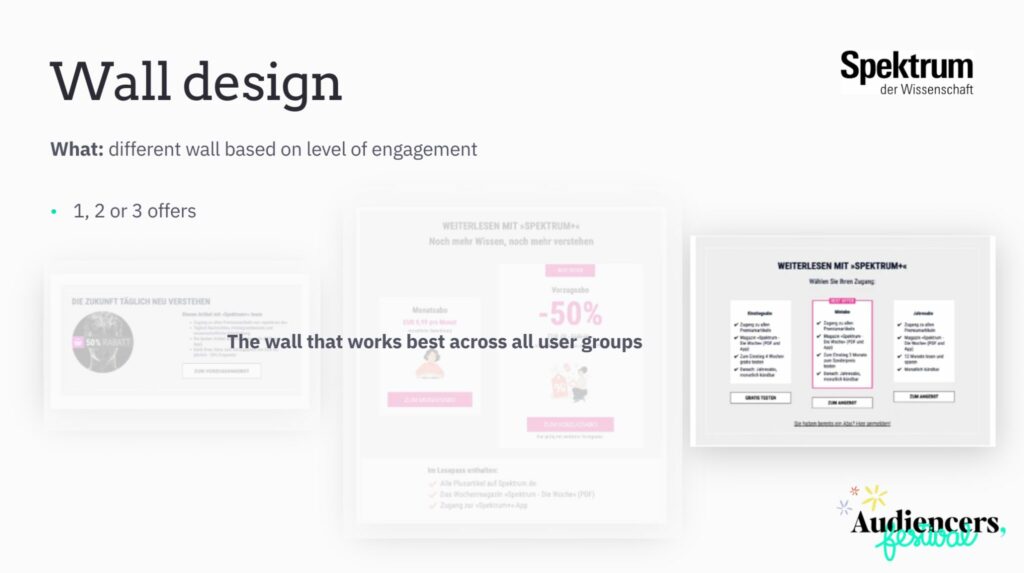
- Paywall design: Spektrum tested walls with one, two, and three offers across the 4 engagement groups defined in Poool’s dynamic paywall dashboard. While a single offer proved least effective across all segments, a three-offer wall with a central “Best Offer” highlight emerged as the strongest performer for the general audience.
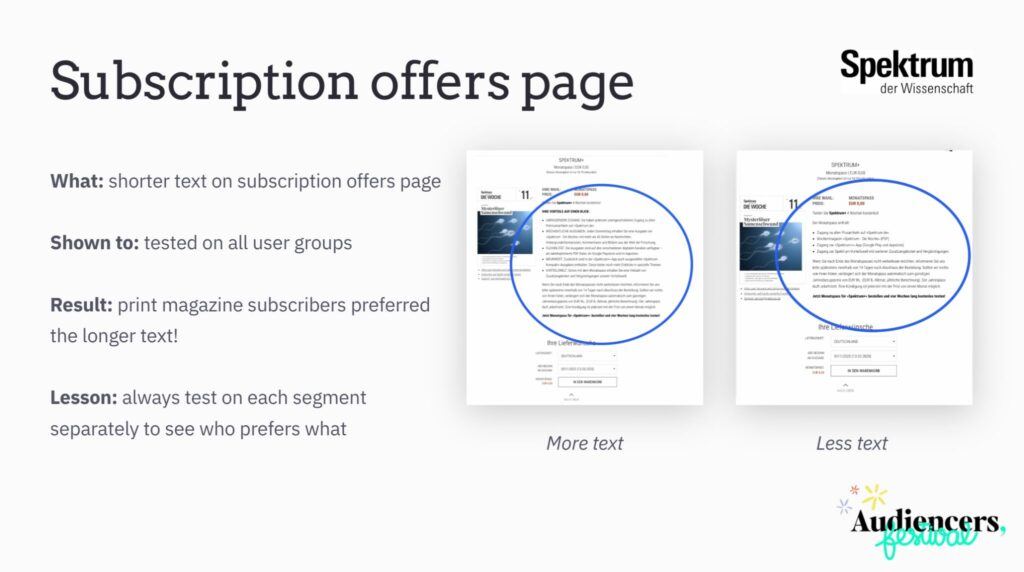
- Text density: On the subscription offer page, most segments preferred shorter, concise text. However, a notable exception was print magazine subscribers, who converted better when presented with more detailed information.
Ann-Kristin shared that this first batch of testing proved very helpful for understanding the behavior of different segments, convincing the team that dynamicity is essential, and that they should start adapting to actual user needs, not just team assumptions.
“Evolution is a perfect way for the perfect adaptation for everyone – if you have some million years of time (spoiler: we didn’t).”
Phase 2: “Testing What Matters” (Test as if Marie Kondo could knock on your door at any time)
Recognizing that they lacked the “million years” required for total evolutionary adaptation, Spektrum moved into a more focused phase: “testing what matters”. This phase prioritized high-impact user groups rather than every possible variation for every segment.
Priority segments
Spektrum identified four key segments for prioritized testing:
- Biggest Group: currently “Volatiles” on mobile devices.
- Most Overall Conversions: currently “Volatiles” on desktop devices.
- Best Converting Group: currently newsletter subscribers.
- “Hidden Gems”: High-potential audiences, a segment that’s hard to identify. Ann-Kristin described this as like playing poker! At the moment, they think these audiences are those receiving mailings already
Device-based segmentation
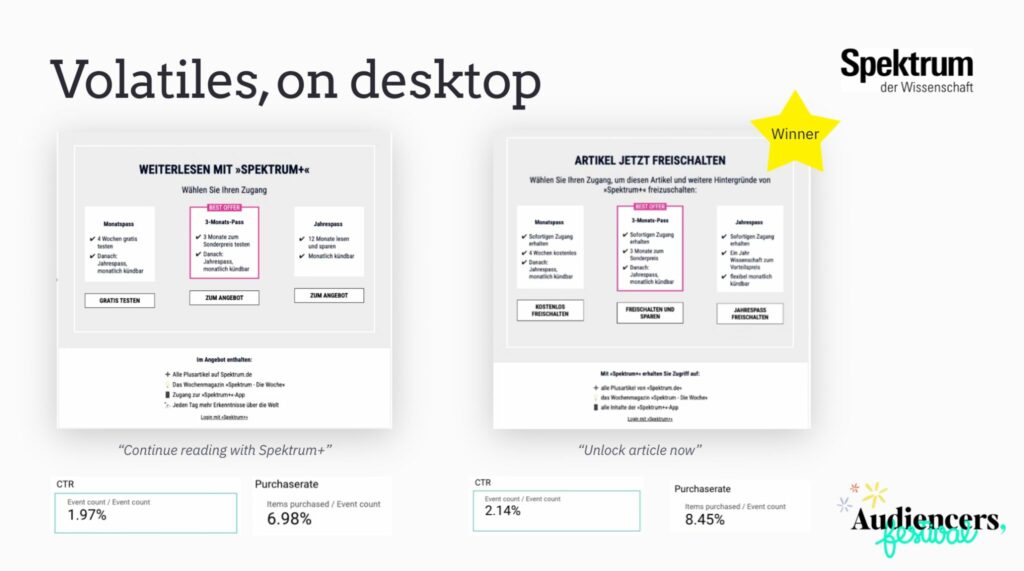
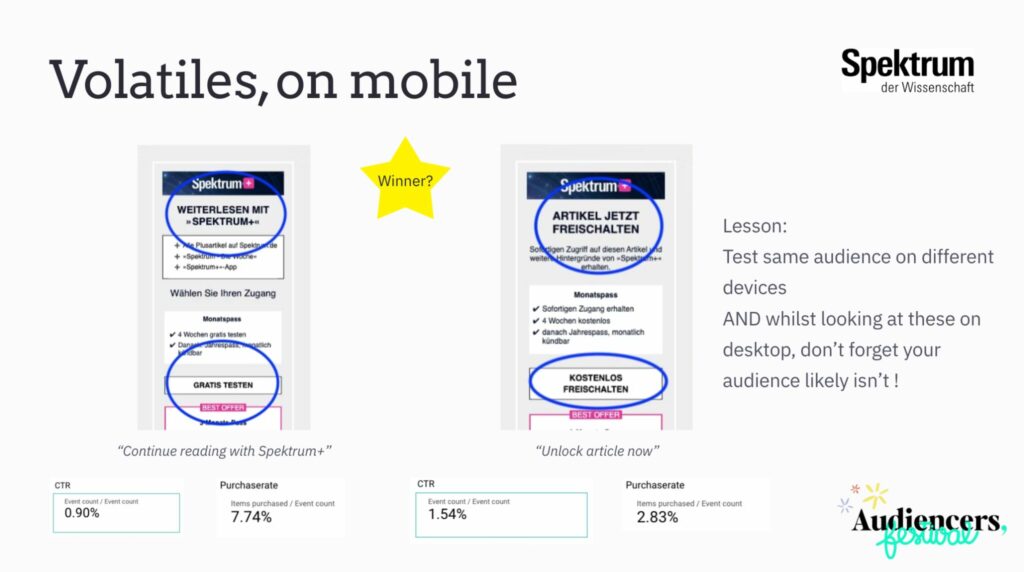
A critical finding in Phase 2 was the difference in behavior between desktop and mobile users. While an “Unlock article now” prompt outperformed “Continue reading with Spektrum+” on desktop (raising both CTR and purchase rates), the same prompt on mobile increased CTR but dropped the purchase rate. It wasn’t so much the variations that were important here, but simply the proof that mobile and desktop users need to be treated differently.
Operational framework and final lessons
To maintain this rigorous testing loop with a relatively small team, Spektrum implemented several organizational priorities:
- Alignment through OKRs and RACI: They used three-to-four-month Objective and Key Results (OKR) cycles to define focus and RACI matrices to establish clear accountability for who is responsible, consulted, or informed for every task.
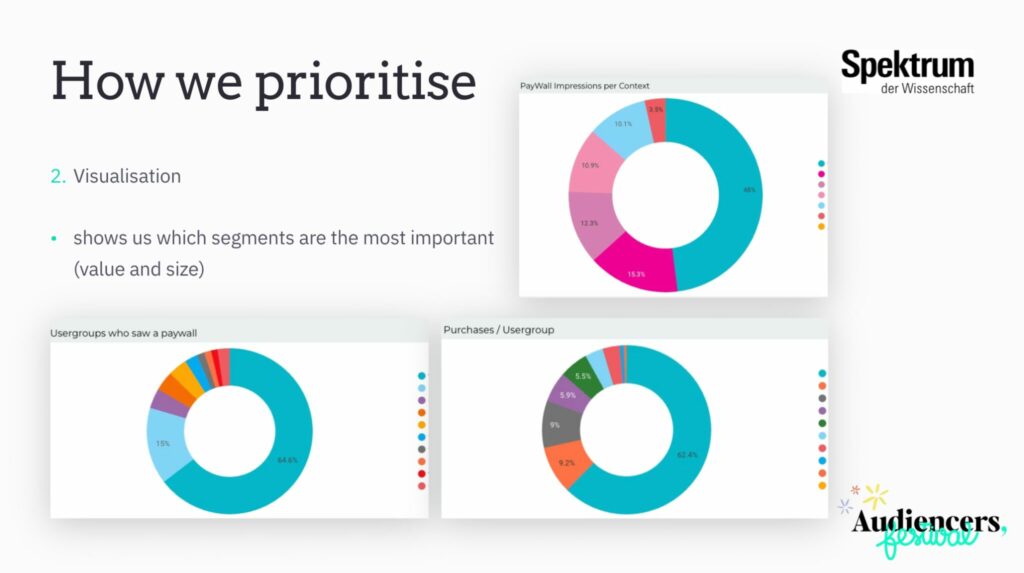
- Data visualization: Spektrum emphasizes that seeing user segments visualized (e.g., in donut charts) makes it impossible to ignore the importance of the largest and highest-value groups.
- Pragmatism over perfectionism: The team adopted “Zen mode,” accepting that “we can’t bake big pretzels with tiny ovens”. They focused on what could be accomplished immediately rather than future ideals.
Spektrum concludes that there is no “final version” of their product, only the next iteration, as user behavior and opportunities constantly evolve.