
In 2019, Forum Communications Company (FCC) launched its first digital paywall.
Seven years later, the company runs subscription models across 30+ local publications. They’ve hit the same reality most publishers face: early growth is exciting. Then comes the plateau. Not to mention external, industry-wide challenges.
Stephanie Schroeder, Chief Revenue Officer, has been leading consumer revenue since day one. What’s changed over the years isn’t just their meter settings. It’s how granular they’ve become — in segmentation, payment failures, cancellation flows, marketing campaigns…
If you’re trying to grow reader revenue in a mature subscription business, Forum Communications provides valuable lessons in the importance of continuous iterations and the value of minor tweaks.
TLDR
If you’re working to break through the subscription plateau, here are five projects mentioned by Stephanie that you might want to consider:
-> Block archived content by considering the percentage of pageviews on 30+ day-old content
-> Fix churn from payment failure
-> Look at save rate by cancellation reason
-> Don't forget about abandoned checkout recovery
-> Consider dynamic paywalling
-> Use AI to challenge your marketing campaigns
Launch fast, iterate forever
Forum Communications spent nearly a year preparing their first launch. But once they went live, they didn’t pause to perfect it before rolling out to other markets.
“As long as nothing was majorly broken, we kept rolling — knowing we’d iterate over time.”
At launch, they:
- Set a loose 10-article meter
- Made registration optional
- Soft-launched to avoid audience shock
- Focused heavily on activating print subscribers digitally
At this point, Covid hit… Like many publishers at the time, they temporarily opened content, before realizing that this wasn’t a short-term event. At this point, registration became a key part of their strategy.
The goal wasn’t immediate subscription conversion, but building a known audience.
The result:
- No meaningful pushback from audiences
- Massive growth in known users
- Significant lift in subscription conversions
If you’re working to launch subscriptions, registration provides a great testing ground and step between anonymous and subscribed. Read more about registration as a strategy here.
Test dynamic paywalling
Data collection helped pave the way for audience segmentation and targeting in their paywall model, based on a collection of engagement signals that suggest propensity to subscribe. The one-size-fits-all metered model was instead replaced by dynamic reader-based paywalls.
- A new visitor with very low propensity to subscribe would be allowed to scan and read uninterrupted. They found it’s more valuable to garner ad impressions from these readers and let them build a habit by sampling the product in hopes they’ll return again.
- A returning visitor who isn’t quite subscription-ready but shows signs of engagement sees a registration wall. The conversion from anonymous to known helps get that reader in the funnel so they can be served more content and return to the site when they have a higher propensity.
- A highly engaged, high-propensity reader will be shown a paywall. This might be determined by a variety of factors, including frequency of visit, duration of visit, registration activity or engagement with newsletters.
The result?
- Readers aren’t blocked from reading content before they’re ready to take action, optimizing ad revenue and allowing new visitors to sample the product
- Registrations and paywall events are optimized at the reader level, which means more readers are allowed to engage with content without sacrificing conversion rates
Don’t overlook the goldmine that is archived content
Most publishers obsess over today’s headlines. FCC looked at 30+ day-old content.
When they checked Google Analytics, they discovered that ~10% of pageviews were on articles older than 30 days.
And unlike homepage traffic, this content is typically accessed via search, social and direct links, which means users are actively seeking out this content.
High intent = high propensity.
So they tested hard paywalling 30+ day-old articles.

The results:
- Conversion rate doubled compared to standard paywalls.
- 15–20% of all subscription conversions now come from archived content walls.
If you’re not measuring the share of traffic on older content, head to your analytics and check what percentage of pageviews are 30+ days old.
Evergreen content is often your most under-monetized asset.
(and no, they didn’t notice any negative SEO impacts as a result of this change!)
Introductory pricing & abandoned checkout
Growth gets harder every year. But Forum Communications are still adding subscribers. So what moves the needle now?
- Introductory pricing
They run 6-month promotional offers at significantly reduced rates.
- 5–10x multiplier on starts during promo periods.
- Churn doesn’t outweigh the acquisition lift.
- Behavioral stickiness builds during that 6-month window.
This won’t work for every publisher. But if you’ve rejected promo pricing outright, consider coming back to the topic.
- Abandoned checkout segmentation
Many publishers don’t target users who abandoned checkout before subscribing, whilst in the ecommerce industry it’s standard practice.
Today, Forum Communications:
- Segment users who start checkout but abandon.
- Run tailored email and digital campaigns specifically to that cohort.
- Nudge them to complete what they started.
Although these aren’t 20% lifts, the 1–2% improvements compound. And at maturity, this is what growth looks like.
Stop losing subscribers to payment failure
The team discovered that the #1 reason for churn wasn’t content dissatisfaction. It was payment failure.
In the past, like many, they reacted after failure, which meant the subscriber had already lapsed.
Now they:
- Use their CDP to detect upcoming payment issues.
- Trigger on-site popups before renewal.
- Remind users they’ll lose access.
- Time messaging precisely to renewal dates.
If payment failure is even 5–10% of your churn, this is low-hanging revenue retention.
Make cancellation easy, but personalize it
Cancellation is where many publishers get defensive and try to keep hold of subscribers at all costs.
FCC did the opposite by making cancellation easy, because friction creates resentment and resentment kills winbacks.
They tested multiple cancellation flow iterations.
What worked:
- Short bullet points
- Clear value reminders
- Personalized next steps
In particular, moving the cancellation survey to the start of the flow.
Instead of:
Cancel → Survey → Exit
They now do:
Why are you cancelling? → Tailored response
If reason = technical issue → Direct to support
If reason = content complaint → Direct to newsroom
If reason = price → Offer extended promo
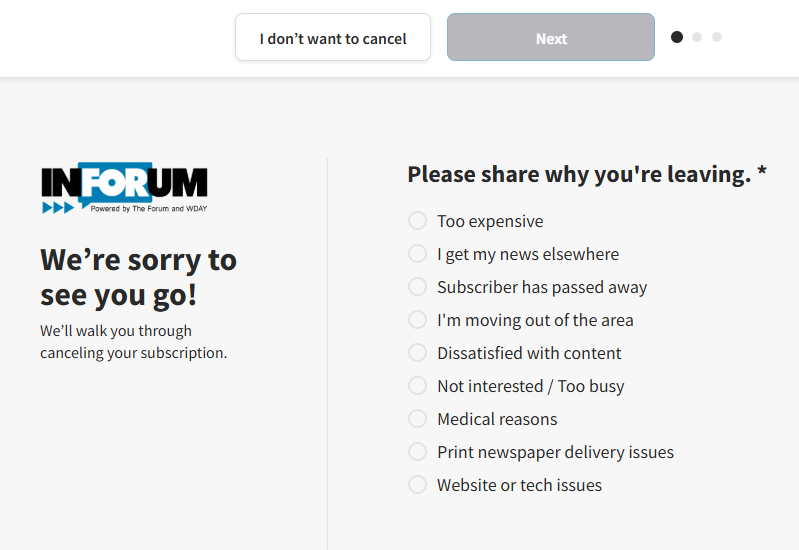
Early tests show measurable lift in save rates.
As Stephanie put it, not everyone in the cancellation flow actually wants to cancel, some want to be heard.
A non-scalable but effective win-back strategy: just call them
The team selected 15 recently canceled subscribers, and the Head of Customer Success called them. Not to resell, but to ask “Why did you leave? What can we improve?”
10 agreed to speak.
9 resubscribed.
Of course, this won’t scale to thousands. But it reveals something critical:
Retention isn’t always about pricing. It’s about relationships.
They also:
- Run segmented win-back email journeys
- Test telemarketing for specific cohorts
- Show former subscribers adapted paywalls and promote annual offers instead of monthly ones

AI in campaigns: A tool to challenge teams, not replace them
FCC is cautious with AI. They don’t use it to replace marketers, but as a way to pressure-test campaigns.
The workflow:
- Human writes campaign brief
- Design assets created
- Human feedback round
- AI review inserted
- Final human edits
They ask questions such as:
- What are the first two clickable elements?
- Is the hierarchy clear?
- Is the CTA obvious?
- Is the core message unambiguous?
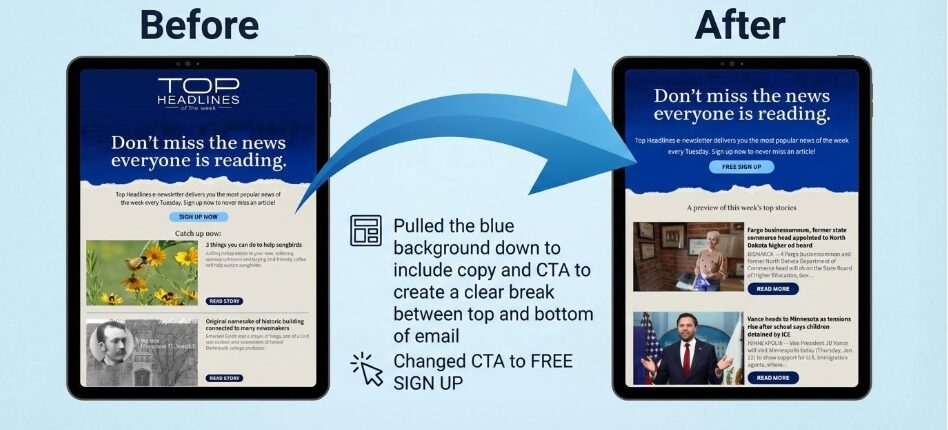
This helps remove emotional bias, surfaces hierarchy issues and sharpens scannability.
For mature subscription businesses, this kind of structured use of AI can produce incremental gains at scale