
Launched in 2018, Republik digital magazine belongs to no one, but to each of their 30,000 members a little bit. The team’s mission? To strengthen democracy with journalism, publishing just 2 to 3 stories per day, prioritizing the highest possible quality, and today funded entirely by subscriptions.
I spoke to David Bauer, Head of Product Development, to hear about how they leverage editorial products for growth.
A bit of context: From April 26 to May 31, 2017, Project R, a non-profit cooperative, ran a crowdfunding campaign to launch a digital magazine in Switzerland. It was an overwhelming success: over 13,000 supporters, together with the Project R development team, aimed to make a significant difference in the media landscape. The magazine, named, "Republik" launched on January 14, 2018 – uncompromising in quality, reader-funded, ad-free, and without any unnecessary frills. (source: Project R)
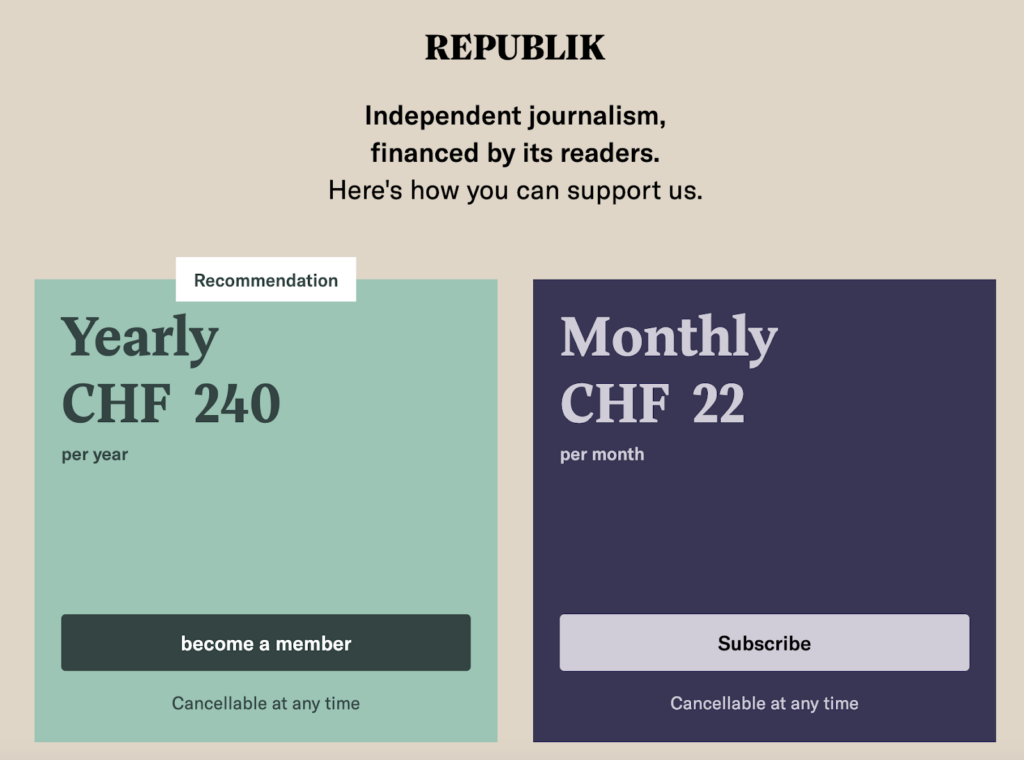

The primary subscription growth channel: registrations
“From the launch up until about a year ago, we had an access model that was at the same time very open and very closed. If you went to the homepage, you’d just see a marketing page with 3 featured articles, and no way of browsing content. But if you had a direct link to an article, for instance shared by a subscriber, searching directly via Google or social media, you could always read it. This meant that we could not really use our biggest asset – our stories – as a driver for subscriptions. Pointing people to them always meant giving access for free.
Today, we flipped the model. You can browse the entire site but content is behind a metered registration model. After creating an account, readers have a week to explore everything we have to offer before we ask them to subscribe. Every story we publish is now a landing page and a starting point for a more permanent connection.

“Product-driven ways” to respectfully get email addresses
“When I joined in 2022, editorial products were not strategically used for lead generation. Republik had run an incredibly successful free newsletter during the Covid crisis that had resulted in thousands of new memberships. However, after that, no new products had been developed to try and replicate that success.
I initially came on board with Republik to help build our Climate Lab – an exploration on how to do climate journalism differently, a project geared towards reaching and engaging new audiences. A climate newsletter that emerged from the lab now has tens of thousands of readers and continues to drive memberships.
This validated our assumption that we should invest more in new, product-driven ways to reach new audiences – with the goal of building engagement and interest in memberships.
We followed up with turning a weekly news briefing that had existed on our website alone into a newsletter, free for everyone. Today, this is one of our main drivers of new addresses, and a product that works well with audiences who are hearing of Republik for the first time
More recently, we’ve started offering email courses as part of this work. The first one offers advice on how to make a real difference in the climate crisis – this one was another product out of the Climate Lab which also serves as an incubator of product experiments. A second one offers a step by step guide on how to break free from big tech.”

“Although, tactically speaking, they are a lead-generation tool, it’s important that we see them as editorial products first, addressing real user needs. We believe these courses work so well because they fit perfectly into our mission and help people take action on topics we’re a trusted source on.. Our coverage helps readers understand the problem, whilst the courses offer a concrete solution. So every article we write on the climate crisis and every investigation into big tech we publish is an opportunity to reach new people and prompt them to sign up to the course. Because what better moment to offer a solution than when you’ve just pointed out the problem?
As an acquisition tool, it’s pretty powerful:
- «Bye-bye Big Tech» saw 2,500 registrations in the first 2 hours
- 12,000 in the first three weeks
- Half of them are not yet subscribers, representing a large opportunity for sales
- One-third of leads are completely fresh
- Open rate is still over 75% for emails later on in the course”
Providing value is marketing in itself
“The key idea behind the courses especially is to provide value before asking for something. Anyone can sign up for free and won’t receive anything else from us for the duration of the course. Once you’ve reached the end, we hope you’ll have got some real value from it and might be open to hearing about what else we can offer.
The tricky part is that both the topic (climate crisis, big tech..) and the product (email course) are very specific, and we’re trying to sell a digital magazine, with articles covering a wide range of themes. So in the messaging immediately following the course, we try to stay close to the context that convinced people to sign up in the first place, e.g. we pitch the magazine subscription with «We keep a close eye on powerful tech companies and report on what informed citizens need to know.»
So far, this strategy works just fine for us and we’re already working on the next products that will serve as a first point of contact with Republik. We have two new newsletters in the making that are both made for specific audiences we want to grow. And we’re currently evaluating ideas for new e-mail courses to launch in early 2026. After that, we’re most likely going to shift our attention towards other channels to reach new audiences, beyond email.