
Lennart Schneider, founder of Subscribe Now podcast & newsletter, and expert on digital subscription models, interviews Stefan Bader, CEO and Co-founder of Cello, to discuss how to build a referral program that ensures sustained growth.
-> Why visibility is the decisive factor
-> How to choose the right rewards
-> Why fairness wins
-> and how you can reduce the cost risk in customer acquisition
For years, companies have been struggling with the same challenge. Specifically, rising customer acquisition costs are making it increasingly difficult to win new subscribers at affordable prices.
There are many reasons for this – paid marketing is becoming increasingly expensive, SEO has less reach since the spread of LLMs, and social media algorithms play a significant role on who sees which content, and when.
However, there’s one growth lever that’s often overlooked, one that can help decrease dependence on external players… your own users. Satisfied, loyal fans are already recommending you, and if implemented correctly, this can become a valuable and inexpensive acquisition channel.
At least that’s what Stefan Badar, CEO and Co-founder of Cello, and guest on my Subscribe Now podcast shared, and he makes some great arguments. Cello, a company based in Munich, has built a referral software that’s now used by some of the world’s leading tech companies, including Miro, Typeform, and Riverside.
In this article, summarizing my conversation with Stefan, you’ll learn how to build a referral program that ensures sustained growth:
- Why visibility is the decisive factor
- How to choose the right rewards
- Why fairness wins
- …and how you can reduce the cost risk in customer acquisition
By the way: You can try out Cello directly. Using my referral link will save you €1,000 and I’ll receive a commission if you become a customer, a great opportunity to support my work.
1. Stop hiding referral programs

The biggest mistake for a referral program is hiding it in a sub-menu. Permanent visibility at the top of the app leads to the strongest user engagement.
The example above, from Neotaste, illustrates this very well. The recommendation program appears on the first screen when you open the app and above the map in the Discover tab.
Stefan gives five tips for optimal visibility:
- If the recommendation icon is visible on the first level and not hidden in a submenu, the usage rate increases by 8x.
- In addition to a gift symbol, the monetary value of the recommendation should also be displayed. A currency symbol increases performance by 3.3x.
- A small animation also draws attention to the referral program – even if we’ve seen a screen many times before and are therefore blind to changes.
- Moments of delight: Specifically look for moments when your user has had a positive experience, such as at the end of an article, or after giving a good rating in the NPS survey. These moments are the perfect time for a recommendation.
- CRM integration: You should also regularly remind your users about the referral program via email or other push channels.
2. Cash beats most other rewards
A referral program is only as strong as the rewards it offers. There are many options: free months, discounts, raffles, vouchers, gifts, etc. But Stefan has seen that money works best for most customers.
There are several reasons for this:
- Money is universally usable and therefore interesting for every user.
- Money remains an incentive even after the tenth or twentieth recommendation, while free months eventually lose their appeal. Many users recommend a product not just once, but on average six to seven times. Money is therefore the perfect incentive for heavy recommenders.
- Money is attractive even to non-subscribers. In freemium models, roughly 90% of users don’t have a subscription, but that doesn’t mean they won’t recommend the product. A successful referral program mobilizes all users, not just paying ones.
- Money also works in the B2B sector: A free month may only benefit the employer who pays for the subscription, whilst a cash bonus goes directly to the employee making recommendations.
- Money can be paid out over a longer period. And that brings us to the next point…
3. Rewards grow with lifetime value
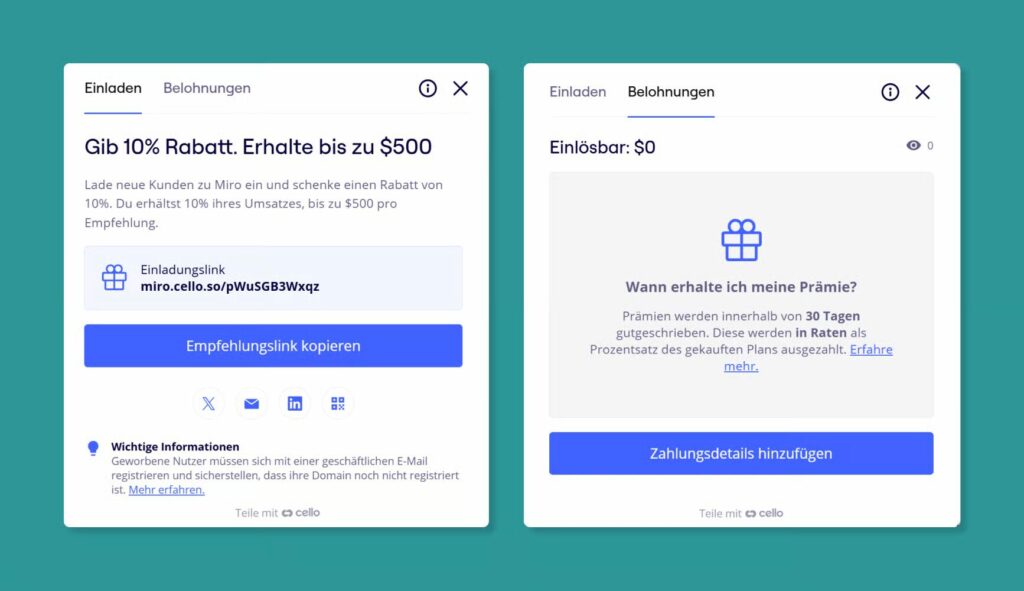
Paid subscription advertising always carries a risk: Acquisition costs are incurred when a subscription is signed, but it’s only months later that you see whether a new customer has recouped those costs. That’s why a short payback period and a good ratio of Customer Acquisition Costs (CAC) to Lifetime Value (LTV) are so crucial.
A referral program can reduce this risk: The bonus doesn’t have to be paid out as a fixed amount at the start, but is distributed monthly as long as the referred user remains a subscriber. In Miro’s example, as the referrer, I receive 10% of the ongoing subscription fees. When the referred subscription ends, my bonus also ends. This eliminates the risk of spending more on a customer than you earn from them.
These ongoing payouts have another advantage: they remind users every month on their bank statement that the referral program is worthwhile, thus motivating them to make further referrals.
4. Bonuses must be worthwhile for both sides.
Another key to success is fairness: When I recommend a product, I’m investing my social capital. If my friends are disappointed or feel exploited, the relationship and my social standing can suffer. So it’s essential that users feel comfortable with the recommendation.
Rewards should therefore not be one-sided. Opt for a balanced reward rather than a particularly high bonus for the referrer, something that also motivates the receiving party to click through the link and use your product. Ultimately, a large number of invitation links sent out are useless if the offers aren’t redeemed, and an attractive, exclusive discount increases the acceptance rate.
However, you should ensure that the discount is time-limited – ideally for the first three or six months. If you offer an indefinite discount, you risk negatively impacting your ARPU in the long run.
This article was originally published in German on the Subscribe Now website, translated and republished with permission.