The Guardian is pretty unique in the US media landscape. Unlike most major players, it’s not owned by a billionaire or conglomerate, it’s owned by The Scott Trust, a mission-driven structure that ensures editorial independence and, crucially, allows the site to remain paywall-free.
Instead of a traditional subscription model, The Guardian relies on voluntary support. This makes their US “End of Year” (EOY) campaign, running from early November, through Giving Tuesday and on to midnight on December 31st, the most critical window in their financial calendar.
Why is EOY so huge in the US?
- The cultural “season of giving”: It leverages a peak period of philanthropic behavior in American culture, as nonprofits and mission-driven organizations all fundraise towards an annual New Year’s Eve deadline.
- The revenue bedrock: For mission-driven organizations like The Guardian, these final weeks often generate a large portion of their annual voluntary support revenue, providing the financial bedrock for the year of reporting ahead.
In their most recent EOY campaign (2025), the final numbers were staggering:
- Total raised: $3.1 million in liquid cash by Dec 31st (exceeding their $3M goal).
- Lifetime Value (LTV): The estimated total value of the campaign (including recurring commitments) is $8.6 million
- Year-on-year growth: This represents an 83% increase in campaign value compared to the 2023 “standard” year (because a presidential election year – as 2024 was – is usually an outlier).
Inside The Guardian’s Record-Breaking US End-of-Year Campaign
I sat down with Georgia Warren, US Executive Editor and VP, Reader and Supporter Strategy at The Guardian, to deconstruct their most recent campaign. In particular, Georgia shared some of the key pillars to this success, lessons that can be applied to any newsroom’s marketing campaigns, whether for the EOY or general subscription acquisition.
Whilst EOY is important, the rest of the year is there to help you prepare
Georgia reveals that while the EOY campaign is the shining moment, the heavy lifting happens during the other ten months of the year. The Guardian uses their “business as usual” periods for constant testing to de-risk their high-stakes holiday season.
- Year-round messaging and UX testing to de-risk during crucial support moments: new ideas are tested out over the lower-risk months so that any messaging can prove it can beat benchmarks before featuring in the EOY campaign
- Deploying incremental gains: the EOY campaign is a culmination of dozens of small optimizations found throughout the year. Everything from the order of bullet points in a module to the specific color of a “Support” button
- Building engagement and understanding the audience: Readers support the Guardian because they believe – as Guardian journalists do – that a free press is vital for democracy. Throughout the year the Guardian team makes sure supporters feel included in this shared mission – sending emails from individual journalists about their work, surveys asking for supporter feedback, letting supporters know about the real-world impact of the stories and investigations they have funded in order to foster the kind of loyalty and engagement that mean people will want to support the year-end campaign
For instance, during non-peak times, they test non-blocking walls that ask anonymous search-engine visitors to sign up for a newsletter instead of a donation. This increased their mailing list by over 66% in three months, creating a massive pool of warm leads for the December push.
Campaigns aren’t single hits – consider phased pushes
The campaign is not a single burst of energy but a carefully choreographed sequence that leverages cultural and political moments.
| Phase | Timing | Strategic Focus |
| The Launch | Early Nov | Launched on the anniversary of Trump’s 2024 victory to lean into the “defense of the free press” mission. |
| Giving Tuesday | Late Nov | A tactical pivot leveraging a high-volume day of American philanthropic giving. |
| The Final Week | Dec 24–31 | An intense, high-cadence period leading up to the December 31st deadline. |
Support comes from across channels, with roughly 25% from site banners, 30% from the below-article appeal and 25% from email campaigns, proving that a multi-channel “surround sound” approach is essential for hitting ambitious targets.
During the campaign, test and optimize in real-time
While traditional A/B testing is the industry standard, it’s often too slow for the “winner-takes-all” windows of Giving Tuesday or New Year’s Eve. To combat this, the Guardian team uses multi-armed bandit testing to optimize messaging in real-time.
- The execution: Rather than splitting traffic 50/50 and waiting weeks for statistical significance, the “Bandit” algorithm evaluates 8–10 simultaneous variations of copy and visual design.
- The benefit: As soon as the algorithm identifies a high-performer, it automatically shifts the majority of traffic to that version. This ensures that during high-intensity periods, the publisher isn’t “wasting” impressions on underperforming messages.
- The lesson: Use adaptive algorithms to let your audience tell you what resonates
Cross-functional work is crucial
A common pitfall for publishers is siloing messaging and “asks” within the marketing department. At The Guardian, the campaign is deeply rooted in the newsroom. Georgia, as an editor, serves as a bridge between journalists and commercial teams.
- Editorial as the value prop: Every public-facing module is reviewed by an editorial eye to ensure the tone is a seamless extension of the journalism, not a jarring commercial break
- Human connection: The campaign leans heavily on transparency. By featuring personal appeals from high-profile columnists and US editor Betsy Reed, they transform “revenue asks” into a conversation about the actual cost of independent reporting.
“Our readers support us because they recognize the free press is under threat. Our job is to reflect that mission back to them, human to human.” — Georgia Warren
Pivot to recurring revenue for sustainability
The Guardian has been carefully shifting to push for recurring support over one-time gifts.
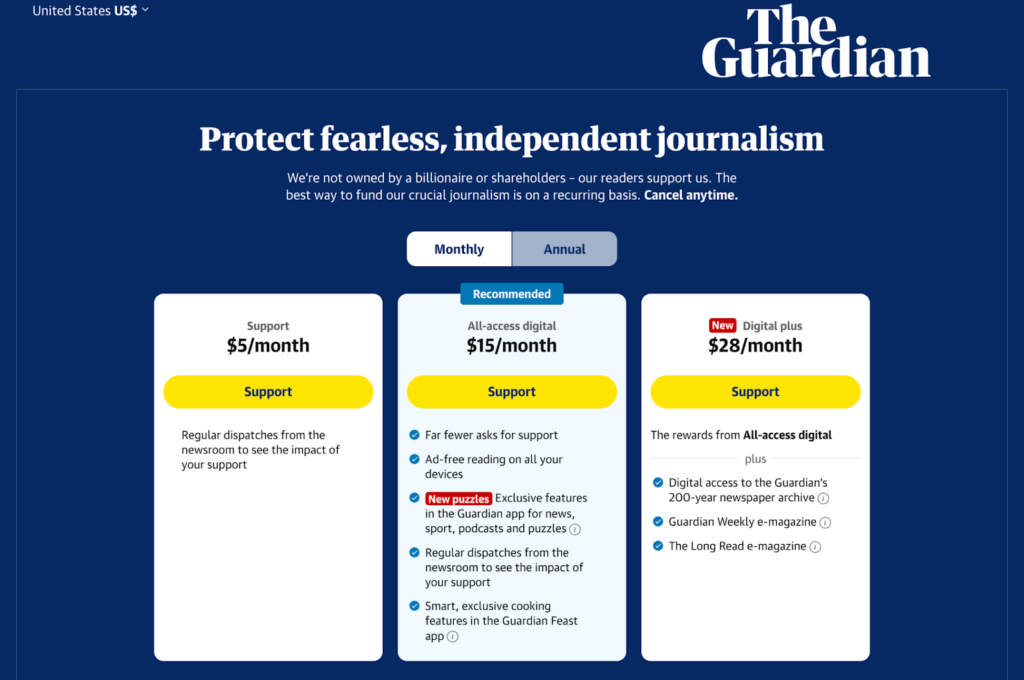
- The team successfully shifted the revenue mix from 51% coming from recurring products in 2023 to 65% in 2025
- Recurring revenue provides a “predictable floor” for the newsroom. Even if a user gives less per transaction ($5/month vs. a one-time $100), the stability and LTV are far higher.
- As a reward for this loyalty, recurring supporters enjoy a cleaner reading experience with site fundraising modules suppressed, reinforcing the value of their ongoing commitment.