

Khalil A. Cassimally, Consultant in Audience Development, User Needs & AI, and regular contributor to Audiencers, shares 7 strategies to not only become data-informed, but data-led.
1. Data is a compass, not a map
2. Connect every role to the bigger goal
3. User value first; business follows
4. Don't focalise on tools
5. Create one source of truth
6. Start with one analysis, and keep going
7. Optimise the funnel; small lifts compound
There is no shortage of data in media operations. There is also no shortage of stress and overwhelm in media operations – and an abundance of data is now contributing to it.
“There’s so much data – I don’t know what to look at, I don’t know what’s important.”
Data is an opportunity for media operations. It improves four things at once:
- Audience understanding (the foundation on which everything else lies)
- Content strategy
- Business performance
- Impact measurement
Unlocking these improvements rely on appropriately leveraging the data in meaningful and actionable ways. And when done systematically, harnessing data becomes a natural part of operations. That’s a data culture to strive for.
Building such a data culture doesn’t happen overnight. And some newsrooms are certainly further along on their data maturity ladder than others.
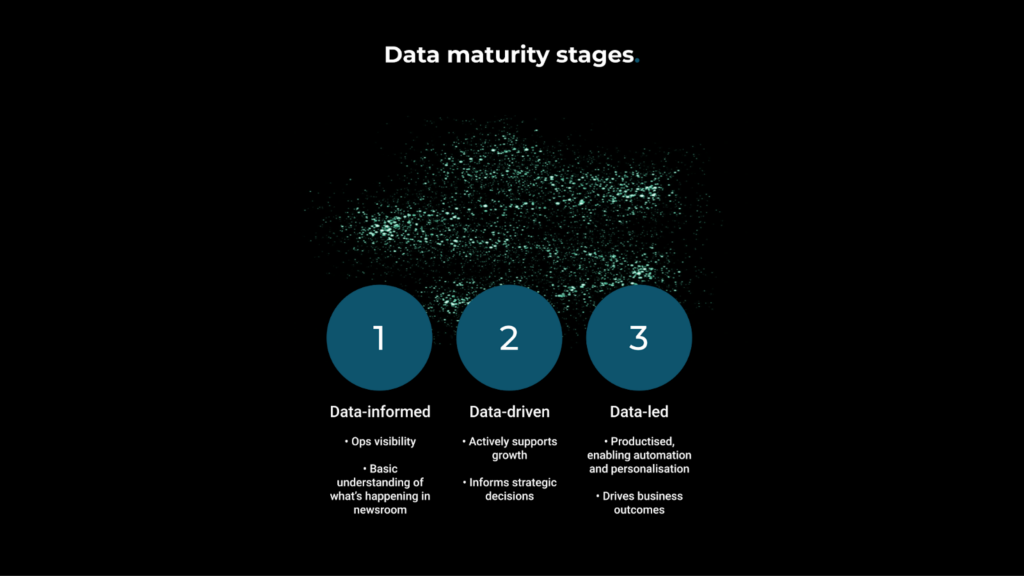
The data maturity ladder is made up of three rungs:
- Data-informed: we have a basic understanding and visibility on what’s happening
- Data-driven: we are actively using data to support strategic decisions, and ultimately growth
- Data-led: we are putting data in service of business outcomes, having systematised its leverage

1. Data is a compass, not a map
Maturity: data-informed, data-driven
Creating a data culture necessitates buy-in from the whole media operation – and that includes editorial staff.
A concern about data typically shared by editorial staff is that they will lose their agency and be forced to “write for the numbers” only. It’s an understandable concern, not least because it’s a reality in many media operations.
But optimal leveraging of data happens when numbers are guides rather than the destination. That’s a shift in mindset. Data is not a report card measuring a reporter’s performance. It’s not about who is not chasing the numbers. Instead it shows opportunities for experimentation. It’s about possibilities that complement editorial expertise and intuition.
The popular user needs model is a great example. The model doesn’t tell reporters what they can or can’t cover. It merely provides them a framework to cover stories they believe are important in ways that are especially valuable to people.
> Here’s more information about the user needs model.
2. Connect every role to the bigger goal
Maturity: data-informed
One of the biggest blockers to data adoption is purpose-blindness. When we don’t know why a metric matters, we don’t care about it. When we don’t know how our work contributes to the bigger picture, we care even less about numbers.
But when we do understand the role we have in moving us towards our objectives, and when we see how certain metrics give direction to our work, data is no longer seen as a hindrance. Instead, it becomes a means to achieving individual and collective goals.
Here are six steps to connect people with data in service of the bigger goal, published by the American Press Institute:
- Define overall objectives
- Connect objectives to newsroom activities
- Establish stakes and relevance for each person
- Provide coaching to support every person
- Push continuous feedback
- Followup in person with face-to-face conversations
> Read more: north star for publishers
3. User value first; business follows
Maturity: data-driven, data-led
Many media operations prioritise what’s best for revenue over what’s best for people. Autoplay videos, increasing screen real estate for ads, focusing on dark user needs are just a few examples of this phenomenon.
But many organisations that grow sustainably across various industries embrace a simple truth: over the long run, business metrics follow user metrics.
When we optimise value creation for people, quality and trust follow, and there’s a good chance revenue will follow too. But optimise for revenue at the expense of what’s best for people and both will suffer eventually.
The most strategic question for a media operation therefore is: “how does this serve people”. If the answer isn’t clear, it’s worth reconsidering.
4. Don’t focalise on tools
Maturity: data-informed, data-driven, data-led
A common – and costly – mistake is investing in a tool before the needs of our media operations have been defined.
The thing is: tools don’t create strategy, they help execute it. They are in service of the strategy. As such, clarity about where we are and where we want to go makes tool selection so much easier, and cheaper.
Here’s a better sequence to consider:
- Define strategy: clarify objectives and create alignment upstream
- Determine maturity stage: assess data maturity and understand needs and internal capabilities
- Create team: decide who owns what aspects of strategy implementation
- Select tools: team picks tools that help them increase operation’s data maturity and enact strategy
5. Create one source of truth
Maturity: data-informed, data-driven
Few experiences erode trust faster than conflicting data. If one dashboard says X and another says Y (looking at you, sampled GA4 reports), people stop believing either.
A strong data culture eliminates competing versions of the truth.
That means:
- One source for core KPIs
- One set of definitions the organisation commits to
Creating a single source of truth can be quite tedious work. What it isn’t however is a purely technical issue. This isn’t just about identifying data that matches closest to reality. I’d argue that it is, in equal part, a leadership issue. It’s also about ensuring that there’s alignment and commitment around the source of truth.
6. Start with one analysis, and keep going
Maturity: data-driven
Most media operations do analysis once, find it “interesting,” and then stop. But one-off analysis rarely changes decisions. True insights emerge from iterative loops.

Here’s the four-step iterative loop:
- Define your hypothesis
- Plan the analysis
- Perform the analysis
- Pressure-test the findings
As Tara Lajumoke, the former managing director of FT Strategies once wrote: “the purpose of a test isn’t to pass or fail, it’s to inform. It’s to use that to then iterate and test more hypotheses.”
News operations that embrace this mindset will generate highly-valuable insights that can inform high-leverage decisions. Because they reduce uncertainty with each cycle by testing ideas, deepening understanding, and optimising value creation for people.
7. Optimise the funnel; small lifts compound
Maturity: data-driven, data-led
When teams test their ideas and see success, it’s exciting. But when success is a 1% improvement, it can be disheartening.
What teams often don’t see is the many small lifts from their many tests producing outsized results further down the funnel.
To understand the real ROI of improvements, teams should:
- Map the funnel: determine starting and end points and steps in between
- Quantify the problem: calculate phase-to-phase conversion baselines and identify the greatest problem areas
- Estimate ROI: understand the real value of improvements
Even small conversion lifts – especially deeper in the funnel – can significantly contribute to financial sustainability and growth.
> Read more: 1 subscriber or 48,000 page views?
Your action plan
Good data culture isn’t built through overhauls. It’s built through shared understanding and iterative progress.

And more importantly: it’s built by remembering who we’re doing this for – the people we serve.