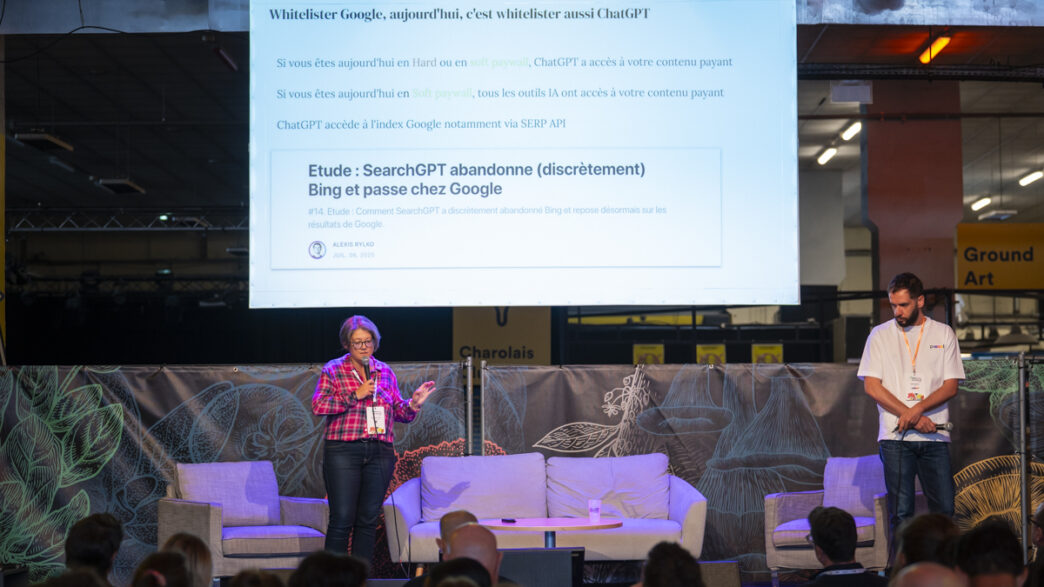
This article summarizes the session presented by Maxime Moné (CEO of Poool) and Virginie Clève (founder of Largow, a consulting agency) at the Audiencers Festival Paris on September 16, 2025. Together, they explored the question of “SEO & Paywalls: how can you combine audience and subscriptions in the age of AI?”
This presentation summarized in 5 points:

- Choosing the paywall type (super hard/hard/soft) should be a strategic decision, not a technical one: each option has a different impact on visibility, content protection, and subscription conversion.

- Anticipate AI: allowing Google to read your content also means opening the door to ChatGPT or Perplexity; blocking Google risks a drop in SEO.

- Secure markup, and calibrate text before the paywall to prevent content leakage and find the balance between SEO (≥ 800 characters) and conversion.

- Adopt a hybrid blocking model: adjust the level of openness according to the value, lifespan, and type of content, rather than a single rule.

- Don't confuse protection with growth: blocking AI protects your content, but only a strong brand and a clear offering will create subscribers.
A lively presentation, Maxime and Virginie gave a candid overview of the current situation. SEO, paywalls, and now artificial intelligence are intertwined in a complex balancing act, where every decision influences visibility, conversion, and content protection.
1) Three types of paywalls… from an SEO perspective
Virginie pointed out that in SEO, paywalls fall into three main categories:
- Super hard: Google is treated as a non-subscriber, with no access to paid content. Examples: Les Échos, L’Équipe.
- Hard: Google is considered a subscriber, so it can crawl all content (e.g., Ouest-France and Le Canard Enchaîné).
- Soft: the majority of the market (~80% of sites)—paid content is visually hidden but remains present in the code, accessible to robots… and to any resourceful user.
Problem: in most newsrooms, this choice is not made by marketing management but by developers or SEO specialists, despite this being a highly strategic decision. “We can no longer treat the type of paywall as a technical parameter,” insists Virginie.
2) Why AI is changing everything
Before the advent of generative AI, a bypassable paywall was no big deal: crafty users were in the minority and subscriber growth continued. Today, it’s a different story. AI such as ChatGPT, Perplexity, and Meta AI can query Google via SERP API and reconstruct all or part of the paid content, without compensation for publishers.
The result: if you consider Google as a subscriber (hard or soft paywall), you are indirectly leaving your content open to AI. But if you close the door completely (super hard), you penalize your SEO. This is an unprecedented dilemma that requires careful consideration and discussion among teams.
Another new development: since August 28, 2025, Google has officially recommended that soft paywalls no longer be used. The search engine wants to avoid indexing paid content by mistake, particularly due to new AI features such as AI Overviews and Gemini. In short: a clear line must now be drawn between free and paid content.
3) Hidden SEO risks in your pages
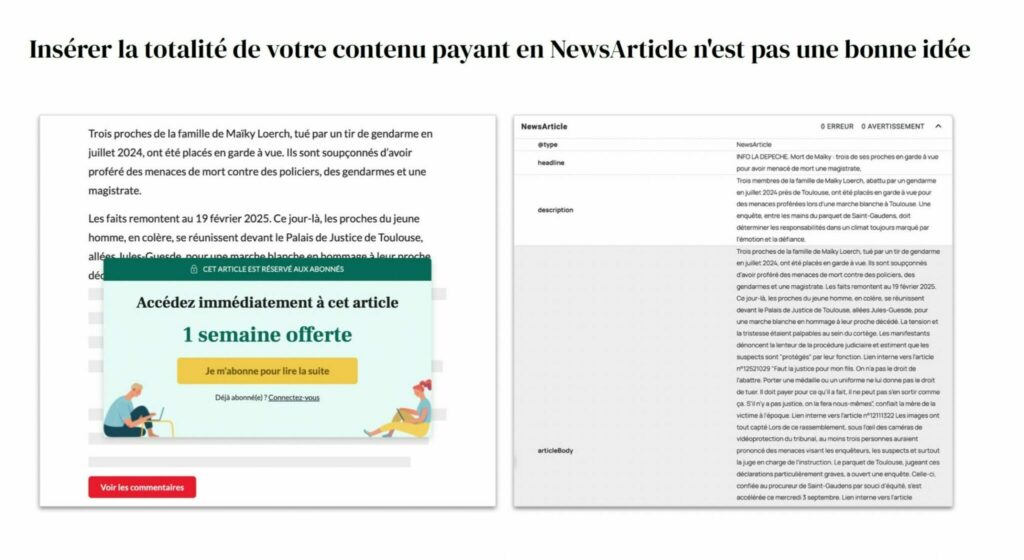
Structured markup: in the NewsArticle or ArticleBody format, you should never insert the entire paid text in plain text. Otherwise, any AI tool or scraper can extract it and republish it elsewhere.
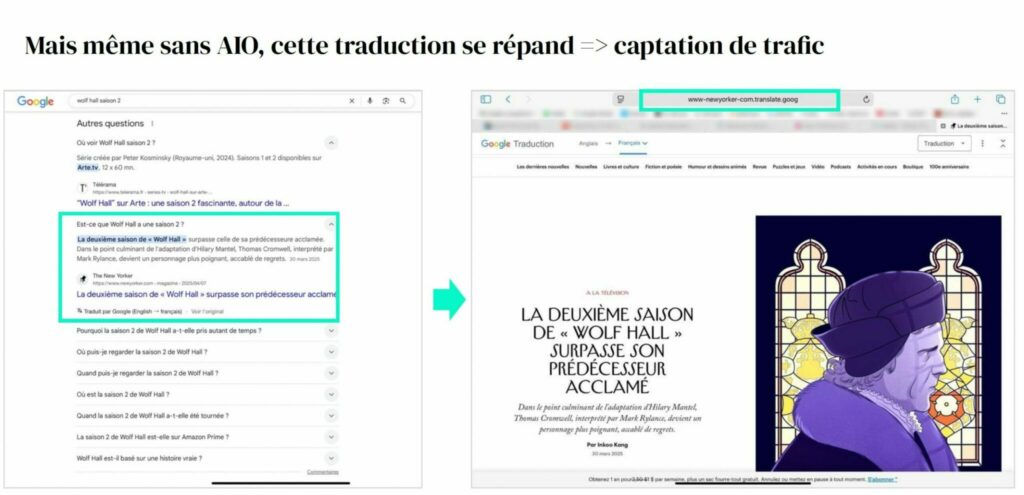
The same problem applies to machine translations: Google Translate can host media pages that are translated and laid out identically, but without tracking or advertising. This is simply a case of value capture.
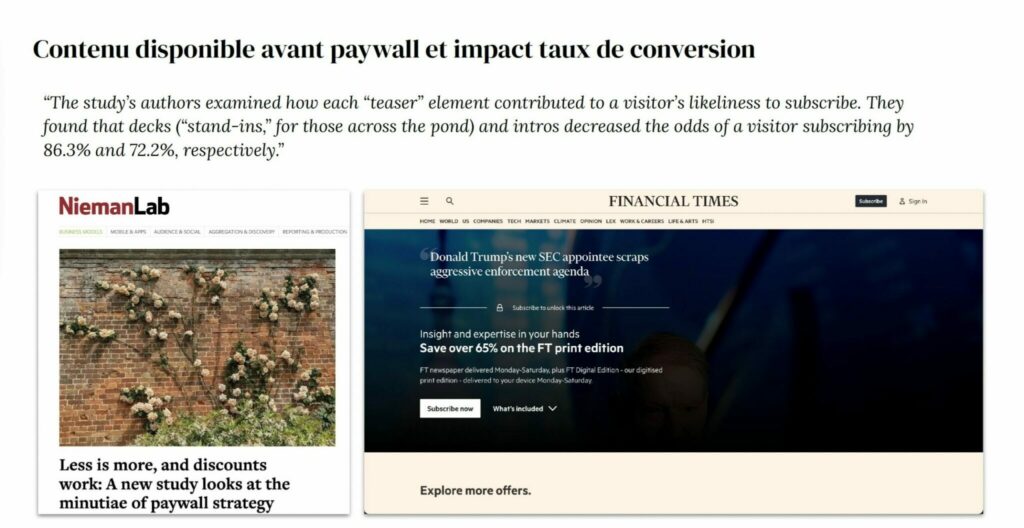
The text before the paywall: Google considers that below 800 characters, a page is “thin content,” and below 1,200 characters, it is of average quality. On the other hand, the more you give, the less you convert. Each media outlet must therefore find its balance between SEO and conversion—ideally through A/B testing.
4) Hybridization, the future standard for paywalls
However, the solution is not to close everything off. Max and Virginie advocate a hybrid blocking strategy: adjusting the level of protection according to the value and lifespan of the content. For example, temporarily opening a news article, then closing it once its peak visibility has passed. Some publishers, such as Ouest-France, are already experimenting with engines capable of automatically arbitrating between free and paid content.
At the same time, other avenues are emerging: technical solutions such as Cloudflare or Akamai (access control, pay-per-crawl), or collective approaches (via GESTE, the Alliance, or joint legal action). But they all rely on one principle: this issue must be addressed across the board—product, SEO, subscriptions, and tech all around the same table.
5) Blocking is not enough to convert
Maxime Moné reminded us: “Users don’t subscribe just to access content. They subscribe for a brand, an experience, a promise.” Work on paywalls and AI is vital for the sovereignty and value of the media, but it will never replace editorial content, trust, and product quality.