
In Germany, most readers do not pay for news, but a few strategies could change that: at least, that’s the conclusion of the study “Navigating German News: topics, formats and willingness to pay,” published by FT Strategies at the end of 2025.
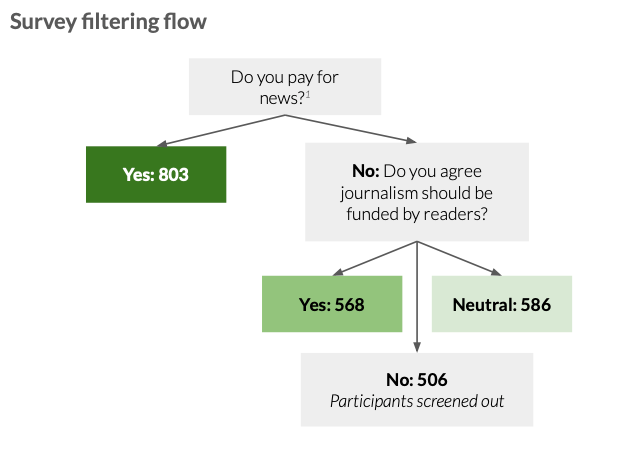
According to the study, based on a sample of 1,957 participants representative of the German population (49% women, 50% men, and 26% under 35), a clear paradox emerges: while German readers are very attached to traditional sources of information, the majority of them (59%) do not pay for news.
By filtering their relationship to the financing of news, the study distinguishes between subscribers (41%), The On-The-Fencers (29%), and The Maybe-Next-Timers (30%). The 29% representing the On-The-Fencers are the most interesting – they support the idea that media should be funded by its readers, even though they don’t yet pay.
Mapping topics based on their value/revenue
TLDR: The number of page views doesn’t necessarily equate to conversions, and audiences are less inclined to pay for certain types of content.
Despite the fact that the most viewed topics are not necessarily those that interest subscribers the most, such as politics or current affairs, there is still a willingness to pay. To better identify this, the study maps the popularity of topics against the revenue they can generate.
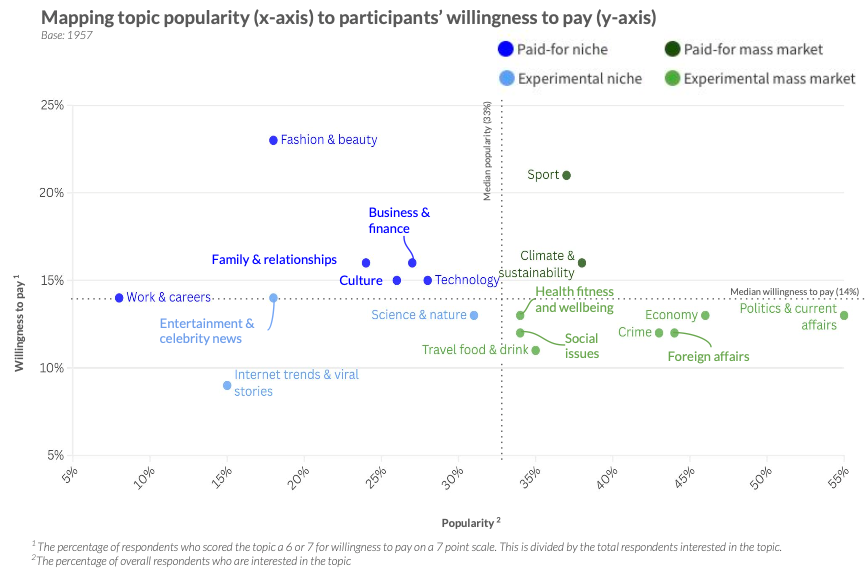
We can see 4 categories emerge that might inform content & product strategies:
- Paid-for-niche: Topics that are low popularity/high willingness to pay which signals a B2B opportunity or a niche vertical for engaged audiences
- Experimental niche: Topics that are low popularity/low willingness to pay which signals high commodification of this type of news. Highly differentiated coverage is the only way to cut through the noise
- Paid-for-mass market: Topics that are high popularity/high willingness to pay signalling an obvious first-mover advantage where brands can reap benefits for becoming known to be the go-to source
- Experimental mass market: Topics that are high popularity/low willingness to pay signalling their importance as ‘service journalism’ stories to put in-front of the paywall
Contrary to assumptions, the most viewed topics are not necessarily those that generate the most subscriptions: topics related to politics are those that interest participants the most (55%), but few of them (14%) are willing to pay to view them.
On the other hand, certain mainstream topics, which are more likely to be funded by readers, should likely be blocked by paywalls to encourage conversion. For example, 21% of participants are willing to pay for sports and 16% for climate-related topics.
The same is true for niche topics that are particularly likely to attract subscriptions, such as fashion and beauty (23%) and finance (16%).
Finding the right format
TLDR: Short videos, breaking news and in-depth text stories are the preferred formats, but younger generations shift towards audio & long video content, and the format should ultimately be adapted to the content itself.
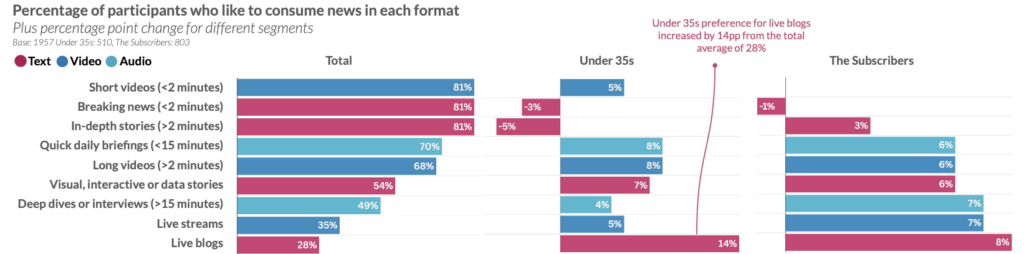
In addition, media outlets wishing to generate subscriptions for this content must adapt to the formats favored by their audiences, which differ according to age: the majority of participants prefer long-form written content (81%, rising to 84% among subscribers), while those under 35 prefer long videos (76%) and podcasts (78%).
Some German media outlets have already grown their audience by adapting to these habits:
- Bild, which offered 12-15% of its content behind paywalls in early 2024, has developed long-form content reserved for subscribers and has become the German newspaper with the most subscribers (over 700,000).
- Die Zeit has developed 27 podcasts, some of which are accessible with a specific podcast subscription, including “Was Jetz?” (What now?) and “Rhonzeimer,” which are among the most listened to podcasts in the country.
It is by adapting the format to the subject matter that media outlets can distinguish themselves and convert the undecided.
Certain uses stand out:
- The short format is valued for topics related to business, finance, fashion, beauty, and trends.
- The long format is more suited to topics related to science, nature, technology, and sports.
- Visual storytelling and data visualization make topics related to science, nature, and technology more concrete.
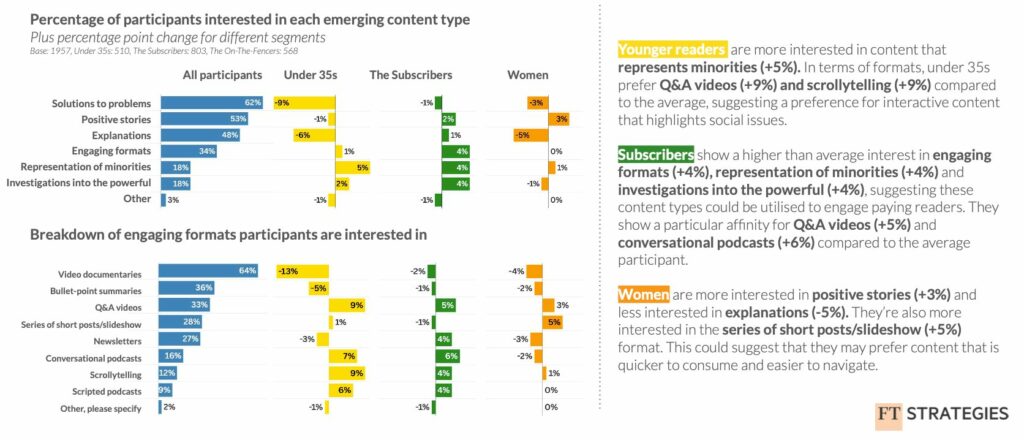
In terms of emerging formats and content opportunities, participants are most interested in solution-based, positive stories, while video documentaries offer a potential new way to engage audiences.
Balancing AI and the human touch
TDLR: AI provides an immediately adapted user experience, but maintaining the human element through contact with journalists can help build subscriber loyalty.
A large proportion of participants would like to see AI developed to improve the user experience. In addition to the ability to summarize and translate, other more interactive features stand out, such as searching for and selecting the most relevant articles (44% of subscribers and on-the-fencers) and the question-and-answer function (37% of young people and 31% of subscribers).
However, the study also suggests the importance of maintaining a human connection with journalists for discussion or moderation, as some media outlets have implemented in recent years:
- Der Spiegel has set up a discussion tool reserved for subscribers, in which journalists sort, select, and sometimes publish certain comments in the print edition.
- After Welt journalists increased the number of responses to user comments under their articles, the number of departures due to a lack of “community” decreased between 2022 and 2023.
Conclusion
To convert readers into subscribers, German media outlets should therefore:
- Optimize their paywall strategy, differentiating between the most viewed topics and those that generate the most subscriptions.
- Provide information in different formats depending on the topic, giving subscribers the choice between long-form written articles, short podcasts, and long videos on platforms.
- Create a strong user experience by combining artificial intelligence with contact with editorial journalists.